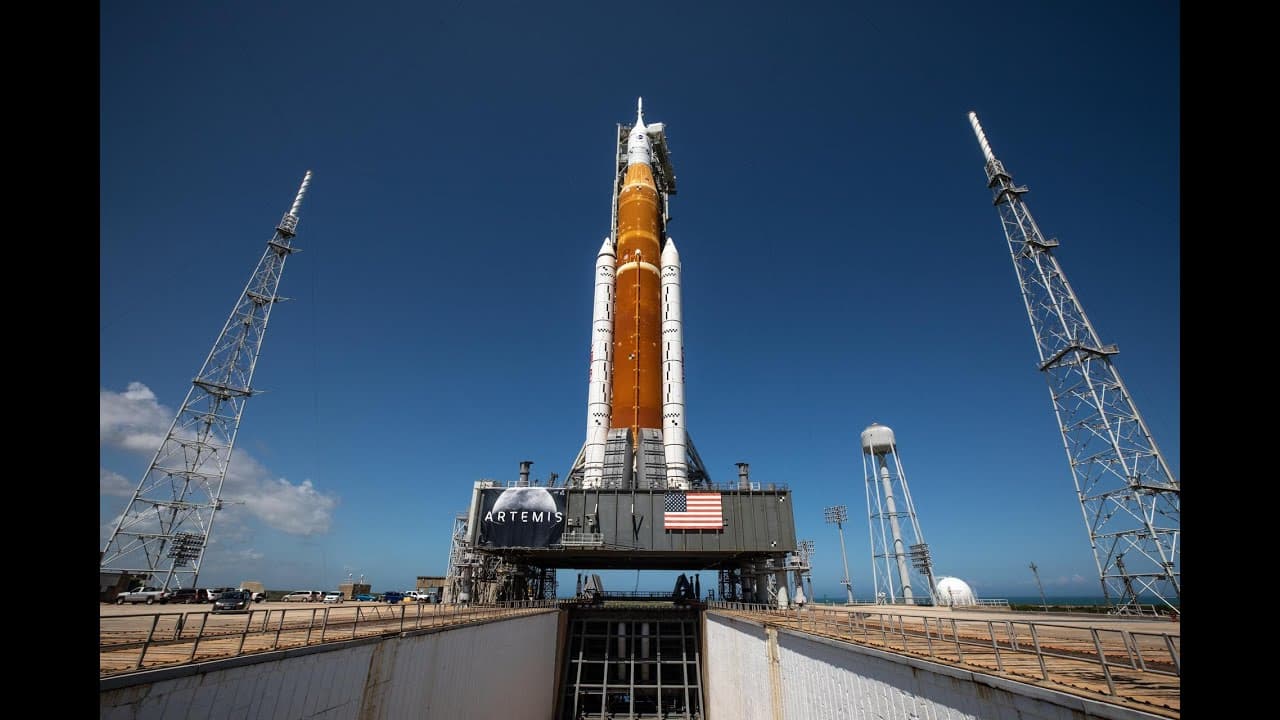
NASA Previews Artemis I Mission to the Moon (Official NASA Broadcast)
TL;DR
NASA's Artemis 1 mission aims to test the Orion spacecraft and prepare for crewed missions to the Moon and Mars.
Transcript
do so good morning everyone and thank you for joining us here in houston texas at the nasa johnson space center i am gary jordan uh thanks for joining us here for our media day here at the johnson space center i hope everybody's been having a good time it's really good to see a crowd of this size out of the johnson space center you'll notice that m... Read More
Key Insights
- 🥵 The Artemis 1 mission will provide valuable data on the performance of the Orion spacecraft's systems, including the heat shield, propellant tanks, and parachute deployment.
- 🎟️ The mission will help refine procedures and address any potential issues before crewed missions are conducted.
- 🎟️ The recovery operations for the Artemis 1 mission involve coordination between NASA and the US Navy, with an emphasis on safety and collecting engineering data.
Install to Summarize YouTube Videos and Get Transcripts
Explore YouTube Video Summarizer or Get YouTube Transcript Extractor
Questions & Answers
Q: What are the key objectives of the Artemis 1 mission?
The Artemis 1 mission aims to test the Orion spacecraft and its systems, collect data on the spacecraft's performance, and inform future crewed missions.
Q: What happens if there is an issue during the ascent phase?
The spacecraft has several abort options in case of an issue during ascent, including untargeted splashdown in the Atlantic Ocean or an abort once around, which would result in a splashdown off the coast of California.
Q: How long can the Orion spacecraft stay in orbit without the upper stage?
If there is an issue with the upper stage, the Orion spacecraft can perform an orbital insertion using its own propulsion system to circularize the orbit. However, it would not be able to complete a mission to the Moon without the upper stage.
Q: What are the backup landing options in case of bad weather at the primary landing site?
The mission has multiple backup landing sites within 1200 nautical miles of the primary landing site off the coast of San Diego. The specific landing site will be determined based on weather conditions and the ability to safely recover the capsule.
Summary & Key Takeaways
-
The Artemis 1 mission, set for launch on August 29th, is an unmanned mission that will test the Orion spacecraft and its systems for future crewed missions.
-
After liftoff, the spacecraft will undergo various maneuvers, including the jettisoning of stages and the deployment of solar arrays, to reach a safe orbit and eventually perform a translunar injection.
-
The mission will collect valuable data on the performance of the spacecraft's systems, such as the heat shield and propellant tanks, and inform future crewed missions.
Read in Other Languages (beta)
Share This Summary 📚
Summarize YouTube Videos and Get Video Transcripts with 1-Click
Try YouTube Summary with ChatGPT & Claude or YouTube Transcript Generator
Explore More Summaries from NASA 📚

Summarize YouTube Videos and Get Video Transcripts with 1-Click
Try YouTube Summary with ChatGPT & Claude or YouTube Transcript Generator