The biggest invention in history | Nick Lane and Lex Fridman
TL;DR
The endosymbiotic relationship between prokaryotic cells and mitochondria was a groundbreaking invention that allowed for the development of complex life forms.
Transcript
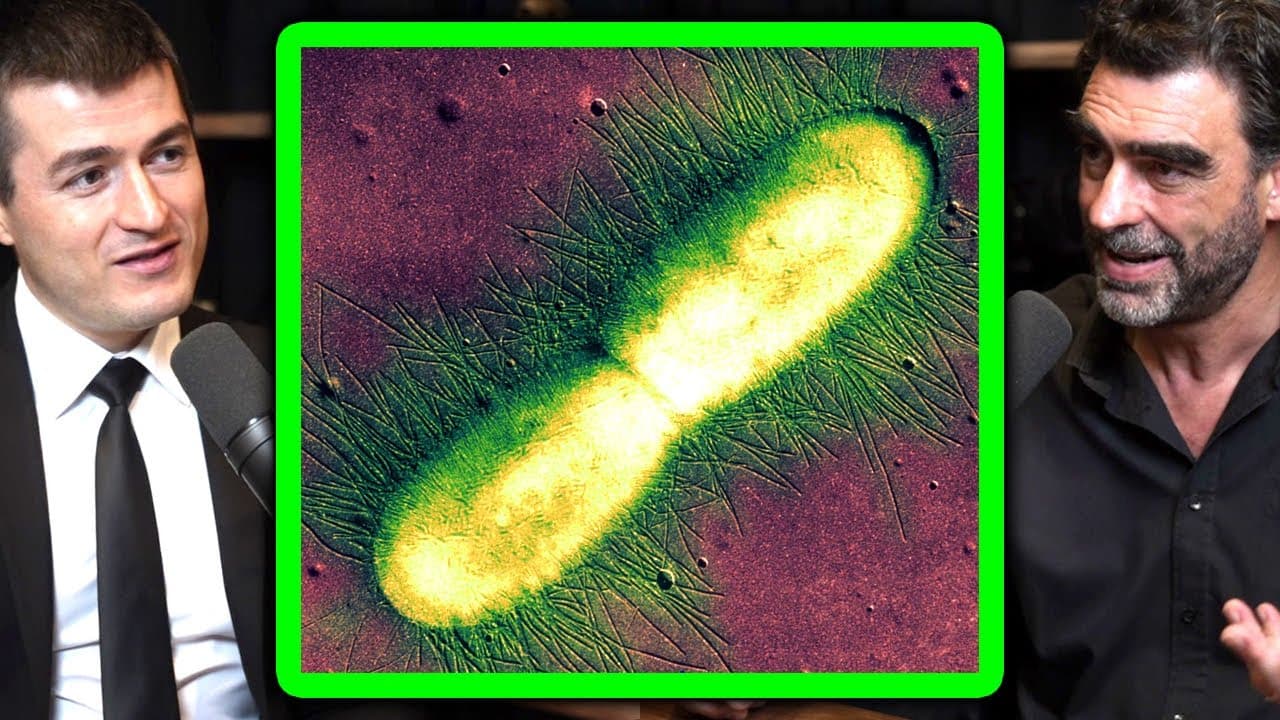
what about eukaryotic versus prokaryotic cells prokaryotes what how big what are each of those and how big of an invention is that i personally think that's the single biggest invention in the whole history of life exciting so what what are they can you explain yeah so so so i mentioned bacteria and archaea these are both prokaryotes um they're bas... Read More
Key Insights
- 🛩️ Bacteria and archaea are prokaryotes, small cells without a nucleus, while eukaryotic cells originated from endosymbiosis.
- 🌥️ Endosymbiosis with mitochondria transformed eukaryotic cells by enhancing energy production and enabling larger genomes.
- 💁 The evolution of complex life forms, such as plants and animals, was made possible through the endosymbiotic relationship between prokaryotes and mitochondria.
- 👾 Prokaryotes have extensively explored genetic sequence space, but their inability to incorporate power pack units like mitochondria prevents them from evolving into complex organisms.
- ⬛ Bacterial cells lack the necessary scale and structure to support the development of larger genomes and the precise gene regulation required for multicellularity.
- 🖐️ The transition from prokaryotic recombination to eukaryotic recombination (sex) played a crucial role in increasing genetic variation and facilitating the evolution of larger genomes.
Install to Summarize YouTube Videos and Get Transcripts
Explore YouTube Video Summarizer or Get YouTube Transcript Extractor
Questions & Answers
Q: What is the difference between prokaryotic and eukaryotic cells?
Prokaryotic cells, like bacteria and archaea, lack a nucleus and are small and simple under a microscope. Eukaryotic cells have a larger nucleus, more genes, and are more complex.
Q: What is the significance of endosymbiosis in the evolution of life?
Endosymbiosis, where one cell lives inside another, led to the creation of eukaryotic cells. This allowed for a larger nuclear genome, increased energy production through mitochondria, and the potential for multicellularity.
Q: How did mitochondria contribute to the evolution of complex life forms?
Mitochondria, originally bacteria, became power packs in eukaryotic cells by discarding most of their genes. This led to a significant increase in energy production, enabling the development of larger genomes and more complex organisms.
Q: Why was the endosymbiotic relationship between prokaryotic cells and mitochondria a difficult invention?
Incorporating mitochondria into cells without causing conflicts or design problems was challenging. Structural and engineering issues had to be overcome to ensure the proper functioning of the power pack units within the host cell.
Summary & Key Takeaways
-
Prokaryotes, such as bacteria and archaea, are small cells without a nucleus, but they exhibit complexity at the molecular level.
-
Eukaryotic cells, which originated from endosymbiosis, have a larger nucleus with more genes and the ability to convert genes into proteins more efficiently.
-
The incorporation of mitochondria, once bacteria themselves, into eukaryotic cells provided a significant boost in energy production and enabled the evolution of complex organisms.
Read in Other Languages (beta)
Share This Summary 📚
Summarize YouTube Videos and Get Video Transcripts with 1-Click
Try YouTube Summary with ChatGPT & Claude or YouTube Transcript Generator
Explore More Summaries from Lex Clips 📚



Summarize YouTube Videos and Get Video Transcripts with 1-Click
Try YouTube Summary with ChatGPT & Claude or YouTube Transcript Generator