What Is Mean Absolute Deviation and How to Calculate It?
TL;DR
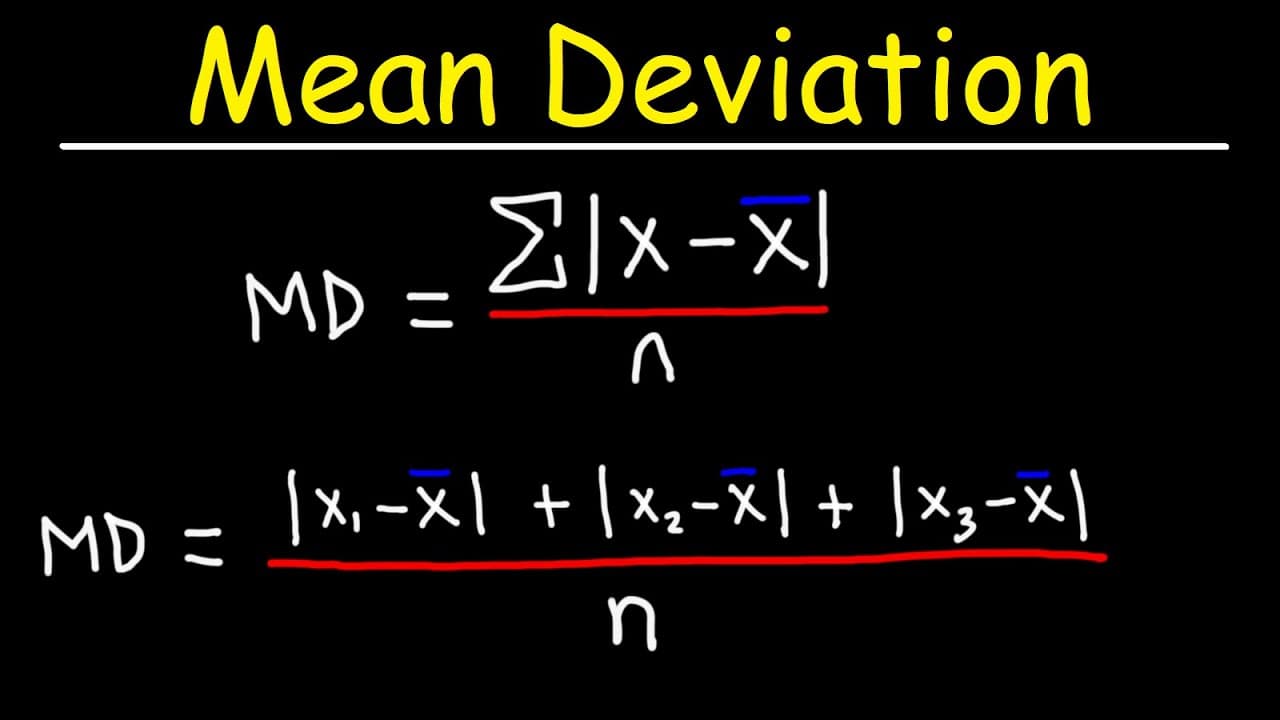
Mean absolute deviation (MAD) measures the average distance of each data point from the mean by taking the absolute differences and averaging them. To calculate MAD, first find the mean of your data set, subtract the mean from each data point, take the absolute values of those differences, and divide the sum by the total number of data points.
Transcript
let's talk about the mean absolute deviation the mean absolute deviation measures the average distance of all the values from the mean now let's talk about how to calculate it let's say we have the numbers 7 11 14 19 22 and 29 in this first example let's use a table to calculate the mean absolute deviation so in the First Column I'm going to put al... Read More
Key Insights
- 😥 Mean absolute deviation is a measure of dispersion, providing information about the spread of data points from the mean.
- 😥 It is calculated by finding the average of the absolute differences between each data point and the mean.
- 😫 Mean absolute deviation can be used to compare the variability of different data sets.
- 😫 A higher mean absolute deviation indicates greater variability or dispersion in the data set.
- 🆘 Mean absolute deviation can help analyze the accuracy or precision of measurements.
- 💄 It is a useful tool in statistical analysis and decision-making processes.
- 🫥 Mean absolute deviation can be visually represented with a number line, showing the deviations of data points from the mean.
Install to Summarize YouTube Videos and Get Transcripts
Explore YouTube Video Summarizer or Get YouTube Transcript Extractor
Questions & Answers
Q: What does mean absolute deviation measure?
Mean absolute deviation measures the average distance between each data point and the mean, providing information about the spread of the data set.
Q: How is mean absolute deviation calculated?
To calculate mean absolute deviation, find the arithmetic mean of the data points, subtract each data point from the mean, take the absolute value of the differences, and find the average of these absolute differences.
Q: How can mean absolute deviation be used in data analysis?
Mean absolute deviation helps analyze the variability of a data set. It can be used to compare the spread of different data sets or measure how closely a particular data point aligns with the mean.
Q: What does a higher mean absolute deviation indicate?
A higher mean absolute deviation suggests that the data points are more spread out from the mean, indicating greater variability or dispersion in the data set.
Summary & Key Takeaways
-
Mean absolute deviation is a statistical measure that calculates the average distance of data points from the mean.
-
It can be calculated by finding the arithmetic mean of the data points, subtracting each data point from the mean, taking the absolute value of the differences, and finding the average of these absolute differences.
-
Mean absolute deviation provides insight into the spread or dispersion of the data set.
Read in Other Languages (beta)
Share This Summary 📚
Summarize YouTube Videos and Get Video Transcripts with 1-Click
Try YouTube Summary with ChatGPT & Claude or YouTube Transcript Generator
Explore More Summaries from The Organic Chemistry Tutor 📚


Summarize YouTube Videos and Get Video Transcripts with 1-Click
Try YouTube Summary with ChatGPT & Claude or YouTube Transcript Generator