Eigenfunctions of a Hermitian operator
TL;DR
Hermitian operators have an infinite number of eigenfunctions and eigenvalues, which can be organized to satisfy orthonormality.
Transcript
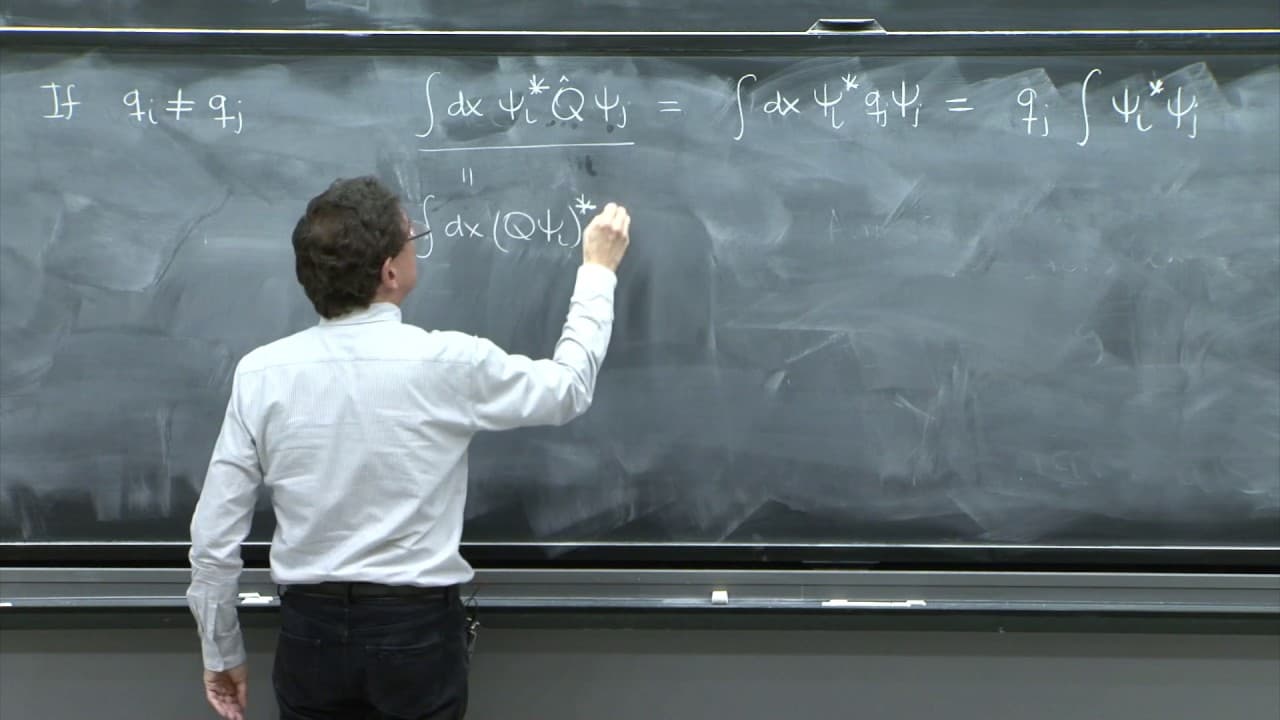
PROFESSOR: So here comes the point that this quite fabulous about Hermitian operators. Here is the thing that it really should impress you. It's the fact that any, all Hermitian operators have as many eigenfunctions and eigenvalues as you can possibly need, whatever that means. But they're rich. It's a lot of those states. What it really means is t... Read More
Key Insights
- 👻 Hermitian operators have an infinite number of eigenfunctions and eigenvalues, allowing for a diverse range of states and phenomena to be described.
- 🇦🇪 The eigenfunctions of Hermitian operators can be organized to satisfy orthonormality, meaning they have unit norm and are mutually orthogonal.
- ❓ Degenerate eigenvalues can introduce complexity, but it is still possible to make the corresponding eigenfunctions orthonormal through linear transformations.
- 😫 Orthonormal eigenfunctions form a complete set that can describe any state within the vector space.
- 👻 The orthonormality of eigenfunctions allows for calculations involving inner products and measuring the difference between functions.
- ❓ The spectral theorem in mathematics provides the theoretical foundation for the properties of Hermitian operators and their eigenfunctions.
- 👾 Hermitian matrices in finite-dimensional vector spaces have eigenvectors that provide a basis for the space.
Install to Summarize YouTube Videos and Get Transcripts
Explore YouTube Video Summarizer or Get YouTube Transcript Extractor
Questions & Answers
Q: What is the significance of Hermitian operators having an infinite number of eigenfunctions?
The fact that Hermitian operators have an infinite number of eigenfunctions means that they can represent a wide range of states and phenomena in quantum mechanics. It allows us to describe complex systems and study their properties.
Q: How are eigenfunctions related to the span of a vector space?
In a finite-dimensional vector space, the eigenfunctions of a Hermitian matrix provide a basis for the space. This means that any state can be written as a linear combination of these eigenfunctions. They form a complete set of vectors that can describe any state within the vector space.
Q: What does it mean for eigenfunctions to be orthonormal?
Orthonormality means that each eigenfunction has unit norm, and different eigenfunctions are mutually orthogonal. This ensures that the inner product (similar to dot product for vectors) between two eigenfunctions is zero unless they are the same function. It allows us to measure the difference between eigenfunctions and perform calculations involving them.
Q: What happens when a Hermitian operator has degenerate eigenvalues?
Degeneracy occurs when multiple eigenfunctions have the same eigenvalue. In such cases, the eigenfunctions may not be automatically orthonormal. However, it is still possible to perform linear transformations and create linear combinations of eigenfunctions to make them orthonormal. This ensures that even with degeneracy, the set of eigenfunctions can span the space.
Summary & Key Takeaways
-
Hermitian operators have as many eigenfunctions and eigenvalues as needed, allowing them to span the space of states.
-
The eigenfunctions of Hermitian operators can be organized to satisfy orthonormality, meaning they have unit norm and are mutually orthogonal.
-
Some Hermitian operators may have degenerate eigenvalues, in which case linear transformations can be used to make the eigenfunctions orthonormal.
Read in Other Languages (beta)
Share This Summary 📚
Summarize YouTube Videos and Get Video Transcripts with 1-Click
Try YouTube Summary with ChatGPT & Claude or YouTube Transcript Generator
Explore More Summaries from MIT OpenCourseWare 📚



Summarize YouTube Videos and Get Video Transcripts with 1-Click
Try YouTube Summary with ChatGPT & Claude or YouTube Transcript Generator