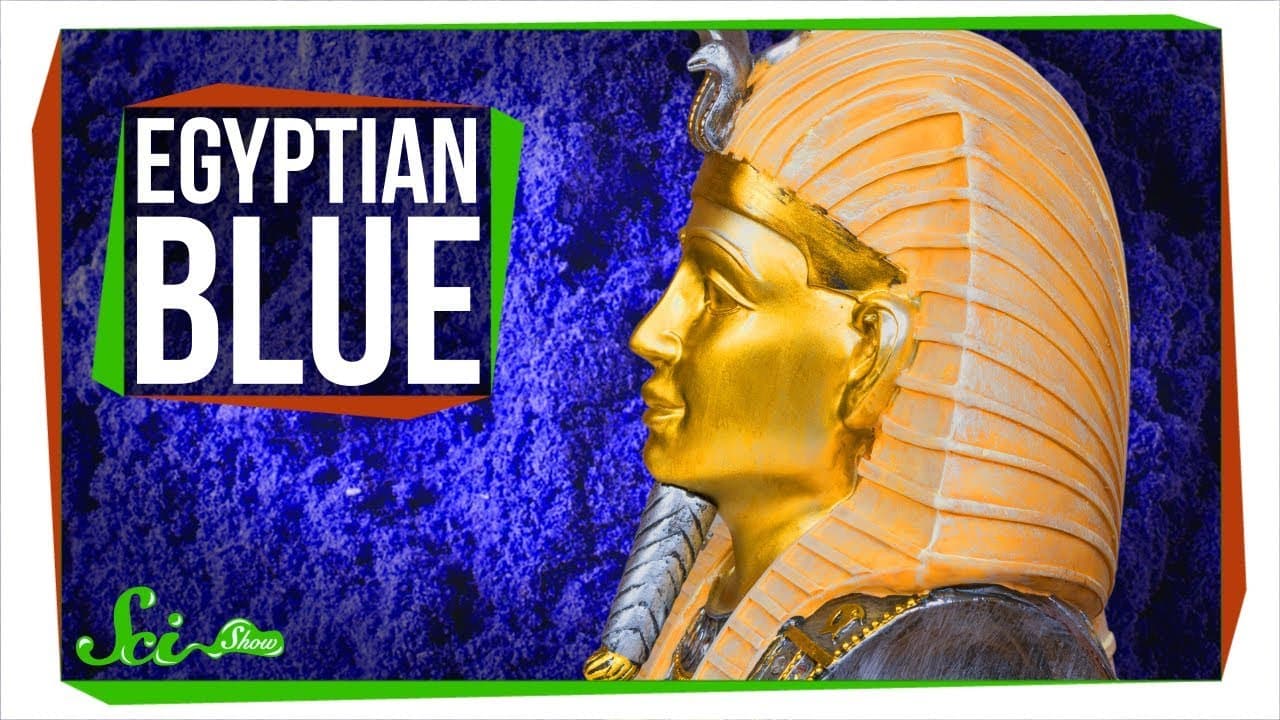
Egyptian Blue: How an Ancient Pigment Could Save Lives
TL;DR
Egyptian blue, the world's first artificial pigment, was rediscovered in Pompeii and is now used for detecting forgery and medical imaging.
Transcript
[♩INTRO ] The tale of the world’s first artificial pigment has all the elements of a good thriller: an ancient mystery, a dramatic rediscovery, and some cutting-edge future technology. Today, this age-old chemical compound may help scientists prevent forgery and even save lives. But before it was doing any of that, it was adding color to the tombs ... Read More
Key Insights
- 💙 The ancient Egyptians invented the world's first artificial pigment, Egyptian blue, by experimenting with different materials and chemical reactions.
- 💙 The popularity of Egyptian blue declined in Roman art, leading to the formula being lost for centuries.
- 💖 The rediscovery of Egyptian blue in Pompeii in 1814 sparked extensive experimentation to determine its composition.
- 💙 The consistency of Egyptian blue's chemical composition across thousands of years makes it a valuable tool for identifying ancient artwork.
- 🤗 Egyptian blue's ability to emit infrared radiation opens up new possibilities for medical imaging and security measures.
- 😉 It could be incorporated into dyes for medical imaging or used in security inks to prevent forgery.
- 💙 Egyptian blue's infrared-emitting properties also make it useful for fingerprint detection on shiny or patterned surfaces.
Install to Summarize YouTube Videos and Get Transcripts
Explore YouTube Video Summarizer or Get YouTube Transcript Extractor
Questions & Answers
Q: How was Egyptian blue made in ancient times?
Ancient Egyptians mixed sand, copper-containing minerals, and natron, shaped the mixture into balls, heated them in an oven, and ground them up to obtain Egyptian blue pigment.
Q: What happened to the popularity of Egyptian blue in Roman art?
As red and yellow colors became more popular in Roman art, the use of Egyptian blue declined and eventually fell out of use.
Q: How was the formula for making Egyptian blue rediscovered?
The formula for making Egyptian blue was rediscovered in 1814 when archaeologists found samples in Pompeii and chemists in London conducted extensive experiments to determine its composition.
Q: What modern applications does Egyptian blue have?
Egyptian blue can now be used for detecting forgery and counterfeiting, as well as in medical imaging techniques due to its ability to emit infrared radiation.
Summary & Key Takeaways
-
Egyptian blue, the world's first artificial pigment, was created by ancient Egyptians using sand, copper-containing minerals, and natron.
-
The formula for making Egyptian blue was lost until it was rediscovered in Pompeii in 1814.
-
Egyptian blue not only adds color to ancient artwork but also emits infrared radiation, making it useful for medical imaging and anti-counterfeiting measures.
Read in Other Languages (beta)
Share This Summary 📚
Summarize YouTube Videos and Get Video Transcripts with 1-Click
Try YouTube Summary with ChatGPT & Claude or YouTube Transcript Generator
Explore More Summaries from SciShow 📚


Summarize YouTube Videos and Get Video Transcripts with 1-Click
Try YouTube Summary with ChatGPT & Claude or YouTube Transcript Generator