21. Spherical compact sources II
TL;DR
This content discusses the properties of the Schwarzschild metric, including its singularity at r=0 and the behavior of objects near r=2gm.
Transcript
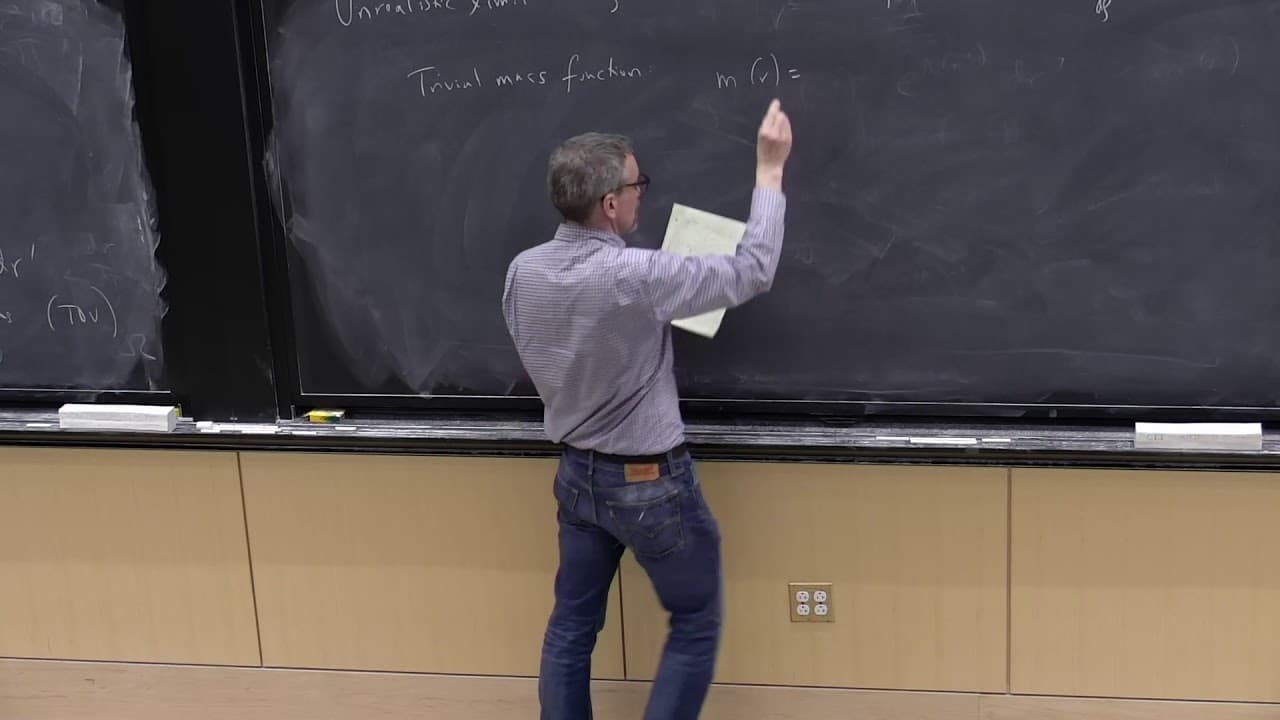
[SQUEAKING] [RUSTLING] [CLICKING] SCOTT HUGHES: So we'll pick up where we ended last time. We're looking at the spacetime of a compact spherical body, working in what we call Schwarzschild coordinates. We deduce that the line element describing this body is of the form ds squared equals negative e to the 2 phi dt squared plus tr squared divided by ... Read More
Key Insights
- 😥 The Schwarzschild metric contains a singularity at r=0, suggesting a possible coordinate singularity or the presence of a massive point-like object.
- 💆 The Tolman-Oppenheimer-Volkoff equations describe the behavior of pressure, function phi, and mass in the interior of the body described by the Schwarzschild metric.
- ⛔ Buchdahl's theorem establishes a limit on the radius of stable spherical fluid configurations.
Install to Summarize YouTube Videos and Get Transcripts
Explore YouTube Video Summarizer or Get YouTube Transcript Extractor
Questions & Answers
Q: Why does the Schwarzschild metric have a singularity at r=0?
The singularity at r=0 in the Schwarzschild metric suggests that something unusual is happening, possibly due to a coordinate singularity or the existence of a massive point-like object at the origin.
Q: What is the significance of r=2gm in the Schwarzschild metric?
When r=2gm, tidal forces become infinite, indicating that the metric is behaving unusually at that radius. Objects approaching this radius experience extremely strong gravitational forces.
Q: Why do objects near r=2gm never reach that radius according to coordinate time?
Coordinate time in Schwarzschild spacetime is based on distant observers synchronized using the Einstein synchronization procedure. The behavior of clocks in this coordinate system is linked to the behavior of light. Clocks synchronized in this way do not observe objects crossing r=2gm.
Q: How does the motion of objects near r=2gm differ in proper time and coordinate time?
Objects near r=2gm reach r=0 in finite proper time, as observed by clocks moving with them. However, clocks synchronized using coordinate time never observe objects crossing r=2gm.
Summary & Key Takeaways
-
The content explores the spacetime of a compact spherical body using Schwarzschild coordinates and the line element describing the body.
-
It introduces the Tolman-Oppenheimer-Volkoff equations, which govern the pressure, function phi, and mass of the body.
-
Buchdahl's theorem states that there is no stable spherical fluid configuration with a radius smaller than 9/4 of gm total.
Read in Other Languages (beta)
Share This Summary 📚
Summarize YouTube Videos and Get Video Transcripts with 1-Click
Try YouTube Summary with ChatGPT & Claude or YouTube Transcript Generator
Explore More Summaries from MIT OpenCourseWare 📚



Summarize YouTube Videos and Get Video Transcripts with 1-Click
Try YouTube Summary with ChatGPT & Claude or YouTube Transcript Generator