20.2.5 System-level Interconnect
TL;DR
Serial point-to-point links have replaced parallel buses, offering high signaling rates, controlled electrical environment, and the ability to use multiple links for increased throughput.
Transcript
Serial point-to-point links are the modern replacement for the parallel communications bus with all its electrical and timing issues. 0..08 Each link is unidirectional and has only a single driver and the receiver recovers the clock signal from the data stream, so there are no complications from sharing the channel, clock skew, and electrical probl... Read More
Key Insights
- 😥 Serial point-to-point links offer significant advantages over parallel buses, including higher signaling rates and a controlled electrical environment.
- 🍻 Multiple serial links can be used in parallel to increase throughput.
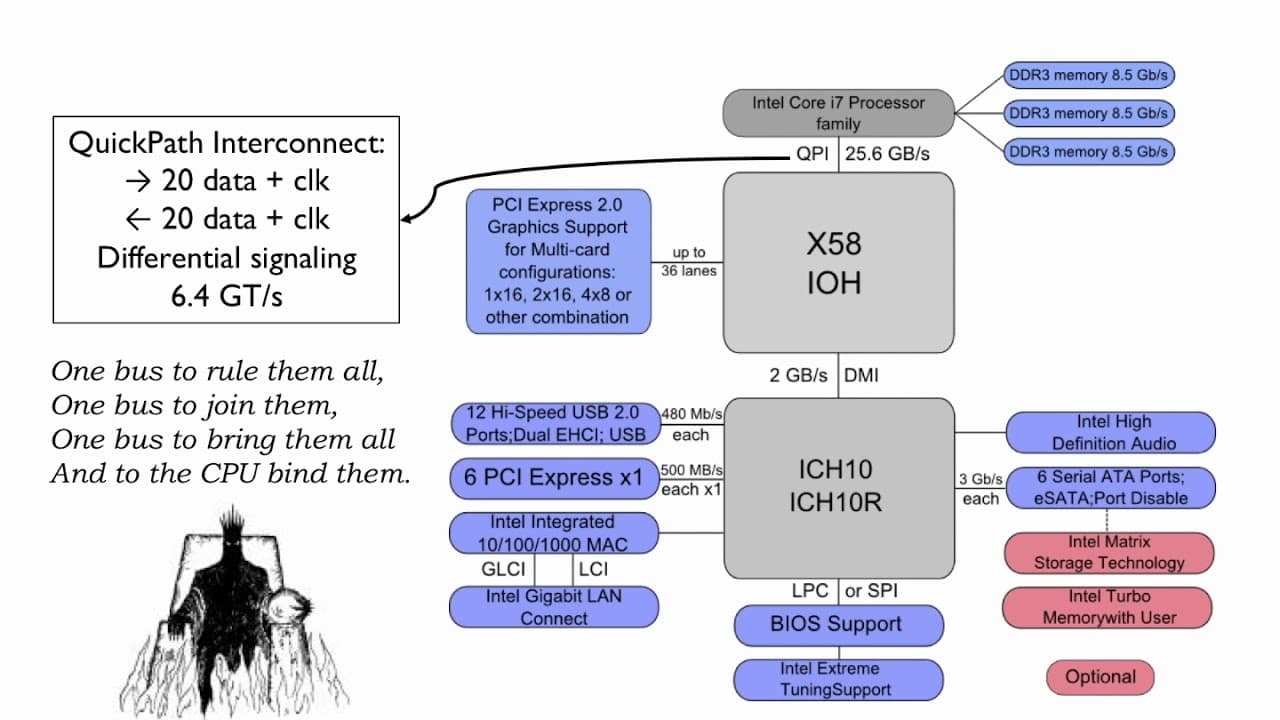
- ✋ The QuickPath Interconnect (QPI) provides high memory bandwidth in modern systems.
- 🍻 PCIe is commonly used as the communication link between components on the motherboard.
- ✈️ Logic is needed for sending and receiving messages on multiple PCIe lanes, but the cost is acceptable with today's technology.
Install to Summarize YouTube Videos and Get Transcripts
Explore YouTube Video Summarizer or Get YouTube Transcript Extractor
Questions & Answers
Q: What are some advantages of using serial point-to-point links over parallel buses?
Serial point-to-point links offer a controlled electrical environment, high signaling rates, and the ability to eliminate complications from sharing the channel, clock skew, and electrical problems.
Q: How does the expansion strategy in modern systems differ from older systems?
In modern systems, add-in cards connect to one or more point-to-point communication links instead of parallel buses.
Q: What is the QuickPath Interconnect (QPI) used for?
The QPI connects the CPU to memories and other components in a system, providing high memory bandwidth with 20 differential signaling paths in each direction.
Q: How does PCIe transmit data between components on the system motherboard?
PCIe transmits data using low-voltage differential signaling (LVDS) over wires with a 100-Ohm characteristic impedance, organized into packets with training sequences, start/end sequences, and data payloads.
Summary & Key Takeaways
-
Serial point-to-point links are the modern replacement for parallel buses, eliminating electrical and timing issues.
-
Each link is unidirectional and has a single driver, with the receiver recovering the clock signal from the data stream.
-
Multiple serial links can be used in parallel to increase throughput, requiring modest additional logic.
Read in Other Languages (beta)
Share This Summary 📚
Summarize YouTube Videos and Get Video Transcripts with 1-Click
Try YouTube Summary with ChatGPT & Claude or YouTube Transcript Generator
Explore More Summaries from MIT OpenCourseWare 📚



Summarize YouTube Videos and Get Video Transcripts with 1-Click
Try YouTube Summary with ChatGPT & Claude or YouTube Transcript Generator