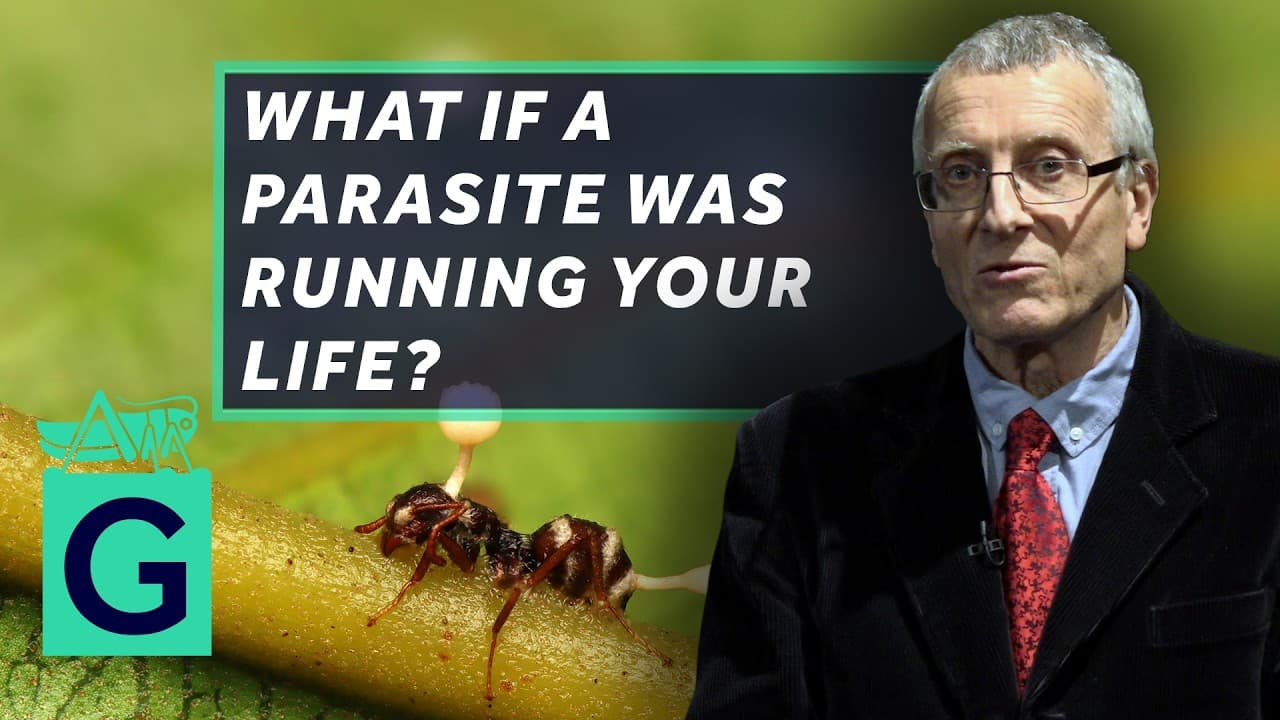
Zombie Ants and Fearless Mice: Parasites and the Brain
TL;DR
Parasites have evolved ways to control and manipulate the behavior of their hosts, impacting their actions, thoughts, and even survival.
Transcript
I wrote a book on animal behavior that came up just in two years ago in 2017 and what I discovered was that lots of the most exciting stories were in the area of parasites and one of the challenges of studying animal behavior is that most of the time we have to treat behavior and the animals making those behaviors as a black box there's no way of g... Read More
Key Insights
- 👻 Parasites have evolved sophisticated ways of controlling and manipulating the behavior of their hosts.
- 👻 Host behavior is influenced by a complex interplay of hormones, neurotransmitters, and neural circuits, all of which parasites can target.
- 👻 Parasites can manipulate both their hosts' physical movements and their cognitive processes.
- 👻 The precise mechanisms by which parasites control host behavior are still largely unknown and require further research.
- ❓ Parasites demonstrate the intricate interconnections between behavior, physiology, and evolutionary processes.
- 🧡 Parasites have extensive impacts on a wide range of animal species, highlighting the universal nature of parasitic interactions.
- 👻 The study of parasites and their manipulation of host behavior offers valuable insights into fundamental questions about life and survival.
Install to Summarize YouTube Videos and Get Transcripts
Explore YouTube Video Summarizer or Get YouTube Transcript Extractor
Questions & Answers
Q: How do parasites manipulate their hosts' behavior?
Parasites can manipulate their hosts by altering hormone levels, affecting neurotransmitters, and even directly influencing neural circuits in the brain.
Q: Can parasites control the behavior of their hosts without physical contact?
Yes, parasites can indirectly manipulate host behavior by infecting them with viruses that alter their behaviors or by introducing genes that affect their neural systems.
Q: Are there any examples of parasites manipulating their hosts' behavior for their own benefit?
Yes, some parasites can manipulate their hosts' behavior to increase their chances of transmission and reproduction. For example, parasitoid wasps inject venom into cockroaches to render them immobile and use them as hosts for their offspring.
Q: Can parasites control human behavior?
There is evidence that some parasites, like Toxoplasma gondii, can affect human behavior, but the extent and significance of these effects are still debated among scientists.
Summary & Key Takeaways
-
Parasites, with their unique evolutionary history, have become experts in controlling and manipulating the behavior of their hosts.
-
Animal behavior is often difficult to study, but parasites offer a window into understanding the inner workings of host behavior and survival.
-
Parasites have intricate life cycles and complex interactions with their hosts, with many species relying on manipulation to ensure their own survival.
Read in Other Languages (beta)
Share This Summary 📚
Summarize YouTube Videos and Get Video Transcripts with 1-Click
Try YouTube Summary with ChatGPT & Claude or YouTube Transcript Generator
Explore More Summaries from Gresham College 📚

Summarize YouTube Videos and Get Video Transcripts with 1-Click
Try YouTube Summary with ChatGPT & Claude or YouTube Transcript Generator