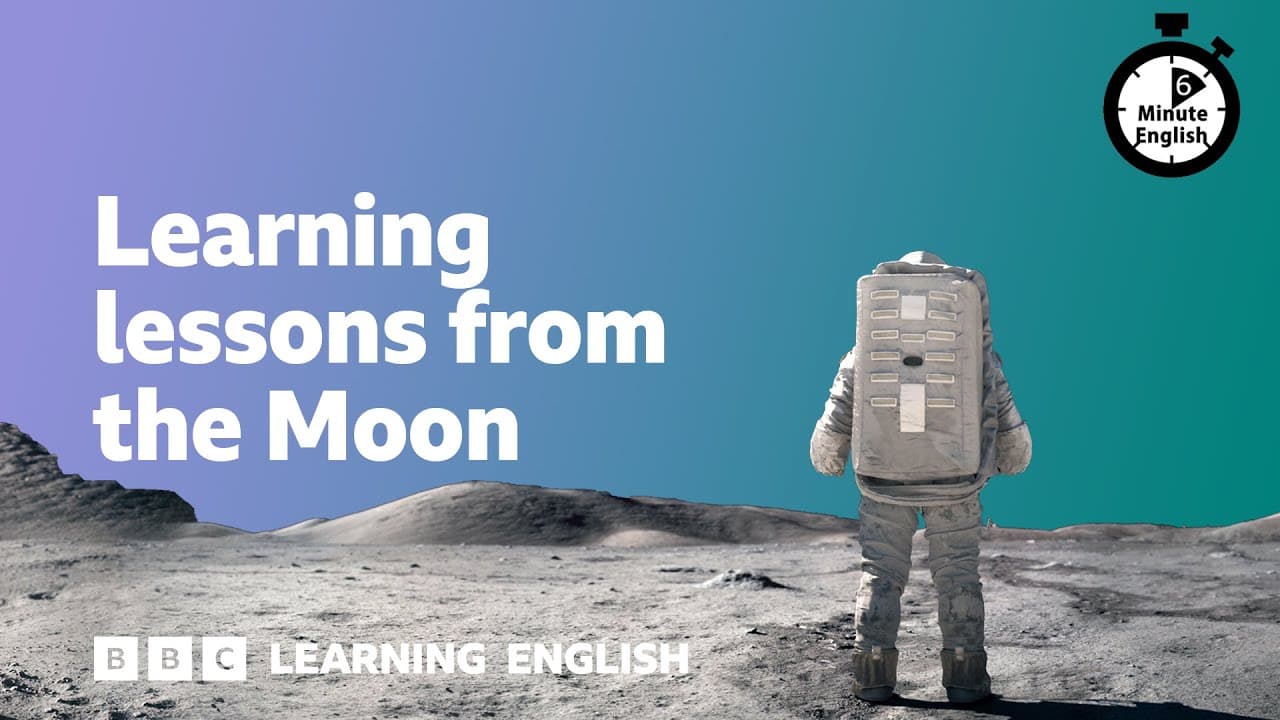
Learning lessons from the Moon ⏲️ 6 Minute English
TL;DR
Exploring renewed interest in moon missions and their scientific significance.
Transcript
Hello. This is Six Minute. English from BBC Learning English I'm Neil and I'm Georgie. "That's one small step for man, one giant leap for mankind" - famous words, but do you know who said them? Of course - that was Neil Armstrong. the first person to land on the moon. Right, the Apollo 11 spacecraft landed Neil Armstrong on the moon on the 20th of ... Read More
Key Insights
- The moon missions of 2023 reignited interest in lunar exploration, with India's Chandrayaan-3 successfully landing, marking India as the fourth country to achieve this.
- The moon's surface, unlike Earth's, remains unchanged, preserving a historical record of the solar system's early days, potentially offering insights into Earth's origins.
- Dr. Becky Smethurst explains that the moon's pockmarked surface, filled with craters, provides evidence of past cosmic events that shaped both the moon and Earth.
- The discovery of water on the moon could reveal the origins of Earth's water, supporting theories that comets and asteroids delivered water to Earth.
- The term 'smoking gun' is used to describe conclusive evidence, such as finding water on the moon that matches Earth's, proving the comet theory.
- Michael Collins, the third Apollo 11 astronaut, played a crucial role by piloting the command module while Armstrong and Aldrin walked on the moon.
- The vocabulary terms 'inert', 'crater', 'pockmarked', 'a big deal', 'trace back', and 'smoking gun' are introduced and explained in the context of lunar exploration.
- The moon's exploration offers a chance to understand not just lunar history, but also Earth's geological past, providing a clearer picture of how life-supporting conditions developed.
Install to Summarize YouTube Videos and Get Transcripts
Explore YouTube Video Summarizer or Get YouTube Transcript Extractor
Questions & Answers
Q: Why is there renewed interest in lunar exploration?
The renewed interest in lunar exploration stems from the scientific potential the moon holds. Its unchanged surface offers a preserved record of the early solar system, which could provide insights into Earth's origins, particularly regarding the presence of water and the conditions that made life possible.
Q: What role does the moon's surface play in understanding Earth's history?
The moon's surface serves as a historical archive, preserving evidence of cosmic events that shaped both the moon and Earth. Unlike Earth's dynamic surface, the moon's inert surface retains marks from impacts, which could reveal how water and other life-supporting materials were delivered to Earth.
Q: What is the significance of discovering water on the moon?
Discovering water on the moon is significant as it could validate theories about the origins of Earth's water. If the water on the moon shares characteristics with Earth's, it would provide a smoking gun, or conclusive proof, supporting the idea that comets and asteroids delivered water to our planet.
Q: Who was the third astronaut on the Apollo 11 mission?
The third astronaut on the Apollo 11 mission was Michael Collins. While Neil Armstrong and Buzz Aldrin walked on the moon, Collins piloted the command module, remaining in lunar orbit. His role was crucial for the mission's success, and the experience profoundly impacted his perspective on Earth.
Q: What does the term 'pockmarked' refer to in the context of the moon?
In the context of the moon, 'pockmarked' refers to the surface being covered in craters, which are large holes created by impacts from meteoroids and other celestial objects. These craters provide a record of the moon's history and offer insights into the early solar system's dynamics.
Q: How does the moon's inert nature contribute to scientific research?
The moon's inert nature, meaning it does not change or move, allows it to serve as a stable record of the solar system's history. This characteristic makes it an invaluable resource for scientists studying the early solar system and Earth's geological past, as it preserves evidence that would otherwise be lost.
Q: What vocabulary terms were introduced in the discussion?
The discussion introduced several key vocabulary terms: 'inert', meaning not moving; 'crater', a large hole caused by an impact; 'pockmarked', marked by small holes and scars; 'a big deal', indicating importance; 'trace back', discovering causes by examining development; and 'a smoking gun', referring to indisputable evidence.
Q: Why is the moon mission considered a 'big deal'?
The moon mission is considered a 'big deal' because it holds the potential to answer fundamental questions about Earth's origins and the development of life-supporting conditions. By studying the moon's preserved history, scientists hope to uncover evidence about how water and other vital elements arrived on Earth.
Summary & Key Takeaways
-
The renewed interest in lunar exploration was highlighted by the 2023 missions of Russia's Luna-25 and India's Chandrayaan-3, with the latter successfully landing on the moon. This achievement makes India the fourth nation to land on the moon, sparking discussions on the scientific significance of lunar missions.
-
The moon's unchanged surface offers a unique opportunity to study the early solar system. Unlike Earth, the moon's surface has remained inert, preserving a historical record of cosmic events that could hold clues to Earth's origins, particularly concerning the presence of water.
-
Dr. Becky Smethurst emphasizes the importance of studying the moon's craters, which are pockmarked due to impacts over billions of years. These craters could provide a smoking gun, or conclusive evidence, supporting the theory that Earth's water came from comet and asteroid impacts.
Read in Other Languages (beta)
Share This Summary 📚
Summarize YouTube Videos and Get Video Transcripts with 1-Click
Try YouTube Summary with ChatGPT & Claude or YouTube Transcript Generator
Explore More Summaries from BBC Learning English 📚

Summarize YouTube Videos and Get Video Transcripts with 1-Click
Try YouTube Summary with ChatGPT & Claude or YouTube Transcript Generator