Negative Data Augmentation
TL;DR
Negative data augmentation introduces transformations that deliberately disrupt class labels, enhancing learning with less labeled data.
Transcript
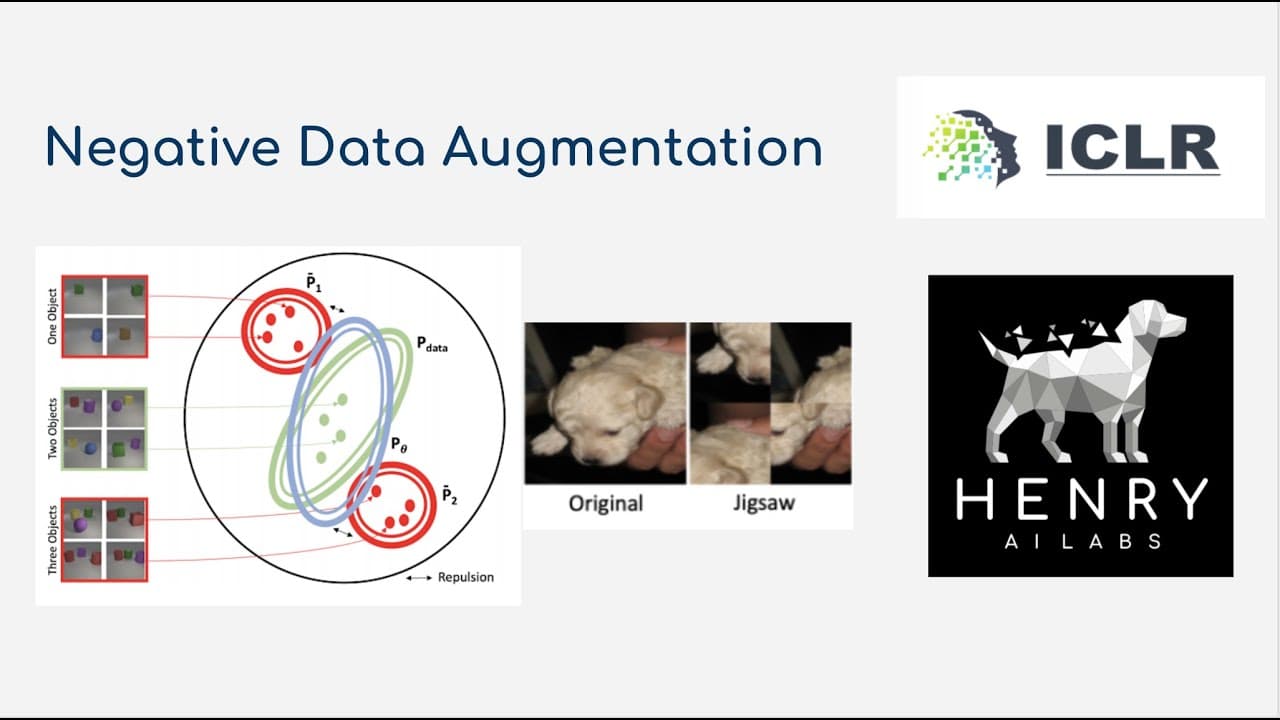
data augmentation is usually used to form new examples that share the same class label as the original instance however we also know of data augmentations that either corrupt the class label or particularly push the image to be out of the distribution of say natural images an example of this is the jigsaw augmentation where you patch up an image an... Read More
Key Insights
- 💨 Negative data augmentation is a novel approach that focuses on transforming data examples in ways that intentionally corrupt their original labels.
- ❎ Jigsaw augmentation exemplifies negative data augmentation, challenging models to learn intricate patterns by distorting familiar structures.
- ✊ The integration of NDA into contrastive learning models enhances their discriminative power by providing clear instances of out-of-distribution data.
- 🔠 Studies show that NDA can significantly improve the quality of generated images in GANs by strengthening the discriminator's performance against unrealistic inputs.
- 🥺 Negative data augmentation may lead to new methodologies in automatic learning where less labeled data is needed, improving efficiency in model training.
- 🏛️ Traditional data augmentation strategies often focus on preserving class labels, which may limit their effectiveness in certain contexts.
- 🆘 The ability to identify out-of-distribution examples helps models develop a comprehensive understanding of data distributions and enhances their generalization capabilities.
Install to Summarize YouTube Videos and Get Transcripts
Explore YouTube Video Summarizer or Get YouTube Transcript Extractor
Questions & Answers
Q: What is negative data augmentation, and why is it significant?
Negative data augmentation introduces transformations that deliberately disrupt the original class labels of data, resulting in out-of-distribution samples. Its significance lies in enhancing the learning process by providing models with examples that showcase what constitutes a deviation from standard distributions, thus enabling better generalization and understanding of the data.
Q: How does jigsaw augmentation function as a negative data augmentation example?
Jigsaw augmentation takes an image, partitions it into patches, and randomly scrambles those patches. This transformation breaks the global structure of the image while preserving local features. As a result, models can learn to recognize what constitutes a cohesive image versus a disordered one, improving their ability to learn complex representations.
Q: In what way does negative data augmentation improve generative adversarial networks (GANs)?
By incorporating negative data augmentations, GANs can better differentiate between real and artificially created images. For example, when jigsaw augmented images are fed into the discriminator, it improves its ability to spot abnormalities, which in turn drives the generator to produce more realistic images by understanding the global structures better.
Q: What results were observed when comparing positive and negative data augmentations?
The results indicated that negative data augmentations, such as jigsaw transformations, performed significantly better than traditional positive data augmentations. Specifically, metrics like the Frechet Inception Distance (FID) showed that NDA led to higher image quality scores compared to label-preserving augmentations.
Q: How can negative data augmentation extend beyond computer vision applications?
While primarily discussed in the context of images, negative data augmentation concepts can also apply to natural language processing (NLP). For example, altering labels in text to create counterfactual examples could enhance training efficiency in tasks like text classification or semantic similarity, suggesting a broader utility across data domains.
Q: What are some other examples of negative data augmentations discussed in the video?
Besides jigsaw augmentation, other examples mentioned include stitching and mixup augmentations, which involve combining parts of different images. These techniques also create out-of-distribution samples, pushing models to better learn distinguishing features by exposing them to more complex data representations.
Q: How does incorporating out-of-distribution examples help combat overgeneralization in models?
By explicitly providing models with out-of-distribution examples through negative data augmentations, the risk of overgeneralization is mitigated. It guides models to understand boundaries within learning spaces more clearly, ensuring they do not assume that unfamiliar but similar patterns belong to the same class during the generation or classification tasks.
Q: What future directions for research does the video suggest regarding negative data augmentation?
The video hints at expanding the application of negative data augmentation strategies into natural language processing, exploring how similar methods can create effective training data for tasks that require understanding differences in class labels. This could lead to enhanced performance in various NLP models dealing with text data.
Summary & Key Takeaways
-
Negative data augmentation (NDA) focuses on using transformations that corrupt class labels, diverging from traditional data augmentation methods, thereby offering new insights for training models like generative adversarial networks (GANs).
-
Jigsaw augmentation serves as a prime example of NDA, as it rearranges image patches to create out-of-distribution samples, which can help models learn global structures by recognizing corrupted patterns.
-
The integration of NDA into contrastive learning frameworks, like contrastive predictive coding and MoCo, shows promising results, suggesting that these techniques can improve the performance of models by better distinguishing between out-of-distribution and real samples.
Read in Other Languages (beta)
Share This Summary 📚
Summarize YouTube Videos and Get Video Transcripts with 1-Click
Try YouTube Summary with ChatGPT & Claude or YouTube Transcript Generator
Explore More Summaries from Connor Shorten 📚
Summarize YouTube Videos and Get Video Transcripts with 1-Click
Try YouTube Summary with ChatGPT & Claude or YouTube Transcript Generator