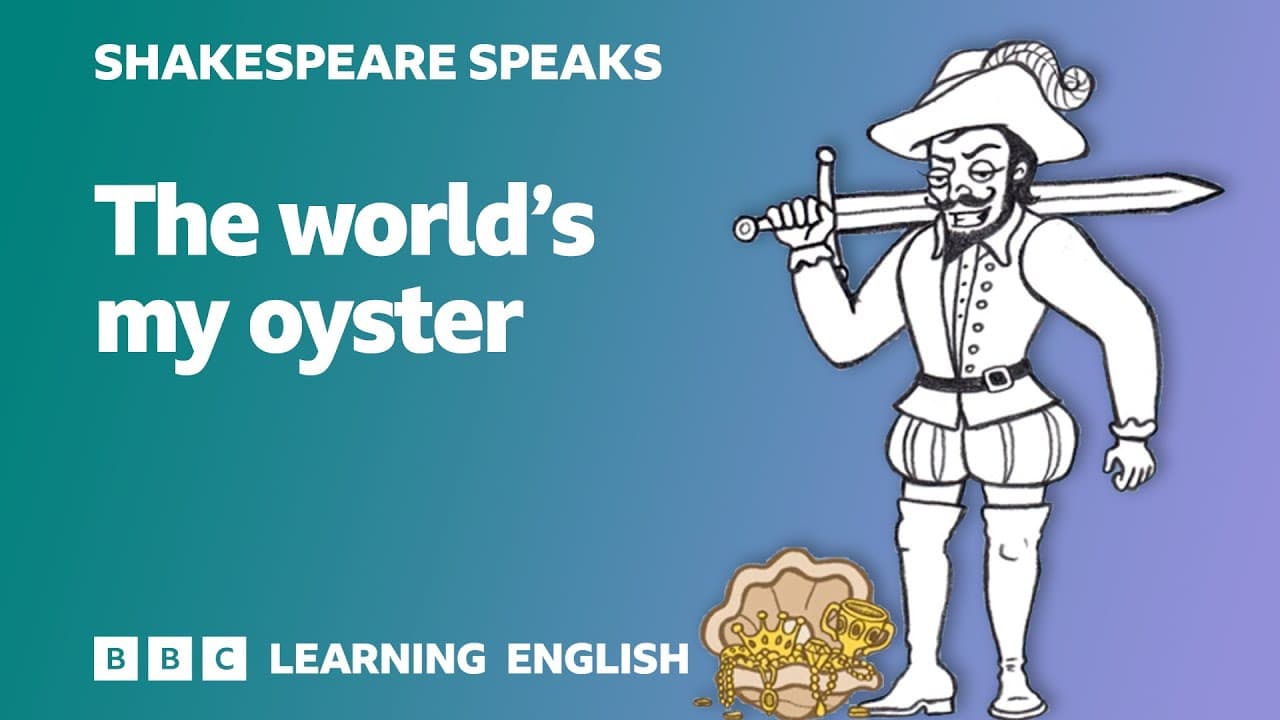
🎭The world's my oyster - Learn English vocabulary & idioms with 'Shakespeare Speaks'
TL;DR
Explore Shakespeare's idiom 'the world is your oyster' and its meanings.
Transcript
The year is 1599. William Shakespeare is at the palace of Queen Elizabeth I of England. The Queen has ordered Shakespeare to write another play. Mr Shakespeare. Tell me about my new play. Your Majesty, The Merry Wives of Windsor is a comedy, in which Sir John Falstaff tries to trick two married ladies into giving him money behind their husbands' ba... Read More
Key Insights
- The video discusses the origin of the idiom 'the world is your oyster,' which comes from Shakespeare's play The Merry Wives of Windsor.
- Queen Elizabeth I commissioned Shakespeare to write The Merry Wives of Windsor, a comedy featuring the character Sir John Falstaff.
- The phrase 'the world's mine oyster' was originally used as a threat in the play but has evolved to mean opportunities abound.
- Sir Walter Raleigh is mentioned as a loyal servant to Queen Elizabeth I, known for bringing her treasures from around the world.
- The idiom suggests that with effort and determination, one can uncover valuable opportunities, much like finding pearls in oysters.
- The phrase is used in modern contexts to describe situations where learning new skills, like languages, can open up opportunities.
- The Merry Wives of Windsor is noted for being Shakespeare's only comedy set entirely in England, offering a realistic portrayal of daily life.
- The video is part of a series by BBC Learning English and The Open University, aimed at teaching English vocabulary and idioms.
Install to Summarize YouTube Videos and Get Transcripts
Explore YouTube Video Summarizer or Get YouTube Transcript Extractor
Questions & Answers
Q: What is the origin of the idiom 'the world is your oyster'?
The idiom 'the world is your oyster' originates from William Shakespeare's play The Merry Wives of Windsor. In the play, the character Pistol uses the phrase 'the world's mine oyster' as a metaphor for taking opportunities by force if necessary. Over time, the phrase has evolved to mean that the world is full of opportunities waiting to be discovered.
Q: How does the video relate the idiom to modern contexts?
The video relates the idiom 'the world is your oyster' to modern contexts by explaining how it describes situations where opportunities are abundant. It emphasizes that learning new skills, such as foreign languages, can open up numerous possibilities. The idiom is used to encourage viewers to seize opportunities and make the most of what the world has to offer.
Q: What role does Queen Elizabeth I play in the video?
In the video, Queen Elizabeth I plays the role of a patron who commissions William Shakespeare to write a new play, The Merry Wives of Windsor. Her interaction with Shakespeare is dramatized, highlighting her appreciation for the character Sir John Falstaff and the treasures brought to her by Sir Walter Raleigh. The video uses this historical context to introduce the idiom 'the world is your oyster.'
Q: Who is Sir John Falstaff, and what is his significance in the play?
Sir John Falstaff is a central character in Shakespeare's play The Merry Wives of Windsor. He is portrayed as a comical and cunning figure attempting to deceive two married women for financial gain. His antics are significant as they provide humor and drive the plot of the play, while also serving as the context for the original usage of the phrase 'the world's mine oyster,' which relates to his scheming nature.
Q: What is the educational purpose of the video series?
The educational purpose of the video series is to teach English vocabulary and idioms through engaging storytelling and historical context. By dramatizing scenes from Shakespeare's plays and explaining the origins and meanings of specific idioms, the series aims to enhance learners' understanding and use of English expressions. It also encourages viewers to explore the richness of the English language and its literary heritage.
Q: How is Sir Walter Raleigh portrayed in the video?
Sir Walter Raleigh is portrayed in the video as a loyal servant to Queen Elizabeth I. He is depicted as someone who brings treasures from around the world to the Queen, exemplifying the idea of exploration and discovery. His actions are used to illustrate the concept of the world being an 'oyster,' full of treasures and opportunities to be seized, aligning with the idiom's metaphorical meaning.
Q: What is the significance of The Merry Wives of Windsor being set in England?
The significance of The Merry Wives of Windsor being set in England lies in its unique position as Shakespeare's only comedy entirely set in his home country. This setting allows the play to offer a realistic portrayal of the daily lives of ordinary people in England, contrasting with Shakespeare's other works that often explore more fantastical or foreign locales. It provides a familiar and relatable backdrop for audiences of the time.
Q: How does the video encourage language learning?
The video encourages language learning by illustrating how mastering new skills, such as learning foreign languages, can open up a world of opportunities, much like the idiom 'the world is your oyster' suggests. It motivates viewers to expand their linguistic abilities, emphasizing that language proficiency can lead to personal and professional growth, as well as a deeper understanding of cultural and literary contexts.
Summary & Key Takeaways
-
The video explores the origin and meaning of the idiom 'the world is your oyster,' first used by Shakespeare in The Merry Wives of Windsor. It highlights how the phrase has evolved from a threat to a metaphor for opportunities and potential, especially when learning new skills.
-
Queen Elizabeth I's interaction with Shakespeare is dramatized, showcasing her commissioning of a new play. The video also delves into the character of Sir John Falstaff and his comedic attempts at trickery, connecting it to the idiom's original usage in the play.
-
The series aims to teach English vocabulary and idioms, using historical context and dramatization to engage learners. The idiom is shown to be relevant today, illustrating how learning and risk-taking can unlock opportunities, much like finding pearls in oysters.
Read in Other Languages (beta)
Share This Summary 📚
Summarize YouTube Videos and Get Video Transcripts with 1-Click
Try YouTube Summary with ChatGPT & Claude or YouTube Transcript Generator
Explore More Summaries from BBC Learning English 📚
Summarize YouTube Videos and Get Video Transcripts with 1-Click
Try YouTube Summary with ChatGPT & Claude or YouTube Transcript Generator