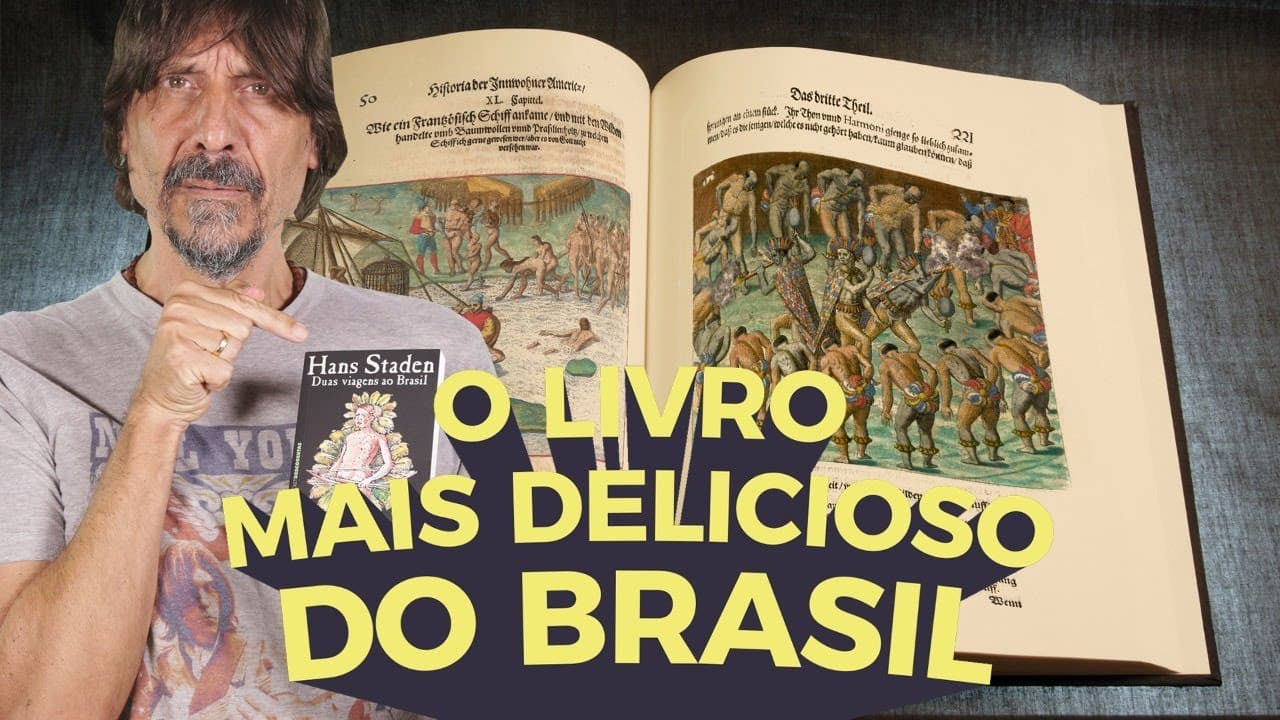
HANS STADEN - O LIVRO MAIS SABOROSO DO BRASIL - EDUARDO BUENO
TL;DR
Explores Hans Staden's book and its cultural impact.
Transcript
Oh, such a tasty book! Such a delicious prose! Every word seems more nutritious than the last! So much seasoning in this piece of literature! And so you thought, “I’m having a deja vu, I’ve seen this start before!” Indeed you did, man, But that start was not about THIS book. I would never talk about Eduardo Bueno’s new Book, “Countercultural Texts,... Read More
Key Insights
- Hans Staden's book, originally published in 1557, provides a detailed account of his experiences in Brazil, including descriptions of cannibalistic rituals.
- The book's original lengthy title reflects the style of the era, emphasizing its detailed and descriptive nature.
- Hans Staden's narrative gained widespread popularity, with translations into multiple languages, becoming a bestseller in Europe.
- Despite its success abroad, the book took a long time to be properly translated into Portuguese, with early translations being notably poor.
- Albert Lofgren's translation in 1900 from the original German edition marked a significant improvement, incorporating valuable historical notes.
- The book influenced Brazilian modernist artists like Tarsila do Amaral and Oswald de Andrade, inspiring the Anthropophagic Movement.
- Monteiro Lobato adapted the book for children, emphasizing its educational potential and historical significance.
- The book's impact extended to Brazilian cinema, inspiring films such as Nelson Pereira dos Santos's 'How Tasty Was My Little Frenchman.'
Install to Summarize YouTube Videos and Get Transcripts
Explore YouTube Video Summarizer or Get YouTube Transcript Extractor
Questions & Answers
Q: What is the significance of Hans Staden's book?
Hans Staden's book is significant because it provides a detailed and firsthand account of his experiences in Brazil during the 16th century, including his captivity by indigenous tribes. It offers valuable insights into the cultural practices of the time, such as cannibalism, and became a bestseller in Europe, influencing various cultural and artistic movements.
Q: How did Hans Staden's book influence Brazilian modernism?
Hans Staden's book influenced Brazilian modernism by inspiring artists like Tarsila do Amaral and Oswald de Andrade. The vivid descriptions of indigenous practices and cultural themes in the book resonated with modernist ideas, leading to the creation of the Anthropophagic Movement, which sought to reinterpret and integrate indigenous culture into Brazilian art and identity.
Q: What challenges did the Portuguese translation of Hans Staden's book face?
The Portuguese translation of Hans Staden's book faced challenges due to initial poor translations, such as the 1892 version by Tristão de Araripe Junior, which was based on a flawed French edition. It wasn't until Albert Lofgren's 1900 translation from the original German text that the book became more accurately represented and accessible to Portuguese-speaking audiences.
Q: How did Monteiro Lobato adapt Hans Staden's book for children?
Monteiro Lobato adapted Hans Staden's book for children by creating a version called 'My Captivity Under the Brazilian Indians,' where characters like Dona Benta and Emilia retell Staden's adventures. He emphasized the book's educational value, highlighting its true and incredible stories as a way to engage children with Brazil's colonial history.
Q: What role did Hans Staden's book play in Brazilian cinema?
Hans Staden's book played a role in Brazilian cinema by inspiring films such as Nelson Pereira dos Santos's 'How Tasty Was My Little Frenchman.' The film, although titled differently, draws from Staden's narrative, exploring themes of cultural encounter and cannibalism, showcasing the book's enduring influence on Brazilian storytelling and historical interpretation.
Q: What was the original title of Hans Staden's book?
The original title of Hans Staden's book was 'True History and Description of a Land of Savages, Naked and Cruel Devourers of Human Beings, Located in the New World of America, Unknown before and after Jesus Christ at the Lands of Hessen until the two last years, Seeing as Hans Staden, from Homberg, in Hessen, has come to know it by his own experience and now brings it to the public with such impression.' This lengthy title reflects the detailed and descriptive nature typical of book titles from that era.
Q: How did Hans Staden's book achieve critical acclaim?
Hans Staden's book achieved critical acclaim due to its accurate and detailed account of his experiences in Brazil, which historians recognized as a true factual narrative. Unlike other contemporary travel accounts that contained exaggerations or falsehoods, Staden's book was praised for its precision and reliability, contributing to its lasting historical and cultural significance.
Q: Who was responsible for the improved Portuguese translation of Hans Staden's book?
The improved Portuguese translation of Hans Staden's book was done by Albert Lofgren in 1900. Lofgren, a Swiss botanist, translated the book directly from the original German edition, incorporating historical notes by Teodoro Sampaio. This translation was a significant improvement over earlier versions, making the book more accessible and accurate for Portuguese-speaking readers.
Summary & Key Takeaways
-
Hans Staden's book, published in 1557, offers a firsthand account of his experiences in Brazil, detailing interactions with indigenous tribes and cannibalistic practices. It became a bestseller in Europe, translated into several languages, and influenced various cultural and artistic movements.
-
The initial Portuguese translations of Staden's book were poor, but Albert Lofgren's 1900 translation from the original German edition improved its accessibility. The book's vivid descriptions and historical accuracy made it a valuable educational resource and a source of artistic inspiration.
-
Hans Staden's narrative inspired Brazilian modernists and filmmakers, contributing to the Anthropophagic Movement and influencing works like 'How Tasty Was My Little Frenchman.' The book's cultural significance continues to resonate, highlighting its enduring impact on Brazilian history and art.
Read in Other Languages (beta)
Share This Summary 📚
Summarize YouTube Videos and Get Video Transcripts with 1-Click
Try YouTube Summary with ChatGPT & Claude or YouTube Transcript Generator
Explore More Summaries from Buenas Ideias 📚





Summarize YouTube Videos and Get Video Transcripts with 1-Click
Try YouTube Summary with ChatGPT & Claude or YouTube Transcript Generator