The Tumbling Box in 3-D
TL;DR
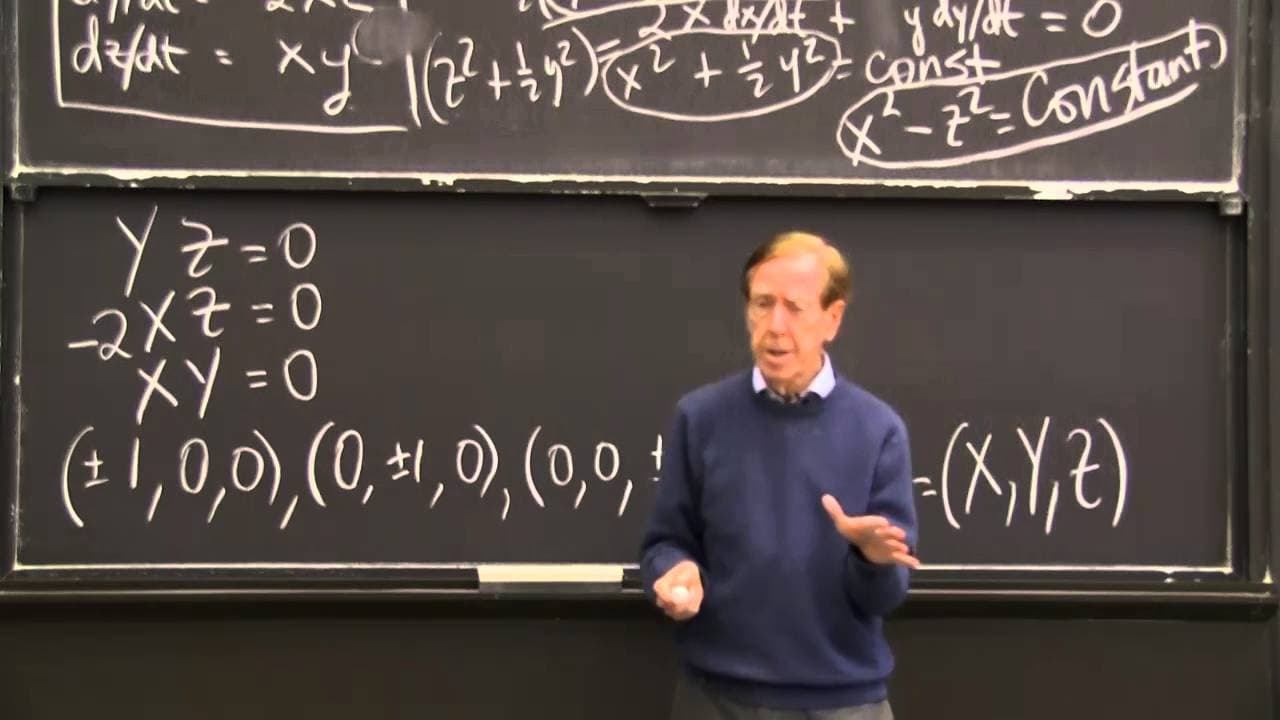
A demonstration using a book to explore the stability of different axes when thrown in the air.
Transcript
PROFESSOR: OK. Here's an example that's more or less for fun. Because you'll see me try to do it. You can do it better. I call the problem the tumbling blocks. Only in this example, in my demonstration, it's going to be a tumbling book. I'm going to take a book, the sacred book, and throw it in the air. And I'll throw it three different ways. And t... Read More
Key Insights
- ❓ The stability of rotation depends on the axis around which the object is thrown.
- 🥺 The short and long axes result in stable rotation, while the intermediate axis leads to instability.
- 😥 The stability can be determined by finding the critical points, calculating the derivatives, and analyzing the eigenvalues of the derivative matrix.
- ❓ The total energy and another conserved quantity remain constant throughout the motion.
Install to Summarize YouTube Videos and Get Transcripts
Explore YouTube Video Summarizer or Get YouTube Transcript Extractor
Questions & Answers
Q: What are Euler's equations and how are they used in this demonstration?
Euler's equations describe the motion of a rotating object by relating the angular momentum to the moments of inertia and angular velocity. In this demonstration, the professor uses these equations to derive the equations of motion for the book when thrown in the air.
Q: How many axes of rotation does a 3D object have?
A 3D object has three axes of rotation - a short axis, a long axis, and an intermediate axis.
Q: What are the conditions for stable rotation?
According to the equations derived, stable rotation occurs when the book is thrown around the short axis or the long axis.
Q: Why is the rotation around the intermediate axis unstable?
The rotation around the intermediate axis is unstable because of the hyperbolic shape of the equation. It leads to tumbling and erratic motion when the book is thrown.
Summary & Key Takeaways
-
The professor uses a book to demonstrate stability while being thrown in the air in three different ways - short axis, long axis, and intermediate axis.
-
The equations of motion for each axis are derived using Euler's equations for angular momentum.
-
The short and long axes result in stable rotation, while the intermediate axis leads to unstable rotation or tumbling.
Read in Other Languages (beta)
Share This Summary 📚
Summarize YouTube Videos and Get Video Transcripts with 1-Click
Try YouTube Summary with ChatGPT & Claude or YouTube Transcript Generator
Explore More Summaries from MIT OpenCourseWare 📚



Summarize YouTube Videos and Get Video Transcripts with 1-Click
Try YouTube Summary with ChatGPT & Claude or YouTube Transcript Generator