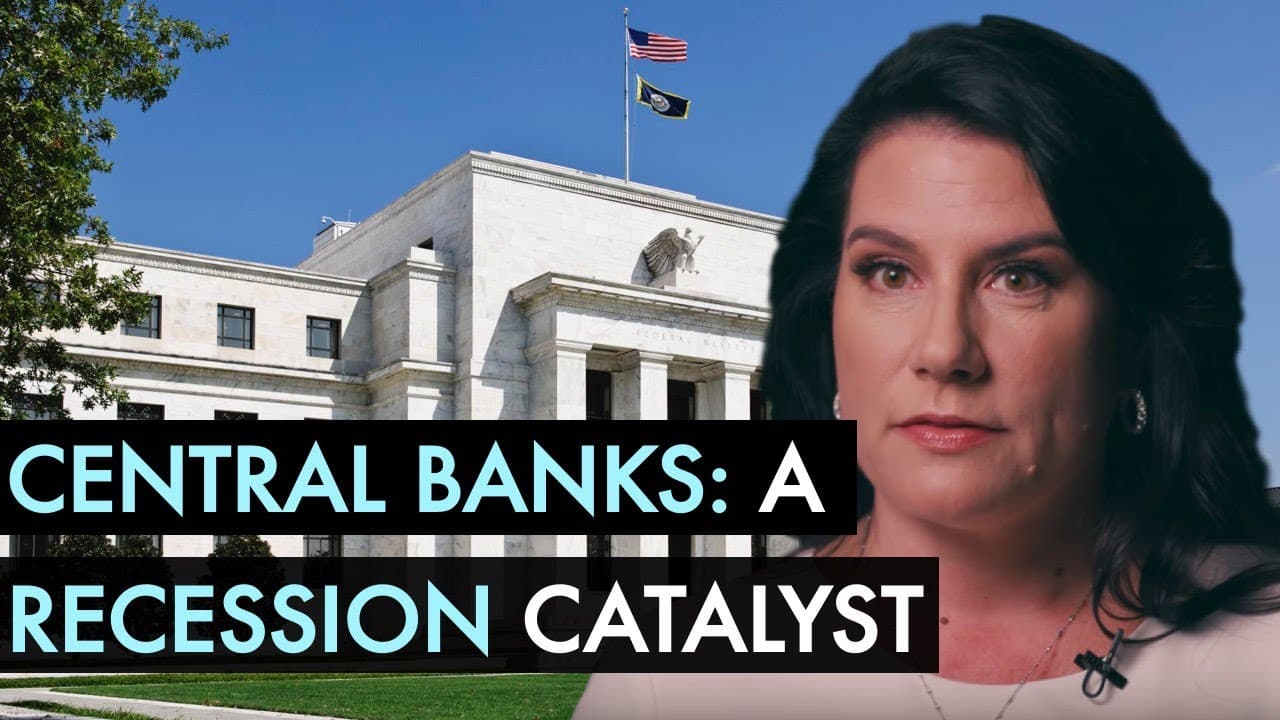
Will Central Bank Liquidity Be the Next Recession Catalyst? (w/ Danielle DiMartino Booth)
TL;DR
Danielle DiMartino Booth discusses the history of central banking, the introduction of moral hazard, the impact of quantitative easing, and the potential consequences for the economy.
Transcript
DANIELLE DIMARTINO BOOTH: Hello, I am Danielle DiMartino Booth. Happy to be back on Real Vision. Since the last time I was on, I have founded a new company called Quill Intelligence. We produce a daily newsletter called The Daily Feather and it's already garnered a cult following. Rolled out right after Memorial Day, and we are looking to truly lau... Read More
Key Insights
- 💁 Alan Greenspan's actions after the 1987 stock market crash introduced moral hazard into the system by leaking information to bond trading desks.
- 🥺 The Fed's response to liquidity events in the markets has led to a cycle of needing increasingly extensive measures for longer durations.
- 🥺 Quantitative easing, implemented on a global scale, has artificially lowered interest rates and led to unintended consequences such as overvaluation of certain asset classes.
- 🌐 The current shift towards quantitative tightening can have significant implications for global liquidity and negative returns in asset classes.
- 👶 The housing market and the potential decline in home prices could have a significant impact on baby boomers' retirement plans and overall financial stability.
- ☠️ The credit markets, particularly triple B rated investment grade bonds and leverage loans, pose significant risks due to potential downgrades and losses.
- 🫰 The MOVE index, which measures bond market volatility, is a critical indicator to watch for potential market disruptions.
- 🧑🤝🧑 Holding cash, short-dated municipal bonds, and gold can provide some protection in the current economic environment.
Install to Summarize YouTube Videos and Get Transcripts
Explore YouTube Video Summarizer or Get YouTube Transcript Extractor
Questions & Answers
Q: What role did Alan Greenspan play in introducing moral hazard into the system?
Alan Greenspan leaked information to bond trading desks ahead of Fed moves to inject liquidity into the system after the 1987 crash, introducing moral hazard into the system.
Q: How has the Fed's approach to financial crises changed over time?
Every time a liquidity event occurred in the markets, the Fed came to the rescue with extraordinary measures. Each time, the measures had to be more extensive and last longer than the previous episode.
Q: What is quantitative easing and how does it differ from previous episodes of monetary policy?
Quantitative easing involves central banks purchasing securities to synthetically produce lower interest rates. It differs from previous episodes in the scale at which it was implemented and the global reach of the program.
Q: What are the potential consequences of the current era of quantitative tightening?
The end of quantitative easing and the shift towards quantitative tightening can lead to a decrease in liquidity in the markets, negative returns in asset classes, and potential economic downturn.
Summary & Key Takeaways
-
Danielle DiMartino Booth explains how central banks have influenced the economy through policies such as quantitative easing and low interest rates.
-
She highlights the role of Alan Greenspan in introducing moral hazard into the system in response to the 1987 stock market crash.
-
DiMartino Booth discusses the potential consequences of the current era of low interest rates and the risk of a housing market decline.
Read in Other Languages (beta)
Share This Summary 📚
Summarize YouTube Videos and Get Video Transcripts with 1-Click
Try YouTube Summary with ChatGPT & Claude or YouTube Transcript Generator
Explore More Summaries from Real Vision 📚

Summarize YouTube Videos and Get Video Transcripts with 1-Click
Try YouTube Summary with ChatGPT & Claude or YouTube Transcript Generator