How Threshold Cryptography Can Solve for Data Privacy
TL;DR
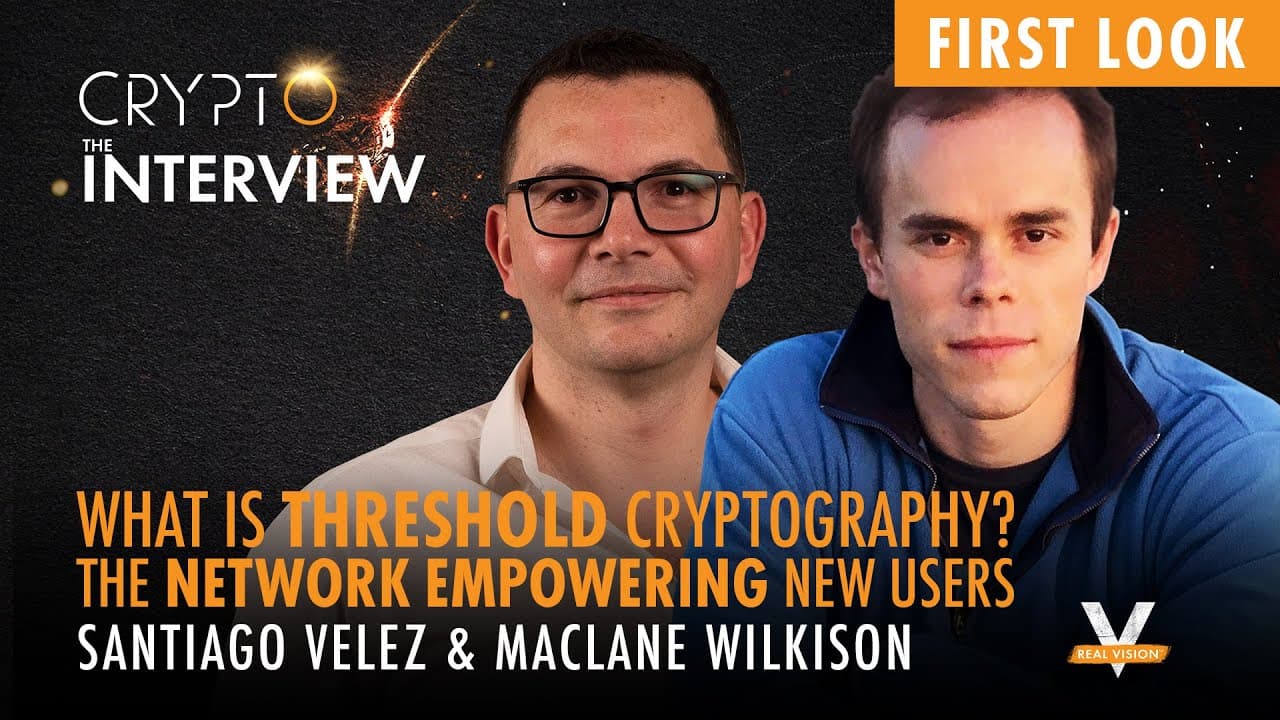
Mclean Wilkinson, CEO of New Cypher and contributor to the Threshold Network, discusses the origins of his project and the importance of cryptography in achieving data privacy and decentralization.
Transcript
hey welcome to real vision my name is santiago velez co-founder of block digital corporation and today i'm excited to bring to you mr mclean wilkinson he's the ceo of new cypher and now contributor to the threshold network welcome mclean thanks santiago hey everyone great to be here excellent so uh today i'd love to do deep dives on all things cryp... Read More
Key Insights
- 👾 In 2013, Mclean Wilkinson became interested in blockchain and cryptography while working in a hacker space in the Bay Area.
- 🚨 The idea for New Cypher emerged from the need for data privacy in decentralized applications.
- 😫 Proxy re-encryption is a core technology used by New Cypher to implement access controls in a public network setting.
- 🤗 New Cypher puts control and sovereignty over encrypted data into the hands of end users.
- 👤 The combination of data privacy and decentralized network architectures offers a fundamental paradigm shift that empowers users.
- 😑 New Cypher's mission is to build tools that enable users to express independence and sovereignty on the web.
- 💄 The cultural and political alignment of blockchain with privacy makes it a natural fit for cryptography and data security.
Install to Summarize YouTube Videos and Get Transcripts
Explore YouTube Video Summarizer or Get YouTube Transcript Extractor
Questions & Answers
Q: How did Mclean Wilkinson get started with blockchain and cryptography?
Mclean began his journey in 2013 when he moved to the Bay Area and attended the SF Bitcoin Developers User Group meetup. This led him to dive into Bitcoin, explore additional functionality on top of it, and identify the need for data privacy in dApps.
Q: What is the core technology behind New Cypher?
New Cypher utilizes proxy re-encryption, a cryptographic technique that allows users to encrypt data client-side and grant or revoke access to others. It eliminates the need for centralized access control and puts control and sovereignty into the hands of end users.
Q: How does New Cypher differ from traditional centralized data architectures?
Unlike centralized systems, New Cypher empowers end users by giving them control over their encrypted data. It shifts the responsibility for encryption and access control from centralized entities to individual users, improving security and privacy.
Q: How does New Cypher contribute to the decentralization of ecosystems?
New Cypher's combination of data privacy and decentralized network architectures provides a paradigm shift in how data is controlled and secured. It enhances the resilience and security of decentralized applications by allowing end users to control their data throughout its lifecycle.
Summary & Key Takeaways
-
Mclean Wilkinson shares his introduction to blockchain and cryptography in 2013 while working at a hacker space in the Bay Area.
-
He explains how the idea for New Cypher emerged from the need for data privacy in decentralized applications (dApps) and the use of proxy re-encryption to implement access controls in a public network setting.
-
New Cypher launched on mainnet in October 2020, providing users with end-to-end encryption and the ability to delegate access to encrypted data.
Read in Other Languages (beta)
Share This Summary 📚
Summarize YouTube Videos and Get Video Transcripts with 1-Click
Try YouTube Summary with ChatGPT & Claude or YouTube Transcript Generator
Explore More Summaries from Real Vision 📚



Summarize YouTube Videos and Get Video Transcripts with 1-Click
Try YouTube Summary with ChatGPT & Claude or YouTube Transcript Generator