L05.5 Uniform Random Variables
TL;DR
Discrete uniform random variables have a range of values in which each value has the same probability, making it useful for scenarios with complete ignorance and equal likelihood of all outcomes.
Transcript
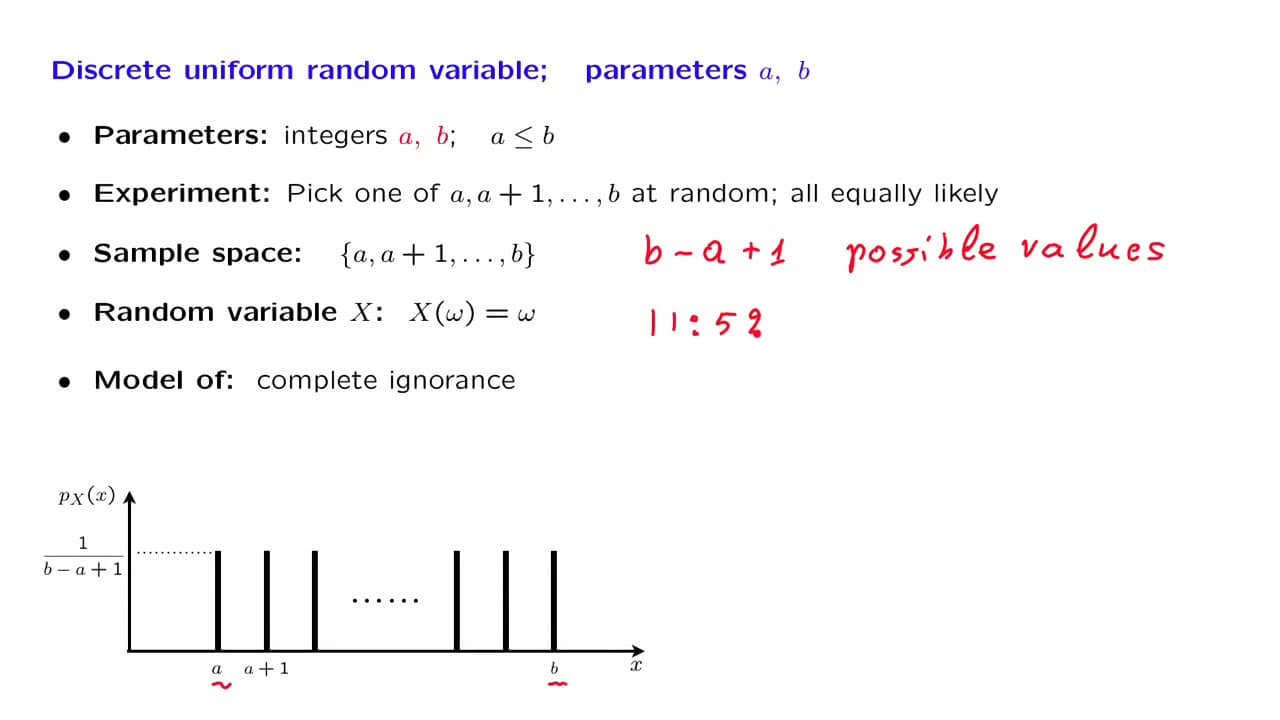
In this segment and the next two, we will introduce a few useful random variables that show up in many applications-- discrete uniform random variables, binomial random variables, and geometric random variables So let's start with a discrete uniform. A discrete uniform random variable is one that has a PMF of this form. It takes values in a certain... Read More
Key Insights
- 🧡 Discrete uniform random variables have a PMF with equal probabilities for each value in a range.
- ❓ It is useful for situations where there is no reason to believe one value is more likely than another.
- 🧡 The sample space consists of the integers within the range, and the number of possible values is determined by the range.
- 📙 The probabilities for each value in the range are 1 over b minus a plus 1.
- 🧡 In the case of a single value range, the random variable becomes a constant.
Install to Summarize YouTube Videos and Get Transcripts
Explore YouTube Video Summarizer or Get YouTube Transcript Extractor
Questions & Answers
Q: What is a discrete uniform random variable?
A discrete uniform random variable is one where each value in a given range has the same probability. It is determined by two parameters, the beginning and end of the range, and represents the outcome of an experiment with equal likelihood for all values.
Q: What is the sample space for a discrete uniform random variable?
The sample space is the set of integers from the beginning (a) to the end (b) of the range. The number of possible values in the sample space is b minus a plus 1.
Q: How are the probabilities determined for a discrete uniform random variable?
Since each value in the range is equally likely, the probability of any particular value is 1 over b minus a plus 1. This choice of probabilities ensures that the PMF sums to one.
Q: Can a discrete uniform random variable have only one possible value?
Yes, in the special case where the beginning and endpoint of the range are the same, the random variable becomes a constant. It is not truly random but can still be considered a random variable with a probability of 1 for that particular value.
Summary & Key Takeaways
-
Discrete uniform random variables have a Probability Mass Function (PMF) with equal probabilities for each value in a given range.
-
The range of values is determined by two parameters, the beginning (a) and the end (b) of the range.
-
The random variable represents the outcome of the experiment, where each value in the range is equally likely.
Read in Other Languages (beta)
Share This Summary 📚
Summarize YouTube Videos and Get Video Transcripts with 1-Click
Try YouTube Summary with ChatGPT & Claude or YouTube Transcript Generator
Explore More Summaries from MIT OpenCourseWare 📚
Summarize YouTube Videos and Get Video Transcripts with 1-Click
Try YouTube Summary with ChatGPT & Claude or YouTube Transcript Generator