Clock Problems | True time | Reasoning | Part-13 | Bharath Kumar
TL;DR
Understanding clock inaccuracies and calculating true time based on incorrect settings.
Transcript
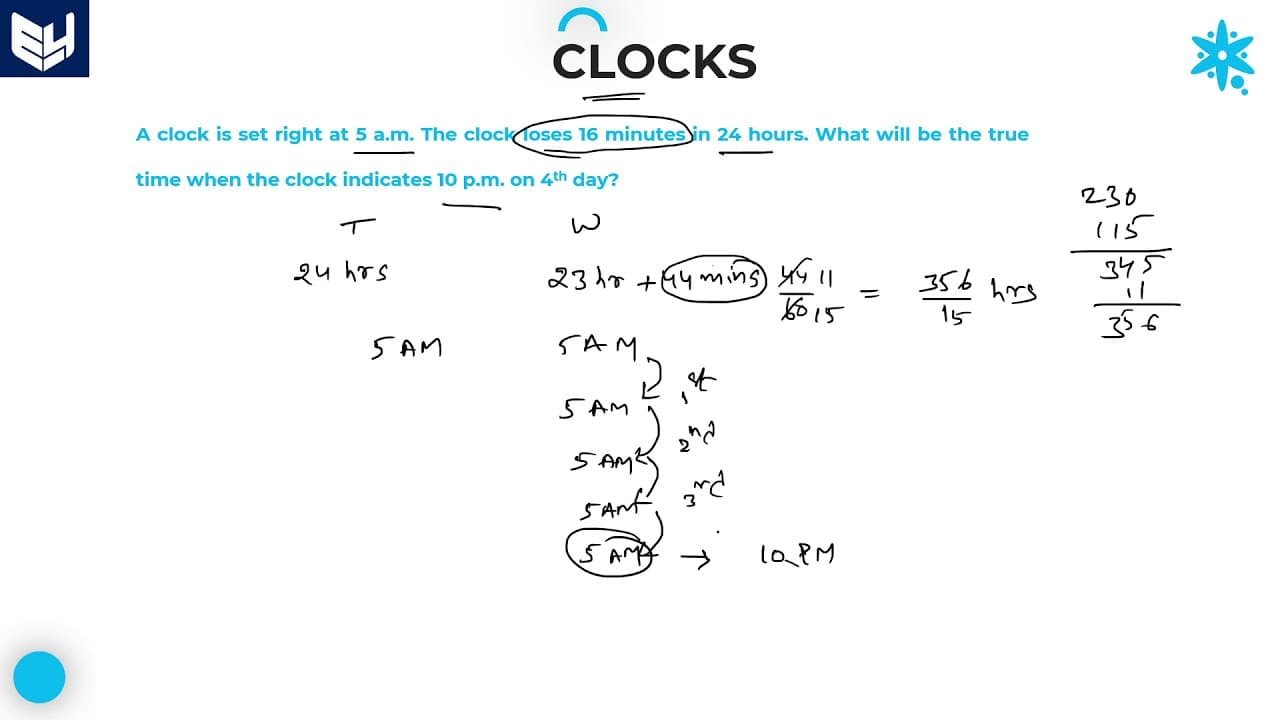
hi everyone welcome back in this session i am going to discussing about uh clock topic this is the last session for this uh clock's topic uh here the first question in this session is a clock is set right at 5 am exactly at 5 00 pm the clock is showing the correct time clock loses 16 minutes in 24 hours in 24 hours clock loses 16 minutes it means t... Read More
Key Insights
- ⏲️ A clock that loses 16 minutes a day shows significant inaccuracies that need correction for true time calculation.
- 😚 The computation for adjusting time involves converting lost minutes into fractions for further calculations.
- ⏲️ For clocks that gain time, the method is similar but requires subtracting the gained time from the displayed incorrect timings.
- ⌛ Understanding the relationship between true time and incorrect readings is crucial for accurate time management.
- 😵 The calculations can be complex but are systematic, involving cross-multiplication and consistent numerical conversion.
- ⏲️ Revisiting established reference points, like setting the clock at specific times, helps maintain clarity in calculations.
- 🤝 Time adjustments also enhance reasoning skills in mathematical problems, especially when dealing with fractions and time.
Install to Summarize YouTube Videos and Get Transcripts
Explore YouTube Video Summarizer or Get YouTube Transcript Extractor
Questions & Answers
Q: How does a clock losing time affect the calculated true time?
When a clock loses time, the displayed time becomes less than the actual time. For instance, if a clock loses 16 minutes in 24 hours, significant calculations are required to adjust the displayed time. By understanding how the loss accumulates over multiple days, the correct true time can be determined by adding back the lost minutes to the inaccurate timing.
Q: What happens when a clock is set correctly but gains time?
When a clock gains time, it shows a later time than true time. For example, a clock gaining 10 minutes in 24 hours means that the wrong clock reading is ahead of the actual time. To calculate the true time based on the gained time, you have to convert the gained extra minutes back into the calculation to find out how much earlier the actual time is.
Q: How do you convert lost minutes into a fractional hour?
To convert lost minutes into a fractional hour, you divide the minutes by 60. For instance, losing 16 minutes converts to 16/60, which simplifies to 4/15 hours. This addition aids in keeping accurate time over longer durations and helps with retrieving the true time.
Q: Why is it necessary to track time loss or gain over multiple days?
Tracking time loss or gain over several days is essential for accurate timekeeping. As inaccuracies compound over time, failing to account for these discrepancies could lead to increasingly incorrect time readings. Establishing a consistent method to calculate and adjust for lost or gained time ensures clarity and accuracy in time-sensitive situations.
Summary & Key Takeaways
-
The content explains how to calculate true time when a clock loses or gains time over a 24-hour period.
-
Specifically, it provides two scenarios: one where a clock loses 16 minutes and another where it gains 10 minutes daily, illustrating how to find true time based on incorrect readings.
-
The video concludes by discussing the method of converting wrong time to true time through detailed calculations involving fractions and cross-multiplication.
Read in Other Languages (beta)
Share This Summary 📚
Summarize YouTube Videos and Get Video Transcripts with 1-Click
Try YouTube Summary with ChatGPT & Claude or YouTube Transcript Generator