P-value and Test Statistic for a Two Sample Z Hypothesis Test in StatCrunch
TL;DR
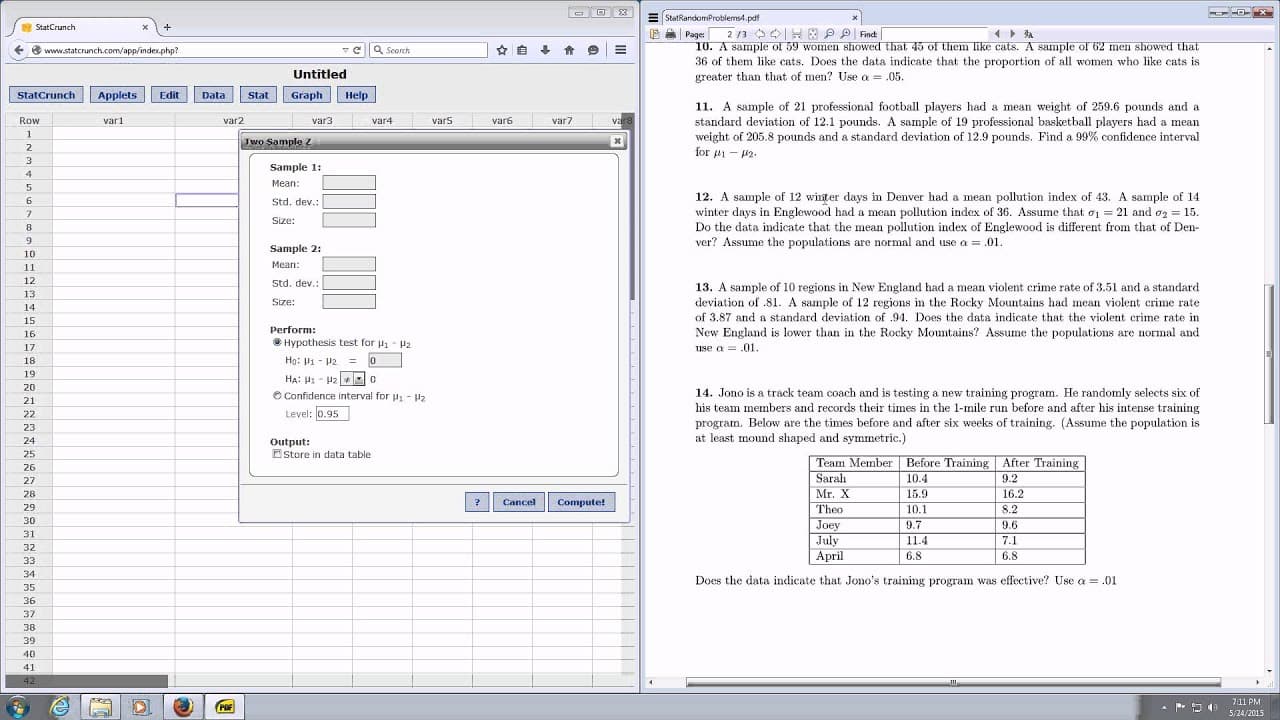
Utilizing z-statistics in StatCrunch to compare pollution index means of Denver and Englewood in a two-sample test.
Transcript
in this video we're going to find the p-value and test statistic for a two-sample hypothesis test for the mean using z-statistics with statcrunch well that's a lot to say so we have a two-sample test for the mean and we're using z we're going to focus on number 12. so if you kind of glance at the question it says a sample of 12 winter days in denve... Read More
Key Insights
- 💤 Z-statistics are utilized when conducting a two-sample hypothesis test for means in StatCrunch.
- ⏯️ Population standard deviations play a crucial role in determining the appropriate statistical test to use for mean comparison.
- 🏆 Interpretation of the test statistic and p-value aids in making conclusions about the significance of differences between sample means.
- 🏆 Understanding the input requirements and function options in StatCrunch can streamline the process of conducting statistical tests.
- 🏆 The choice of hypothesis (e.g., equal to, greater than, less than) influences the interpretation of the test results.
- ❓ Data analysis in StatCrunch involves entering sample sizes, mean values, and population standard deviations accurately to obtain valid results.
- 😀 The calculated p-value represents the likelihood of observing the obtained difference in means under the null hypothesis assumption.
Install to Summarize YouTube Videos and Get Transcripts
Explore YouTube Video Summarizer or Get YouTube Transcript Extractor
Questions & Answers
Q: How is the two-sample Z-test for mean conducted in StatCrunch?
The process involves inputting sample sizes, mean pollution index values, and population standard deviations into the z-statistics tool for two samples with summary in StatCrunch.
Q: What does the test statistic of 0.96 indicate in this analysis?
The test statistic of 0.96 represents the difference in mean pollution indexes between Denver and Englewood in standard deviation units based on the sampled data.
Q: How is the p-value interpreted in the context of this two-sample test?
The p-value of 0.3355 suggests that there is a 33.55% chance of observing a difference in mean pollution indexes between Denver and Englewood as extreme as the one obtained, assuming the null hypothesis is true.
Q: Why is the assumption of equal population standard deviations important in this analysis?
Assuming equal population standard deviations allows for the use of z-statistics in comparing the means of two samples, ensuring that the statistical analysis is conducted accurately.
Summary & Key Takeaways
-
Analyzing a two-sample hypothesis test for mean pollution index using z-statistics with StatCrunch.
-
Comparing mean pollution indexes of 12 winter days in Denver and 14 winter days in Englewood, given population standard deviations.
-
Calculating the test statistic and p-value to determine if the mean pollution index of Englewood is different from Denver.
Read in Other Languages (beta)
Share This Summary 📚
Summarize YouTube Videos and Get Video Transcripts with 1-Click
Try YouTube Summary with ChatGPT & Claude or YouTube Transcript Generator
Explore More Summaries from The Math Sorcerer 📚


Summarize YouTube Videos and Get Video Transcripts with 1-Click
Try YouTube Summary with ChatGPT & Claude or YouTube Transcript Generator