Speed Control Of DC Motor | Armature Voltage control | DC machines | Lec-61
TL;DR
This content discusses methods for controlling speed in DC motors, focusing on armature resistance and voltage control.
Transcript
hello everyone in the last session we discussed about the Armature resistance control in the transmission resistance control just look at here when the Armature resists external resistance will be varied and automatically speed can be varied so by using that we have discussed some more points in that the when the Armature current increases few draw... Read More
Key Insights
- 🐎 Armature resistance control allows for speed variation by adjusting external resistance, impacting armature current and speed inversely.
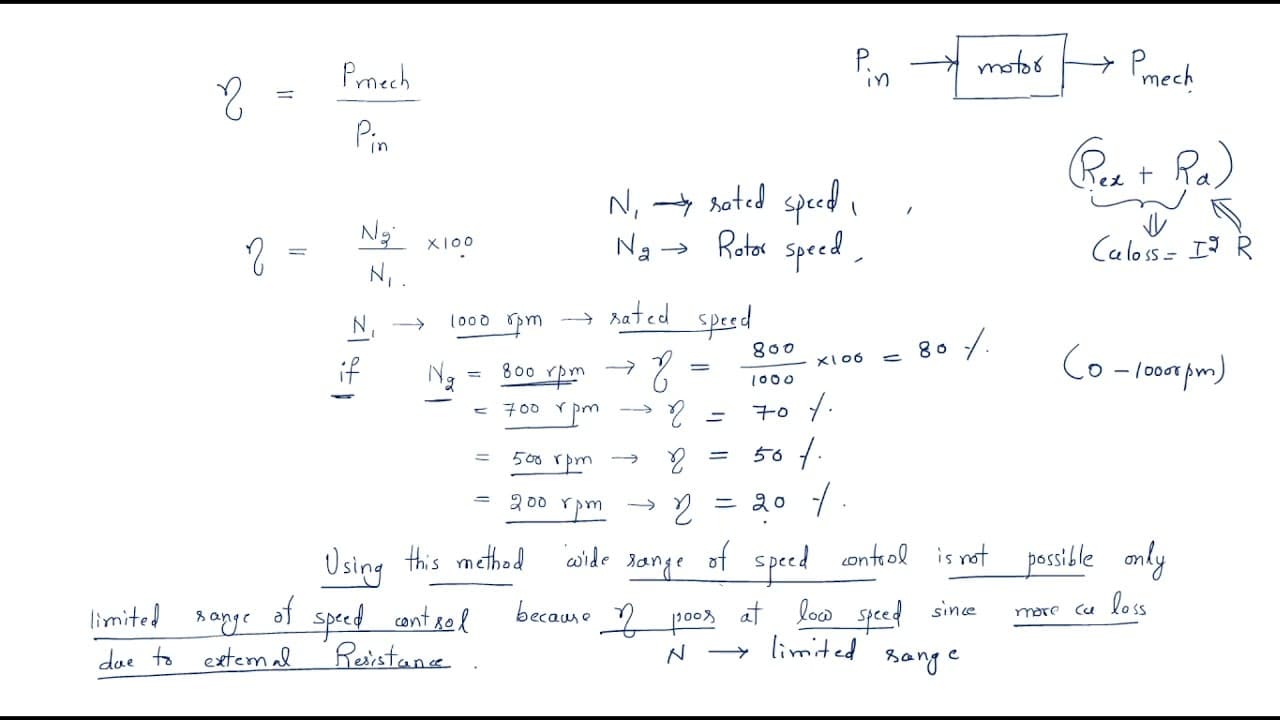
- 🌸 Efficiency in DC motors diminishes at low speeds due to increased copper losses associated with higher external resistances.
- ⚡ Armature voltage control serves as an effective mechanism for adjusting motor speed, maintaining operation within safe voltage limits.
- 🧑🦼 The relationship between armature voltage and motor speed creates a predictable framework for controlling performance.
- 🧑🦼 Speed characteristics differ significantly between DC shunt and series motors, emphasizing the need for tailored control strategies.
- ⚡ Voltage ratings impose constraints on the operational capacity of DC motors, particularly in high-demand applications.
- 🐎 Practical applications of speed control mechanisms often require a balance between simplicity, cost, and performance efficiency.
Install to Summarize YouTube Videos and Get Transcripts
Explore YouTube Video Summarizer or Get YouTube Transcript Extractor
Questions & Answers
Q: What is the relationship between armature resistance and motor speed?
The armature resistance affects the motor's speed by introducing external resistances that can lower the speed. As the armature current increases, with no external resistance, the speed is higher, but adding resistance leads to a decrease in speed. This relationship is crucial for understanding DC shunt and series motors.
Q: How does external resistance influence the efficiency of a DC motor?
External resistance impacts efficiency because it can lead to increased copper losses, which are proportional to the resistance and the square of the current (I^2R). Higher resistance results in poorer efficiency, especially at low speeds, making it essential to balance resistance and speed for optimal performance.
Q: Why is armature voltage control only applicable below rated speed?
Armature voltage control is limited to below the rated speed due to insulation challenges. Operating above the rated voltage can compromise insulation integrity, risking damage. This method ensures that motors operate safely while still allowing some variation in speed.
Q: How are speed and voltage related in DC motors?
The speed of DC motors is directly proportional to the armature voltage. For example, if the applied voltage is reduced, the motor's speed decreases correspondingly. Thus, controlling voltage is a key strategy for managing motor speed in various applications.
Q: What is the efficiency of a DC motor operating at 800 RPM if its rated speed is 1000 RPM?
The efficiency can be calculated by the ratio of the actual speed to the rated speed, multiplied by 100. Therefore, if the rated speed is 1000 RPM and the rotor speed is 800 RPM, the efficiency is (800/1000) x 100, which equals 80 percent.
Q: What are the advantages of using armature resistance control?
Armature resistance control offers a straightforward method for speed regulation by varying resistance levels. This approach is particularly useful in applications where fine control over speed within a limited range is sufficient, as it is simple and cost-effective.
Summary & Key Takeaways
-
The content explains armature resistance control methods for varying the speed of DC motors, specifically highlighting the relationship between armature current and speed.
-
It discusses the limitations of armature resistance control, emphasizing how external resistances impact efficiency and speed range in DC motors.
-
The document introduces armature voltage control as another method for speed regulation in DC motors, detailing operational principles and efficiency considerations.
Read in Other Languages (beta)
Share This Summary 📚
Summarize YouTube Videos and Get Video Transcripts with 1-Click
Try YouTube Summary with ChatGPT & Claude or YouTube Transcript Generator