Laplace transform of t^n using series expansion L{t^n} for non-negative integers n
TL;DR
The Laplace transform of t^m can be found using series expansions and the fact that the Laplace transform of e^at is 1/(s-a).
Transcript
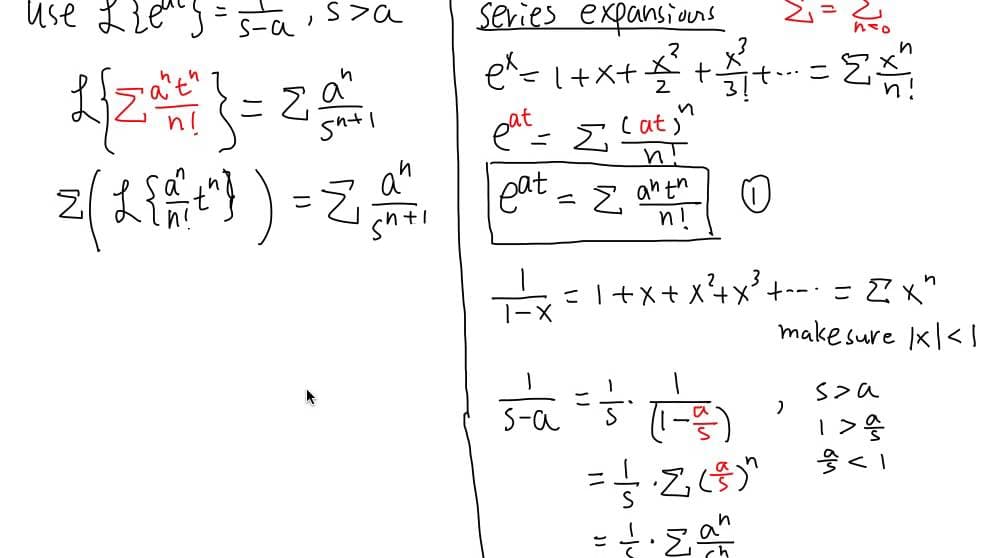
okay we are going to figure out what's the laas transform of t to the m power and this is how we are going to do it we are going to use the fact that the laass of e to the a power this is the same as saying one over s minus a and we must make sure that s is greater than a in order for this to work and along with this we also need some other tools a... Read More
Key Insights
- ☺️ The Laplace transform of t^m can be found using series expansions of e^x and 1/(1-x).
- 😃 The series expansion for e^x is useful for finding the Laplace transform of e^at, where a is a constant and t is the variable.
- ☺️ The series expansion of 1/(1-x) is useful for finding the Laplace transform of 1/(s-a), where s is a variable and a is a constant.
- 😑 By applying these series expansions, the Laplace transform of t^m can be expressed as summations of terms involving a/n! and s^n+1.
- 😀 The series expansions are valid for certain conditions, such as s > a and |x| < 1.
- 😑 The series expansions allow for the manipulation of terms in the Laplace transform expression.
- 🍉 The final result of the Laplace transform of t^m can be obtained by manipulating the series expansions and combining terms.
Install to Summarize YouTube Videos and Get Transcripts
Explore YouTube Video Summarizer or Get YouTube Transcript Extractor
Questions & Answers
Q: What series expansions are necessary to find the Laplace transform of t^m?
The series expansions of e^x and 1/(1-x) are necessary. The series expansion of e^x is the sum of x^n/n!, while the series expansion of 1/(1-x) is the sum of x^m.
Q: What conditions must be met for the series expansions to work?
For the series expansion of e^x to work, the value of x can be any real number. However, for the series expansion of 1/(1-x) to work, the absolute value of x must be less than 1.
Q: How can the series expansion of e^x be used to find the Laplace transform of t^m?
By substituting at for x in the series expansion of e^x, the Laplace transform of e^at can be expressed as a summation of terms involving a/m! and t^m.
Q: How can the series expansion of 1/(1-x) be used to find the Laplace transform of t^m?
By considering 1/(s-a) as 1/s * 1/(1-a/s), the series expansion of 1/(1-a/s) can be used to express the Laplace transform of 1/(s-a) as a summation of terms involving a/n! and s^n+1.
Summary & Key Takeaways
-
The Laplace transform of t^m can be determined using series expansions of e^x and 1/(1-x).
-
The series expansion for e^x is 1 + x + (x^2)/2 + (x^3)/3! + ... and can be written in sigma notation as the sum of x^n/n!.
-
The series expansion for 1/(1-x) is 1 + x + x^2 + x^3 + ... and can be written as the sum of x^m.
-
By applying these series expansions, the Laplace transform of t^m can be expressed as a summation of terms involving a/n! and s^n+1.
Read in Other Languages (beta)
Share This Summary 📚
Summarize YouTube Videos and Get Video Transcripts with 1-Click
Try YouTube Summary with ChatGPT & Claude or YouTube Transcript Generator
Explore More Summaries from blackpenredpen 📚
Summarize YouTube Videos and Get Video Transcripts with 1-Click
Try YouTube Summary with ChatGPT & Claude or YouTube Transcript Generator