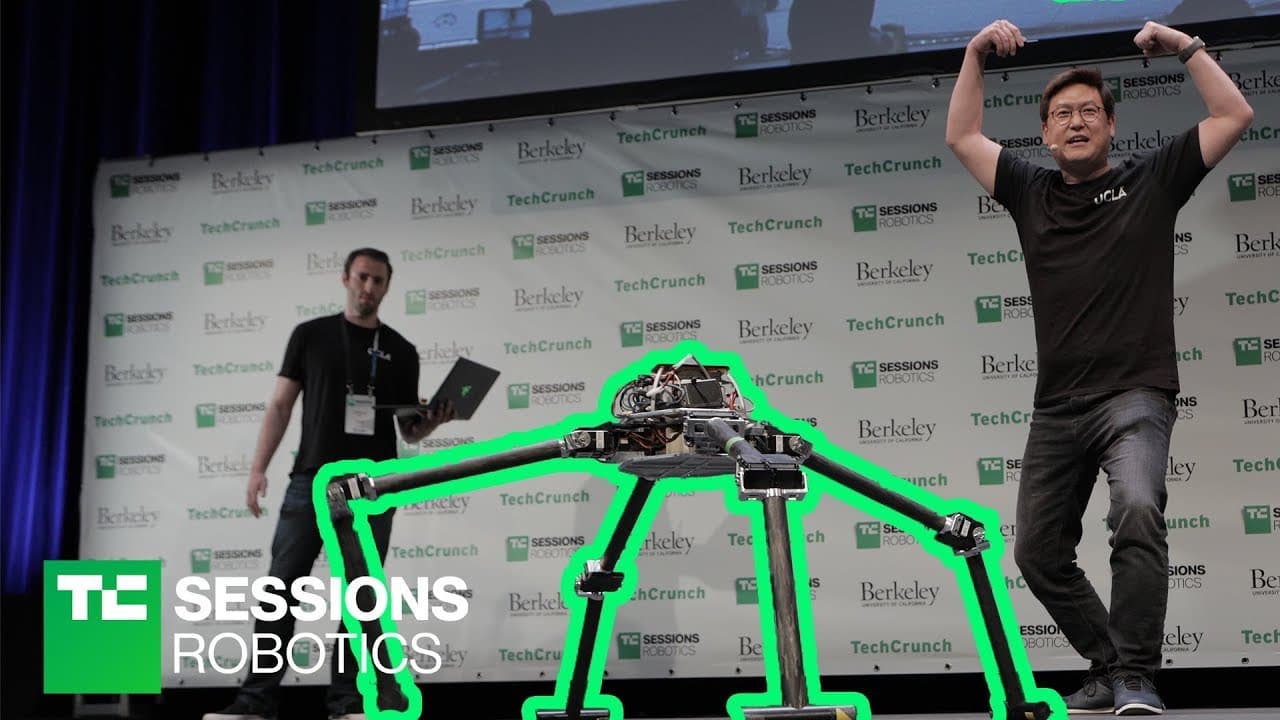
DEMO: NABi and ALPHRED (Dennis Hong, UCLA) | TC Sessions Robotics 2018
TL;DR
UCLA researchers have developed a new approach to bipedal locomotion using sideways walking, leading to stable and low-cost robots. They have also created a revolutionary compliant actuator called BEAR that allows for dynamic and customizable movements.
Transcript
hello everybody good afternoon again my name is Dennis Hall I'm a professor and the director of romola the robotics and mechanisms laboratory at UCLA at UCLA ramallah we do a lot of different type of research and development robotics we're one of the early pioneers and autonomous vehicles in 2007 at DARPA urban challenge we placed third place we co... Read More
Key Insights
- 🤖 UCLA's Robotics and Mechanisms Laboratory has shifted its research focus to human robots and has developed various robots for different applications.
- 😀 Sideways walking has been identified as a solution to the stability problem faced by bipedal locomotion robots, as it eliminates the unwanted twisting movements caused by leg distance.
- 🤖 Nobby, a sideways-walking robot, has been designed and offers a simple, stable, and cost-effective locomotion method.
- 👻 The lab has also developed the BEAR actuator, which is compliant and allows for customizable and dynamic movements in robots.
Install to Summarize YouTube Videos and Get Transcripts
Explore YouTube Video Summarizer or Get YouTube Transcript Extractor
Questions & Answers
Q: What challenges have researchers at UCLA faced in developing humanoid robots?
Researchers at UCLA have encountered difficulties regarding stability, complexity, and cost in creating humanoid robots. These robots tend to fall down easily and are slow in their movements, making them impractical for real-world applications.
Q: How is sideways walking a solution to the stability problem in bipedal locomotion robots?
Sideways walking aligns the left and right legs, reducing the unwanted twisting moments that cause robots to fall down. This method of locomotion is inspired by fencing and ballet, which also utilize sideways movements for stability.
Q: How has UCLA's Robotics and Mechanisms Laboratory addressed the limitations of humanoid robots?
The lab has introduced Nobby, a two-legged robot that does not resemble a human, but walks in a sideways manner. By eliminating feet, ankles, and traditional leg movements, they have created a simple, stable, and low-cost locomotion method.
Q: What is the purpose of the BEAR actuator developed by UCLA researchers?
The BEAR (Back Drivable Electromechanical Actuator for Robots) actuator is compliant and allows for dynamic movements. It offers the ability to change damping, physical properties, and even stiffness. This actuator provides a revolutionary solution for bipedal locomotion and enables customizability in robot movements.
Summary & Key Takeaways
-
UCLA's Robotics and Mechanisms Laboratory has shifted its focus to human robots and has developed various innovative robots, including Darn-opie, Sapphire, and Navi.
-
Traditional bipedal locomotion robots face stability issues due to unwanted twisting movements caused by the distance between legs, but by adopting sideways walking, stability is improved.
-
The lab has designed a new robot named Nobby that walks in a sideways manner, eliminating the need for feet and ankles, resulting in a simple and stable locomotion method.
Read in Other Languages (beta)
Share This Summary 📚
Summarize YouTube Videos and Get Video Transcripts with 1-Click
Try YouTube Summary with ChatGPT & Claude or YouTube Transcript Generator
Explore More Summaries from TechCrunch 📚






Summarize YouTube Videos and Get Video Transcripts with 1-Click
Try YouTube Summary with ChatGPT & Claude or YouTube Transcript Generator