Radar Range equation | Problems | Part-2/2 | Radar Systems | Lec-17
TL;DR
The video explains solving radar range equations with practical examples.
Transcript
hi everyone in this video I am going to explain about the problems I am continuing the problems only and because problems are also very important from this radar systems first topic rather range equation in the previous video I have explained two problems one is very simple problem which can be asked for two marks or three marks and the second prob... Read More
Key Insights
- 🤩 Understanding radar system operation requires familiarity with key parameters such as transmitter power, antenna gain, and target cross-section.
- 🧡 The radar range equation is pivotal for calculating both maximum detectable range and received signal strength in radar applications.
- 🇦🇪 Proper unit conversion is critical in ensuring valid results, especially when dealing with measurements in different units.
- 🌍 Real-world problems based on previous exams can serve as effective learning tools for grasping theoretical concepts in radar technology.
- 🧡 The radar detection range is highly susceptible to variations in operational parameters, illuminating the need for careful configuration in practical settings.
- ❓ Accurate calculations support the radar's functionality and efficiency, providing significant implications for various critical activities such as navigation and surveillance.
- ✊ Calculating received power accurately requires a clear understanding of how to manipulate the radar formula, adjusting parameters to reflect the conditions of the radar environment.
Install to Summarize YouTube Videos and Get Transcripts
Explore YouTube Video Summarizer or Get YouTube Transcript Extractor
Questions & Answers
Q: What is the significance of the radar range equation?
The radar range equation is crucial for determining the maximum distance a radar system can effectively detect a target. By considering parameters like transmitter power, antenna gain, target radar cross-section, and minimum detectable signal, one can assess the operational capabilities of the radar system, ensuring efficient target detection.
Q: Why is unit conversion emphasized in radar calculations?
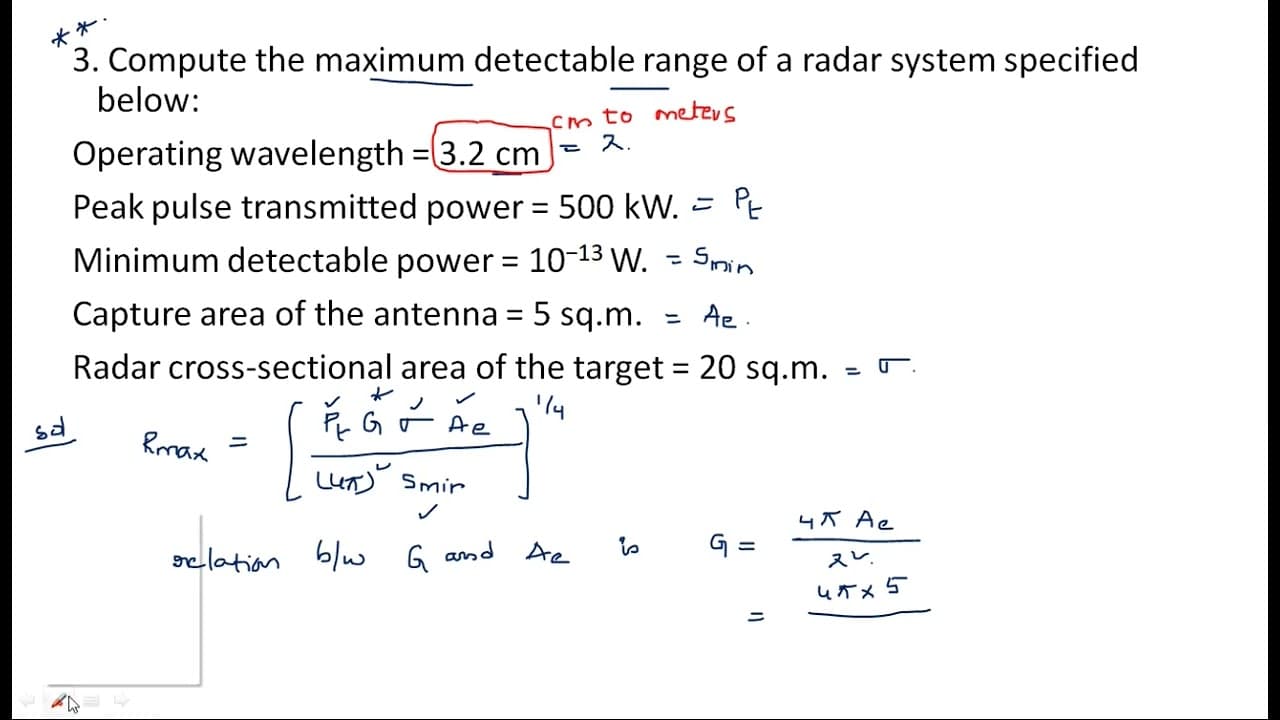
Unit conversion is vital to ensure consistency and accuracy when substituting values into radar calculations. For example, using centimeters instead of meters can lead to significant discrepancies in results. The video highlights that converting all measurements to the correct units beforehand is essential for deriving valid maximum range values.
Q: How do we calculate maximum radar range using given parameters?
To calculate the maximum radar range, we use the formula R Max = (PT * G * Sigma * AE) / (4 * π² * S_min)^(1/4). By replacing PT with transmitter power, G with gain, Sigma with target cross-section, AE with antenna area, and S_min with minimum detectable signal, we can solve for R Max accurately.
Q: What factors affect the range of radar detection?
Several factors influence radar detection range, including peak transmitted power, gain of the antenna, radar cross-section of the target, and the minimum detectable signal. Adjustments in these parameters can either extend or limit the radar’s ability to detect targets at varying distances.
Q: What parameters were given in the video’s radar problem?
In one of the problems discussed, the parameters included the operating wavelength, transmitter power (500 kilowatts), radar cross-section (20 square meters), and minimum detectable signal. These values were used to calculate the maximum detectable range effectively through the established radar range equation.
Q: How did the video derive the received power at 50 kilometers?
The video outlines that to compute the received power at a given distance, the modified radar range equation is used, highlighting parameters such as transmitter power, gain, target radar cross-section, and range. By substituting these variables into the formula, the resultant power is calculated.
Q: Why is it important to check calculations in radar problems?
Validating calculations ensures that the derived range or power values are accurate and reliable. Mistakes in calculations can lead to misinterpretations of the radar's capabilities, impacting practical applications like search and rescue operations, air traffic control, and military applications.
Q: What should be considered when using formulas in radar calculations?
When using formulas in radar calculations, it's essential to ensure all parameters are accurately represented in the same measurement unit and that the relationships between parameters are correctly understood as per the radar equations. This ensures precision in the final results.
Summary & Key Takeaways
-
The video discusses radar range equations, providing important details on radar system parameters such as power, gain, and minimum detectable signal.
-
It focuses on practical problem-solving techniques derived from previous exam questions to compute maximum radar detection range and received power.
-
Conversion of units, especially from centimeters to meters, is emphasized to ensure accurate calculations for radar ranges in meters.
Read in Other Languages (beta)
Share This Summary 📚
Summarize YouTube Videos and Get Video Transcripts with 1-Click
Try YouTube Summary with ChatGPT & Claude or YouTube Transcript Generator