What Is Fick's Law of Diffusion and How Is It Applied?
TL;DR
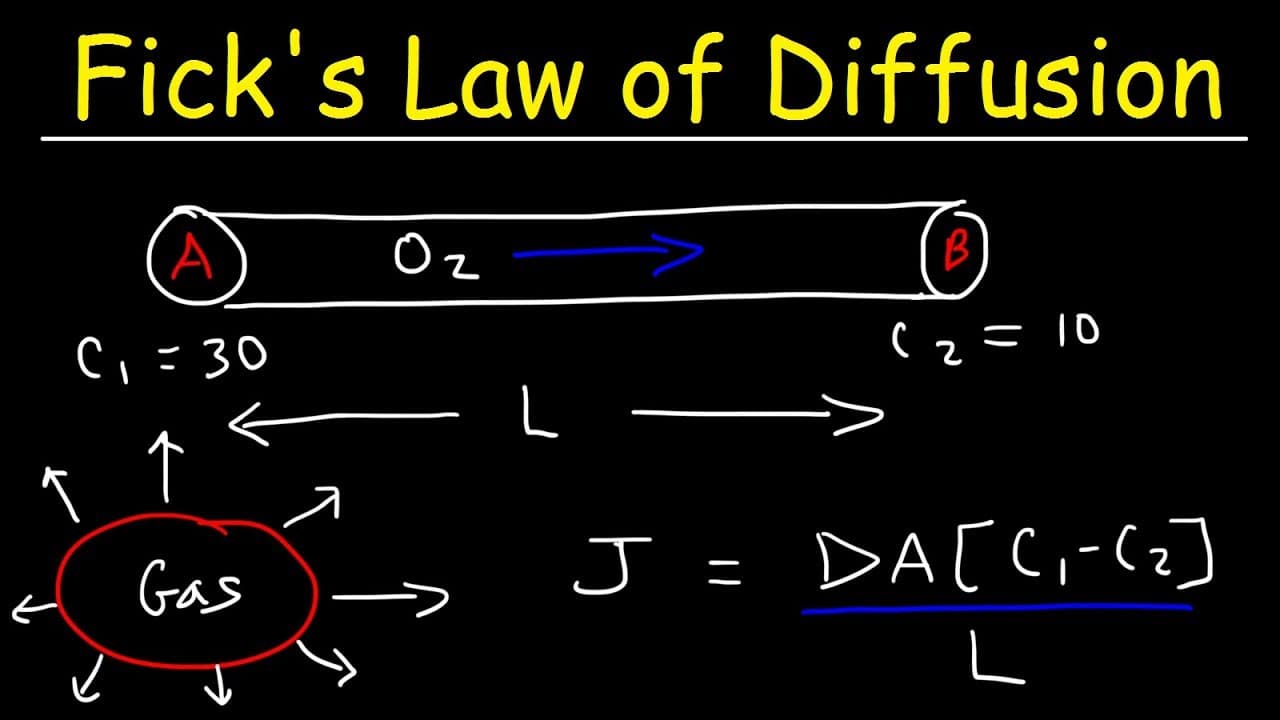
Fick's Law of Diffusion describes how substances move from areas of high concentration to low concentration, and it can be applied to calculate the diffusion flow rate using the equation j = D * A * (c1 - c2) / L. In this example, the calculated diffusion flow rate of oxygen through a 10-meter pipe is 2.9 x 10^(-6) kilograms per second.
Transcript
in this video we're going to focus on fick's law of diffusion so in this problem we have a long circular pipe and this pipe is 10 meters long and oxygen gas is flowing in this pipe now we have the cross-sectional radius of the pipe which is 16 centimeters and the concentrations are 30 and 10 kilograms per cubic meter now diffusion is a process wher... Read More
Key Insights
- 😘 Fick's Law of Diffusion explains how materials move from areas of high concentration to low concentration.
- ☠️ Diffusion flow rate is calculated using factors such as the diffusion constant, cross-sectional area, difference in concentration, and length of the pipe.
- 🤒 The concentration gradient indicates how the concentration changes per meter along the pipe.
- ⏳ The diffusion flow rate determines the amount of material that travels per unit time.
Install to Summarize YouTube Videos and Get Transcripts
Explore YouTube Video Summarizer or Get YouTube Transcript Extractor
Questions & Answers
Q: How does diffusion work?
Diffusion is the process where material moves from an area of high concentration to an area of low concentration. It can be compared to the spreading of gas particles when perfume is sprayed in a room.
Q: What is the formula for calculating diffusion flow rate?
The formula is j = D * A * (c1 - c2) / L, where j is the diffusion flow rate, D is the diffusion constant, A is the cross-sectional area, c1 and c2 are the concentrations, and L is the length of the pipe.
Q: How are the units for the diffusion constant determined?
The units of the diffusion constant can be determined by examining the units of the other variables in the equation. In this example, the units are kilograms per second.
Q: How can we convert minutes to seconds in unit conversion?
To convert minutes to seconds, you multiply the number of minutes by 60. This conversion is necessary when dealing with diffusion flow rate, which is measured in kilograms per second.
Summary & Key Takeaways
-
Fick's Law of Diffusion states that material moves from regions of high concentration to low concentration.
-
The diffusion flow rate is calculated using the formula j = D * A * (c1 - c2) / L, where j represents the amount of material that travels per unit time.
-
In this example, the diffusion flow rate of oxygen through a pipe is calculated as 2.9 * 10^(-6) kilograms per second.
Read in Other Languages (beta)
Share This Summary 📚
Summarize YouTube Videos and Get Video Transcripts with 1-Click
Try YouTube Summary with ChatGPT & Claude or YouTube Transcript Generator
Explore More Summaries from The Organic Chemistry Tutor 📚






Summarize YouTube Videos and Get Video Transcripts with 1-Click
Try YouTube Summary with ChatGPT & Claude or YouTube Transcript Generator