Safety guideline for COVID-19: Chapter 4 overview
TL;DR
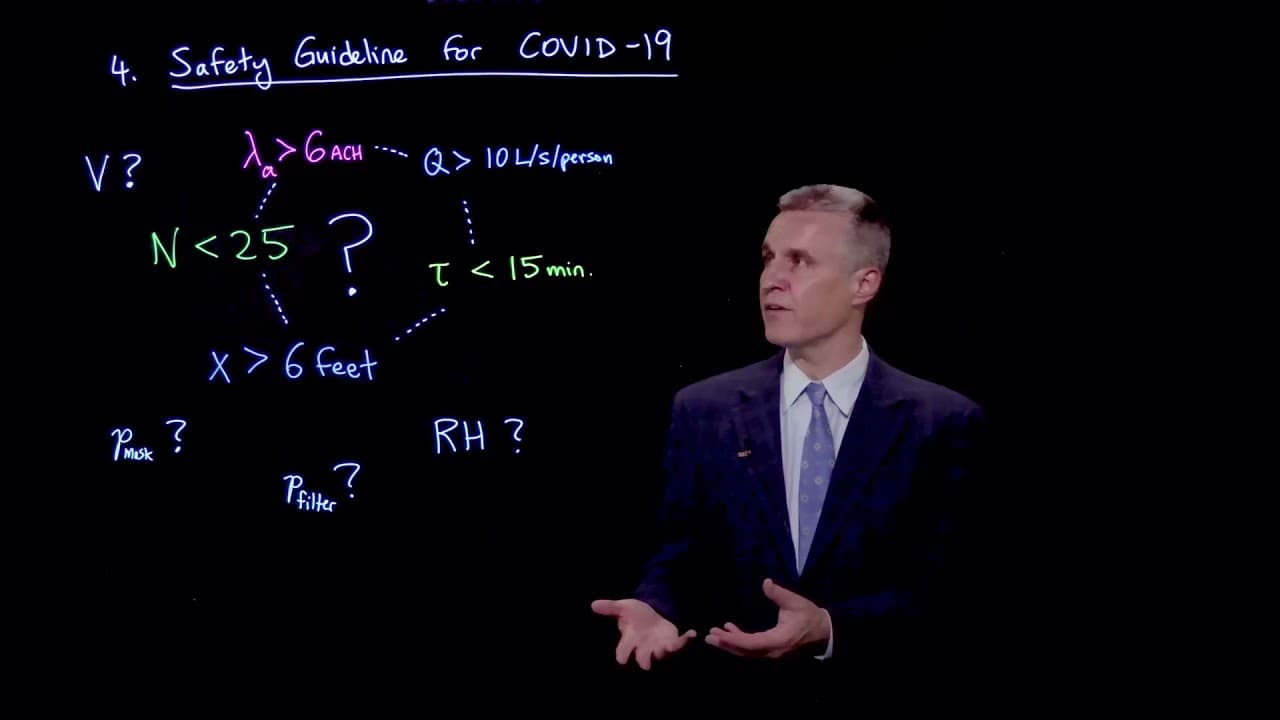
Existing guidelines for limiting the spread of COVID-19 indoors are based on various parameters such as social distancing, occupancy limits, fresh air change rate, and time spent in close contact, but it is challenging to create a universal guideline due to the interdependence of these variables.
Transcript
PROFESSOR: So now we're ready to synthesize our knowledge of airborne transmission in a well-mixed room and epidemiological models to arrive at a safety guideline to limit the indoor airborne spread of COVID-19, or, more generally, other respiratory pathogens. Existing guidelines limit one parameter that might be important. For example, social dist... Read More
Key Insights
- ⛔ Existing guidelines for limiting the indoor spread of COVID-19 are based on parameters like social distancing, occupancy limits, fresh air change rate, and time spent in close contact.
- ❓ It is challenging to create a universal guideline due to the interdependence and variability of these parameters.
- 😷 Other variables such as relative humidity, filtration efficiency, mask quality, and the volume and geometry of the space also play a role in the airborne spread of COVID-19 indoors.
- ❓ Superspreading events provide valuable data for deriving specific guidelines tailored to COVID-19.
Install to Summarize YouTube Videos and Get Transcripts
Explore YouTube Video Summarizer or Get YouTube Transcript Extractor
Questions & Answers
Q: What are some of the parameters considered in existing guidelines for limiting the indoor spread of COVID-19?
Existing guidelines consider parameters like social distancing, occupancy limits, fresh air change rate, and time spent in close contact. These parameters aim to reduce the risk of transmission by minimizing contact and increasing ventilation.
Q: Why is it challenging to create a universal guideline for limiting indoor airborne spread?
Creating a universal guideline is challenging because these parameters are interrelated. For example, a larger space with high ventilation may allow for more people to gather safely, while a small enclosed space with poor ventilation can increase the risk even with a limited number of people. The effectiveness of each parameter is influenced by other variables such as volume, geometry, filtration efficiency, and mask quality.
Q: How are superspreading events being utilized to derive specific guidelines for COVID-19?
Superspreading events, where a small number of individuals infect a disproportionately large number of people, provide valuable data on the infectiousness of exhaled breath. By studying these events and analyzing the available data, researchers can make reasonable and consistent inferences to parameterize guidelines specifically for COVID-19.
Q: Are there other variables that can impact the airborne spread of COVID-19 indoors?
Yes, variables like relative humidity, filtration efficiency, and mask quality can also impact the spread of airborne particles. These variables, along with the volume and geometry of the space, need to be considered when formulating guidelines to limit the spread of COVID-19 in indoor environments.
Summary & Key Takeaways
-
Guidelines to limit indoor airborne spread of COVID-19 are based on parameters like social distancing, occupancy limits, fresh air change rate, and time spent in close contact.
-
It is difficult to create a universal guideline as these parameters are interrelated and dependent on factors like volume, geometry, filtration efficiency, and mask quality.
-
Superspreading events are being studied to derive specific guidelines for COVID-19 based on available data on infectiousness of exhaled breath.
Read in Other Languages (beta)
Share This Summary 📚
Summarize YouTube Videos and Get Video Transcripts with 1-Click
Try YouTube Summary with ChatGPT & Claude or YouTube Transcript Generator
Explore More Summaries from MIT OpenCourseWare 📚



Summarize YouTube Videos and Get Video Transcripts with 1-Click
Try YouTube Summary with ChatGPT & Claude or YouTube Transcript Generator