3.2.6 Introduction to Logistical Regression - Video 4: Logistic Regression in R
TL;DR
A logistic regression model is built in R to better predict poor care in patients using the number of office visits and prescriptions for narcotics as independent variables.
Transcript
This plot shows two of our independent variables, the number of office visits on the x-axis and the number of narcotics prescribed on the y-axis. Each point is an observation or a patient in our data set. The red points are patients who received poor care, and the green points are patients who received good care. It's hard to see a trend in the dat... Read More
Key Insights
- 😨 Visual inspection of the data points does not reveal a clear trend between the number of office visits, narcotics prescriptions, and care quality.
- 😨 Both the number of office visits and narcotics prescriptions have a positive correlation with poor care, as indicated by the significant coefficients in the logistic regression model.
- 🍧 The AIC value is used as a measure of model quality and selection, with the preferred model having the minimum AIC.
- 😨 Predictions made by the logistic regression model show higher probabilities for actual poor care cases compared to good care cases.
Install to Summarize YouTube Videos and Get Transcripts
Explore YouTube Video Summarizer or Get YouTube Transcript Extractor
Questions & Answers
Q: What are the independent variables used in the logistic regression model?
The independent variables used are the number of office visits and the number of prescriptions for narcotics.
Q: How is the accuracy of the baseline model calculated?
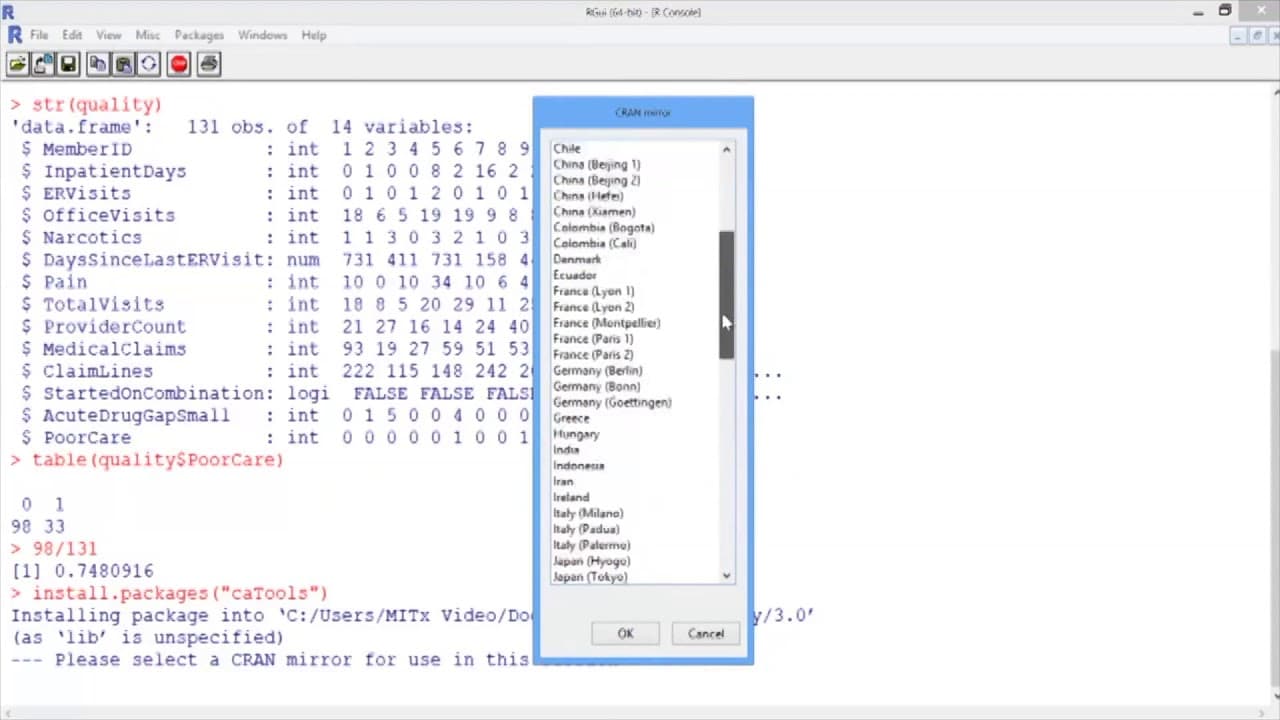
The accuracy of the baseline model is calculated by predicting good care for all patients, as it is the most frequent outcome. The accuracy is approximately 75%.
Q: What percentage of the data is allocated to the training set and testing set?
75% of the data is allocated to the training set, which is used to build the model, while 25% is allocated to the testing set for evaluating the model's performance.
Q: How is the logistic regression model built in R?
The logistic regression model is built using the "glm" function in R, specifying the dependent variable, independent variables, and the data set. The model uses the "binomial" family argument for logistic regression.
Summary & Key Takeaways
-
The content discusses the process of building a logistic regression model in R to predict poor care in patients.
-
The dataset used contains information on patient visits, prescriptions, and care quality.
-
A baseline model is established to predict the most frequent outcome (good care) and achieve an accuracy of 75%.
Read in Other Languages (beta)
Share This Summary 📚
Summarize YouTube Videos and Get Video Transcripts with 1-Click
Try YouTube Summary with ChatGPT & Claude or YouTube Transcript Generator
Explore More Summaries from MIT OpenCourseWare 📚



Summarize YouTube Videos and Get Video Transcripts with 1-Click
Try YouTube Summary with ChatGPT & Claude or YouTube Transcript Generator