How Does the Atlas Robot Achieve Humanoid Movement?
TL;DR
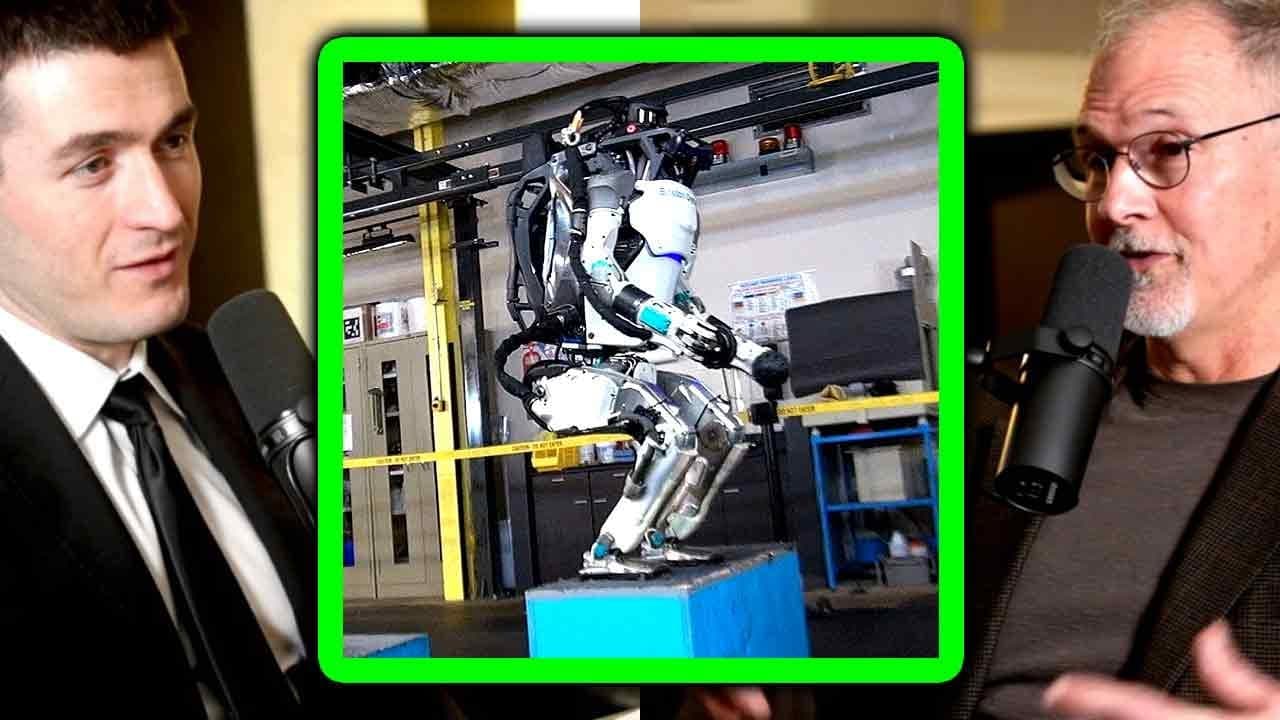
Achieving natural movement in the Atlas humanoid robot took 10 to 15 years, focusing on fine-tuning walking and running dynamics. The development included tackling complex physics and singular configurations, with recent advancements allowing real-time adjustments for jumping and manipulation using model predictive control techniques.
Transcript
well how hard is it to get the humanoid robot Atlas to do some of the things it's recently been doing let's forget the flips and all of that let's just look at the running maybe you can correct me but there's something about running I mean that's not careful at all that's your falling forward you're jumping forward and are falling so how hard is it... Read More
Key Insights
- 🤖 Developing natural-looking walking for humanoid robots is a complex and time-consuming task that requires dealing with challenges such as singular configurations and simplifying physics models.
- 👻 Model predictive control techniques and advancements in computation have significantly aided the development of more natural and robust behaviors in robots like Atlas, allowing them to adjust their motions in real-time based on predictions.
- 😀 Humanoid robots like Atlas face unique challenges due to their large size, weight distribution, and the need for maintaining balance while performing various tasks.
- 👻 Physics-based simulation tools have been crucial in the development of humanoid robots, allowing for efficient testing, modeling of interactions with the environment, and validation of control algorithms.
- 🤖 The ability to simulate and predict foot-ground contact and dexterous manipulation remains an ongoing challenge for further advancing humanoid robot capabilities.
- 🤖 Improving walking and mobility on different terrains, such as sand, is a feasible goal for humanoid robots like Atlas, although specific adaptations and optimization may be required.
- 🤖 The development of humanoid robots like Atlas involves a continuous learning and improvement process, with iterations, breaking, fixing, and redesigning being essential steps in refining robot capabilities.
Install to Summarize YouTube Videos and Get Transcripts
Explore YouTube Video Summarizer or Get YouTube Transcript Extractor
Questions & Answers
Q: How long did it take to develop natural-looking walking for Atlas?
Developing natural-looking walking for Atlas took around 10 to 15 years, with the team facing challenges in achieving the desired motion and ensuring the robot landed on extended legs while walking.
Q: What were some challenges in achieving good walking for Atlas?
The team had to deal with singular configurations, where the leg is fully extended and can't move further in one direction, making it more difficult to calculate torques and positions accurately. Simplifying the complex physics of the human body into a mathematical model also posed challenges.
Q: Why is under actuation a challenge in humanoid locomotion?
Under actuation means that the robot cannot be pushed in any direction at will, as it relies on the mediation of external forces through its feet. This poses a challenge for achieving natural movement, as the robot needs to compensate for the lack of external forces continually.
Q: How does the size and weight of Atlas impact its balance and locomotion abilities?
The large upper body and heavy legs of Atlas make it more challenging to maintain balance and perform tasks involving manipulating objects. The inertia of the upper body and the additional weight of objects carried by the robot increase the complexity of its motions.
Summary & Key Takeaways
-
Developing natural-looking walking for humanoid robot Atlas took around 10 to 15 years, with the team facing difficulties in achieving the desired motion and getting the robot to walk on extended legs.
-
The challenge of designing good walking involved dealing with singular configurations and simplifying the complex physics of the human body into a subsystem that can be described mathematically.
-
Jumping with Atlas has evolved rapidly in recent years, with the development of model predictive control techniques that allow the robot to think ahead and adjust its motion in real-time.
Read in Other Languages (beta)
Share This Summary 📚
Summarize YouTube Videos and Get Video Transcripts with 1-Click
Try YouTube Summary with ChatGPT & Claude or YouTube Transcript Generator
Explore More Summaries from Lex Clips 📚




Summarize YouTube Videos and Get Video Transcripts with 1-Click
Try YouTube Summary with ChatGPT & Claude or YouTube Transcript Generator