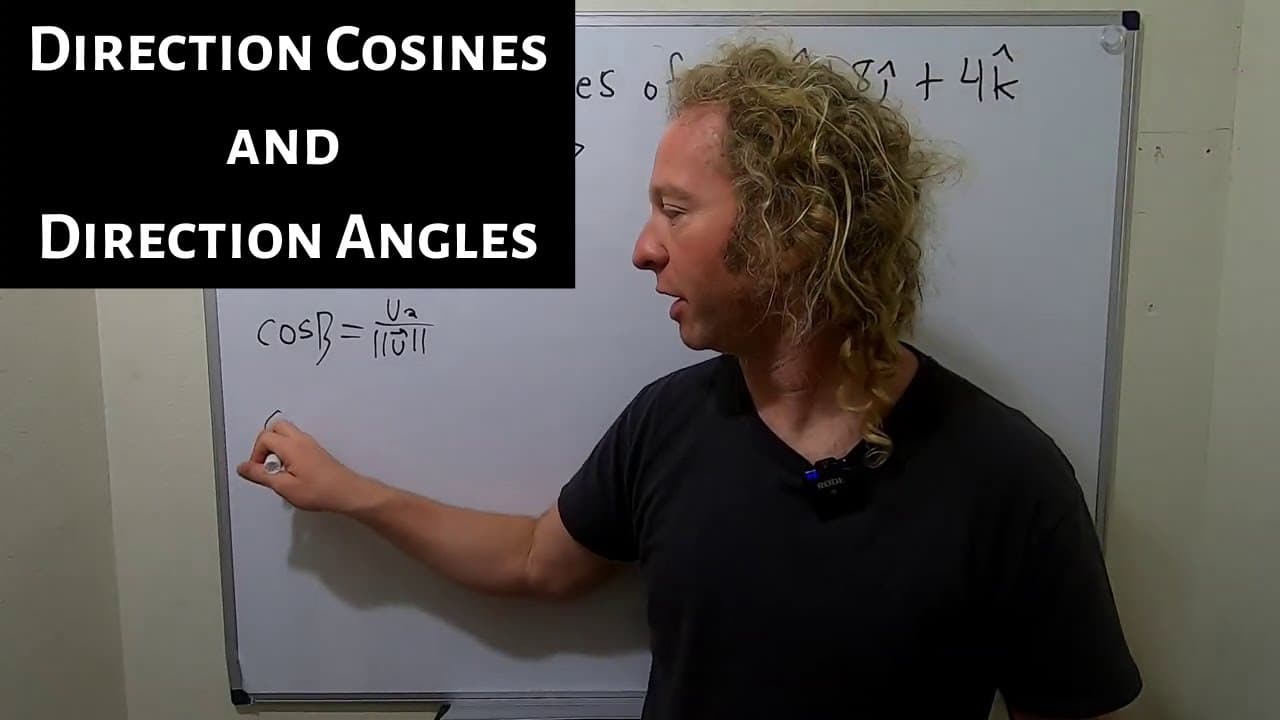
How to Find the Direction Cosines and Direction Angles of a Vector
TL;DR
Learn how to calculate direction cosines by converting vectors to component form and using cosine formulas.
Transcript
hey what's up everyone in this video we're going to find the direction cosines of this vector here you so kind of a strange thing to do direction cosines not something you see in all math classes let's go ahead and do it let me show you how to do this so basically there's a formula so before we use the formula though let's write this in component f... Read More
Key Insights
- 🫡 Direction cosines indicate the orientation of a vector with respect to coordinate axes.
- 💁 Converting vectors to component form simplifies the calculation of direction cosines.
- 🖐️ Magnitudes play a crucial role in determining direction cosines through trigonometric formulas.
- 🔺 Direction angles reveal the orientation of a vector relative to unit vectors in three dimensions.
- 🔺 Inverse cosine functions are used to find direction angles from calculated direction cosines.
- 💁 Direction cosines provide valuable information about the alignment of vectors in mathematical analysis.
- ❓ Understanding direction cosines enhances the interpretation and manipulation of vectors in vector calculus.
Install to Summarize YouTube Videos and Get Transcripts
Explore YouTube Video Summarizer or Get YouTube Transcript Extractor
Questions & Answers
Q: What are direction cosines and why are they important in vector analysis?
Direction cosines represent the cosine of angles between a vector and coordinate axes, aiding in understanding vector direction in three-dimensional space. They are crucial for determining orientation and alignment in mathematical calculations.
Q: How do you convert a vector into component form to calculate direction cosines?
To calculate direction cosines, first express the vector in component form by listing its respective components along the x, y, and z axes. This step simplifies the process of finding direction cosines using trigonometric formulas.
Q: What is the formula for calculating direction cosines, and why are they referred to as direction angles?
The formula involves dividing vector components by the magnitude of the vector to obtain directional cosines. They are called direction angles as they represent the angles between the vector and each unit vector (i, j, k) along the coordinate axes.
Q: How can you determine the direction angles from the calculated direction cosines?
By applying inverse cosine functions to direction cosine values, you can find the direction angles between the vector and the corresponding unit vectors. These angles provide insights into the orientation of the vector in three-dimensional space.
Summary & Key Takeaways
-
Understand the concept of direction cosines and how they relate to vectors.
-
Convert a given vector into component form to calculate direction cosines using cosine formulas.
-
Determine the direction angles between the vector and unit vectors by finding magnitudes and applying inverse cosine calculations.
Read in Other Languages (beta)
Share This Summary 📚
Summarize YouTube Videos and Get Video Transcripts with 1-Click
Try YouTube Summary with ChatGPT & Claude or YouTube Transcript Generator
Explore More Summaries from The Math Sorcerer 📚

Summarize YouTube Videos and Get Video Transcripts with 1-Click
Try YouTube Summary with ChatGPT & Claude or YouTube Transcript Generator