What Is the Solow Model and Its Economic Implications?
TL;DR
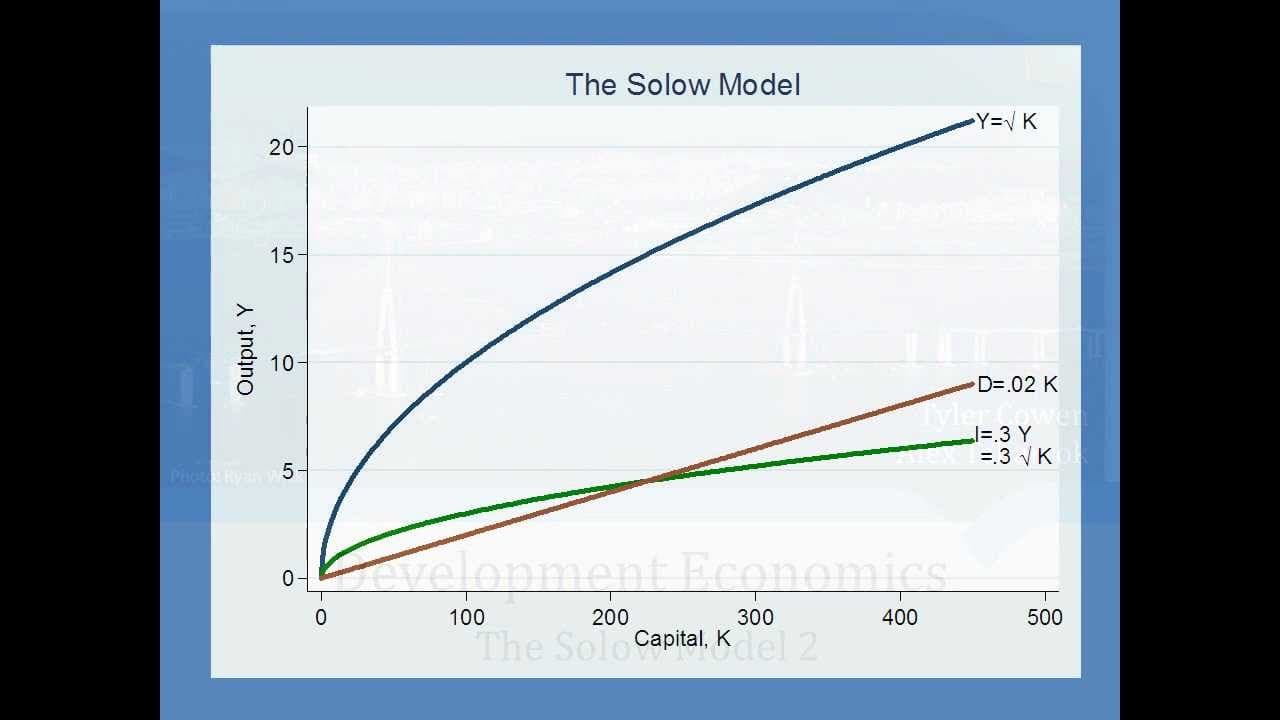
The Solow Model illustrates how changes in savings rates, technology, and population growth affect economic output and growth. By demonstrating that higher savings rates and better ideas lead to greater capital accumulation and GDP per capita, it emphasizes the significance of steady-state investment and the interplay between labor and capital in economic productivity.
Transcript
hi so when our second lecture on the solo model we're going to do some comparative statics we're gonna see what happens when you change the savings rate for example we're also going to add in ideas and population growth and see what happens when you change those factors as well let's get going let's briefly review the solo model so remember that th... Read More
Key Insights
- The Solow Model emphasizes the steady state where investment equals depreciation, indicating no growth or shrinkage in the economy.
- An increase in the savings rate shifts the investment curve upwards, leading to capital accumulation and higher GDP per capita.
- Introducing ideas into the model enhances productivity, resulting in more output for the same capital stock and encouraging further capital accumulation.
- The model can be generalized using the Cobb-Douglas production function, allowing for the inclusion of labor alongside capital in predicting output.
- The production function can be expressed in per worker terms, simplifying the analysis of output and capital on a per capita basis.
- Population growth affects capital per worker, with higher population growth leading to lower GDP per capita in the model.
- The model's predictions are demonstrated through a Mathematica project, showcasing the effects of changing savings rates, technology, and depreciation.
- Future discussions will explore how well the Solow Model explains real-world data and its limitations in predicting economic outcomes.
Install to Summarize YouTube Videos and Get Transcripts
Explore YouTube Video Summarizer or Get YouTube Transcript Extractor
Questions & Answers
Q: What happens when the savings rate increases in the Solow Model?
When the savings rate increases, the investment curve shifts upwards, leading to capital accumulation. This results in a higher capital stock until investment equals depreciation again. Consequently, GDP per capita increases as the economy reaches a new, higher steady state.
Q: How does the Solow Model incorporate ideas or productivity?
The Solow Model incorporates ideas by introducing a productivity factor 'a' in the production function. An increase in 'a' means more output for the same capital stock, enhancing GDP per capita. This encourages further capital accumulation, leading to a new equilibrium with higher productivity and output levels.
Q: What is the significance of the Cobb-Douglas production function in the Solow Model?
The Cobb-Douglas production function generalizes the Solow Model by including both capital and labor as factors of production. It allows for a more realistic representation of output, where doubling capital and labor results in doubled output. This function is crucial for analyzing per capita output and capital dynamics.
Q: How does population growth affect the Solow Model's predictions?
In the Solow Model, population growth affects capital per worker. Higher population growth increases the depreciation rate of capital per worker, leading to a lower GDP per capita. Conversely, lower population growth can result in higher GDP per capita, as capital is more effectively utilized per worker.
Q: What role does the depreciation rate play in the Solow Model?
The depreciation rate, in the Solow Model, determines how quickly capital stock diminishes over time. It includes both physical depreciation of capital and the effects of population growth. A higher depreciation rate reduces capital per worker and GDP per capita, while a lower rate allows for greater capital accumulation.
Q: How does the Solow Model explain economic growth using per worker terms?
By expressing the production function in per worker terms, the Solow Model focuses on output and capital per worker. This approach simplifies the analysis of economic growth, illustrating how changes in savings, productivity, and population growth impact GDP per capita and capital accumulation on an individual basis.
Q: What insights can be derived from the Mathematica project demonstration?
The Mathematica project demonstrates the Solow Model's predictions by adjusting variables like savings rates, technology, and depreciation. It visually shows how these changes affect capital stock and GDP per capita, reinforcing the model's theoretical predictions and providing a practical understanding of economic dynamics.
Q: What future topics will be explored in relation to the Solow Model?
Future discussions will explore the Solow Model's ability to explain real-world data and its limitations. Topics such as why some countries fail to adopt technological advancements and the role of ideas in economic growth will be examined to provide a deeper understanding of the model's applicability and constraints.
Summary & Key Takeaways
-
The Solow Model is analyzed to understand the effects of changing variables such as savings rates, ideas, and population growth on economic outcomes. By examining steady states and capital accumulation, the model predicts changes in GDP per capita and overall economic growth.
-
Incorporating ideas into the Solow Model enhances productivity, leading to increased output from the same capital stock. This encourages further capital accumulation, resulting in a higher GDP per capita and demonstrating the model's utility in understanding economic growth dynamics.
-
The generalized Solow Model using the Cobb-Douglas production function includes labor and capital, allowing for a more comprehensive analysis of output per worker. Population growth is integrated into the model, highlighting its impact on GDP per capita and capital per worker.
Read in Other Languages (beta)
Share This Summary 📚
Summarize YouTube Videos and Get Video Transcripts with 1-Click
Try YouTube Summary with ChatGPT & Claude or YouTube Transcript Generator
Explore More Summaries from Marginal Revolution University 📚

Summarize YouTube Videos and Get Video Transcripts with 1-Click
Try YouTube Summary with ChatGPT & Claude or YouTube Transcript Generator