2020 Conference on Firms, Trade and Development - Ben Olken
TL;DR
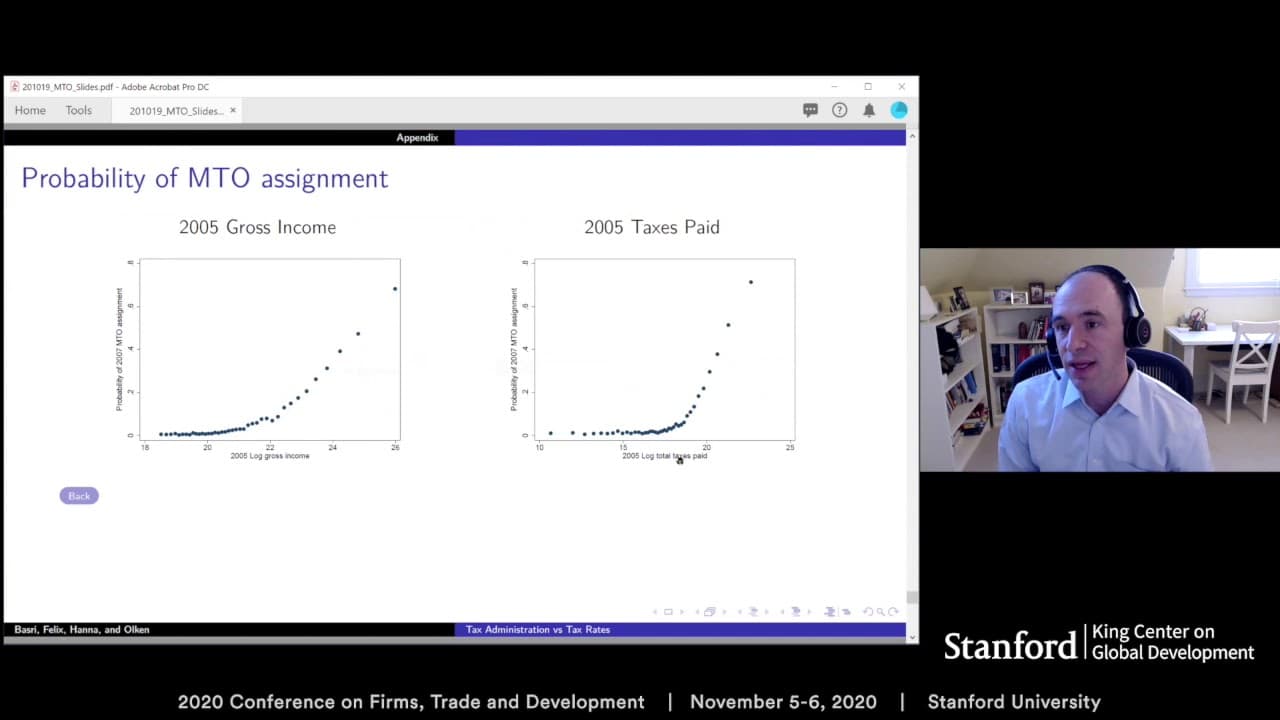
Tax administration reform in Indonesia led to significant increases in tax revenue, driven by higher top-line revenues rather than reduced deductions or improved collections. The reform also resulted in increased formal employment and reduced size-dependent enforcement.
Transcript
thanks chris so our next speaker is uh ben orkin who i think i i see uh right there so um ben just go ahead and share your screen i understand you're fresh from teaching so thanks for joining us yes i just finished teaching like five minutes ago but i think i i should be okay perfect and the the ground rules are you have 50 minutes to present um th... Read More
Key Insights
- 🚕 Tax administration reform in Indonesia led to significant increases in tax revenue, driven by higher top-line revenues rather than reduced deductions or improved collections.
- 🚕 The reform resulted in increased formal employment and reduced size-dependent enforcement, which may have contributed to the increase in tax revenue without significantly distorting firm growth.
Install to Summarize YouTube Videos and Get Transcripts
Explore YouTube Video Summarizer or Get YouTube Transcript Extractor
Questions & Answers
Q: What was the purpose of the tax administration reform in Indonesia?
The reform aimed to address the challenge of low tax revenue in developing economies by improving tax administration for larger corporate taxpayers. The creation of Medium Taxpayer Offices (MTOs) in each tax region allowed for more intensive and less size-dependent enforcement.
Q: What were the key findings of the study?
The study found that the tax administration reform led to substantial increases in tax revenue, driven by higher top-line revenues rather than reduced deductions or improved collections. The reform also resulted in increased formal employment and reduced size-dependent enforcement.
Q: How did the increases in reported gross incomes contribute to the rise in tax revenue?
The study suggests that the increases in reported gross incomes indicate that more business activities were being recorded and reported to the tax authorities. This, in turn, resulted in higher tax payments and overall tax revenue.
Q: What were the implications of the study for tax rates?
The study estimated an elasticity of taxable income of 0.6, suggesting that there is room for Indonesia to increase its corporate income tax rates without reaching the Laffer rate. This implies that tax administration reforms may be more effective than changes in tax rates for increasing tax revenue.
Summary & Key Takeaways
-
Low tax revenue is a challenge for developing economies, and there is uncertainty about whether tax administration reform or changes in tax rates are more effective in raising revenue.
-
A study in Indonesia analyzed the impact of a large-scale tax administration reform on corporate taxation and compared it to a change in tax rates.
-
The reform, which created regional Medium Taxpayer Offices (MTOs), led to substantial increases in tax payments, including VAT, corporate income tax, and withholding taxes.
-
The MTOs also resulted in higher reported gross incomes, increased formal employment, and reduced size-dependent enforcement.
Read in Other Languages (beta)
Share This Summary 📚
Summarize YouTube Videos and Get Video Transcripts with 1-Click
Try YouTube Summary with ChatGPT & Claude or YouTube Transcript Generator
Explore More Summaries from Stanford Institute for Economic Policy Research (SIEPR) 📚






Summarize YouTube Videos and Get Video Transcripts with 1-Click
Try YouTube Summary with ChatGPT & Claude or YouTube Transcript Generator