How Do Autonomous Agents Work in Simulations?
TL;DR
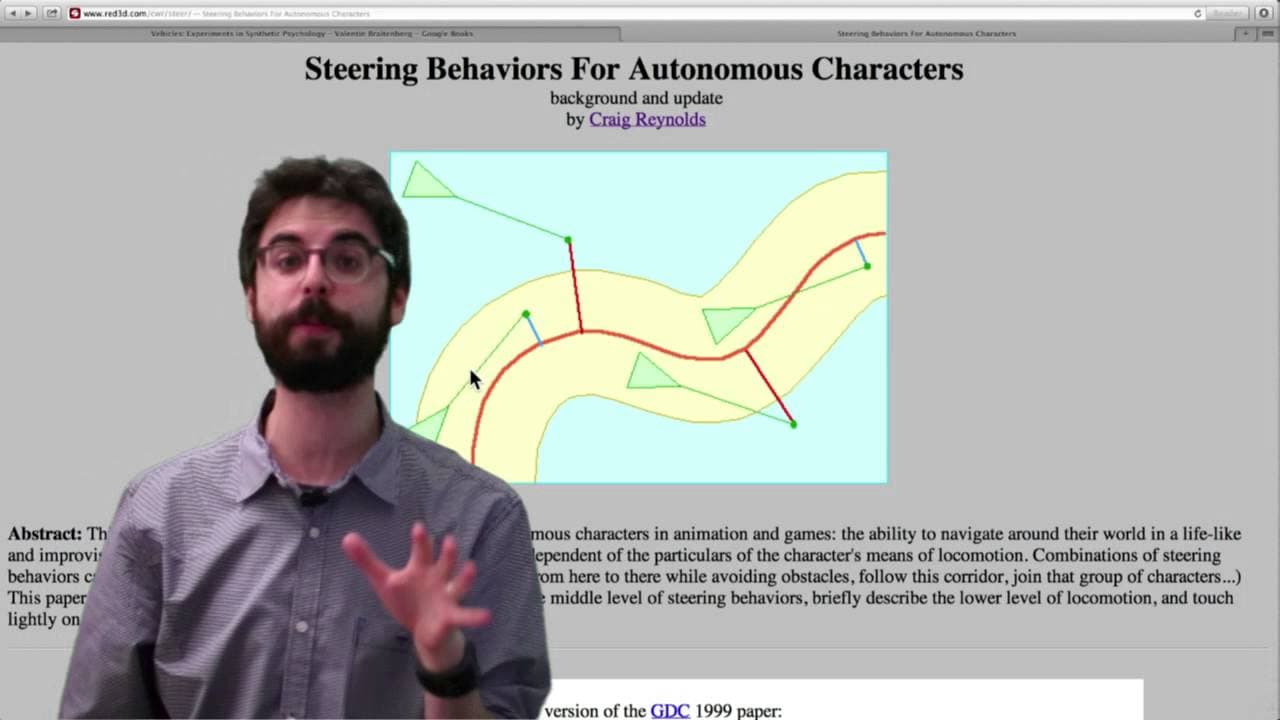
Autonomous agents in simulations operate by perceiving their environment, calculating actions based on their limited perception, and responding without a global leader. They can exhibit complex behaviors like flocking by following simple rules, showcasing how individual interactions can lead to emergent intelligence. This approach is influenced by Craig Reynolds' steering behaviors and inspired by the concept of vehicles from Valentino Braitenberg.
Transcript
okay my glasses on high uh fixing my hair okay edit that part out welcome to another video in the nature of code video series and today I don't have anything in my my pen here it is f2 Holden I feel more come from this way today we are making a huge leap forward so if you actually watched every single video or at least most of them up until now you... Read More
Key Insights
- 💄 Simulations evolve from static objects to entities making decisions.
- ❓ Understanding complex systems from simple agent interactions.
- ⛔ Autonomous agents have limited perception and calculate actions independently.
- 🪛 Steering forces drive agent behaviors in simulations.
- 📏 Flocking simulations demonstrate emergent intelligence from individual rules.
- ❓ Craig Reynolds' steering behaviors model influences autonomous character creation.
- 🚙 Vehicles by Valentin Braytonburg inspires autonomous character concepts.
Install to Summarize YouTube Videos and Get Transcripts
Explore YouTube Video Summarizer or Get YouTube Transcript Extractor
Questions & Answers
Q: How does the transition from inanimate objects to autonomous agents impact simulations?
This transition allows for entities in simulations to make decisions based on perception, leading to more dynamic and lifelike behaviors.
Q: What characterizes complex systems where simple agents generate intelligent behavior?
Simple rules governing individual agents interact to create emergent complexity, as seen in flocking behaviors or ant colonies.
Q: What are the key principles of autonomous agents in simulations?
Autonomous agents have limited perception, calculate actions based on their environment, and operate without a global plan or leader.
Q: How does the concept of action selection, steering, and locomotion apply to autonomous agents?
Autonomous agents select actions based on desires, apply steering forces to navigate, and utilize locomotion methods to move within a simulation.
Summary & Key Takeaways
-
Transition from inanimate objects to autonomous agents in simulations.
-
Exploring the concept of complex systems arising from simple agent interactions.
-
Principles of autonomous agents: limited perception, action calculation, and no global plan.
Read in Other Languages (beta)
Share This Summary 📚
Summarize YouTube Videos and Get Video Transcripts with 1-Click
Try YouTube Summary with ChatGPT & Claude or YouTube Transcript Generator
Explore More Summaries from The Coding Train 📚
Summarize YouTube Videos and Get Video Transcripts with 1-Click
Try YouTube Summary with ChatGPT & Claude or YouTube Transcript Generator