9.4.3 R9. Operating Room Scheduling - Video 2: An Optimization Model
TL;DR
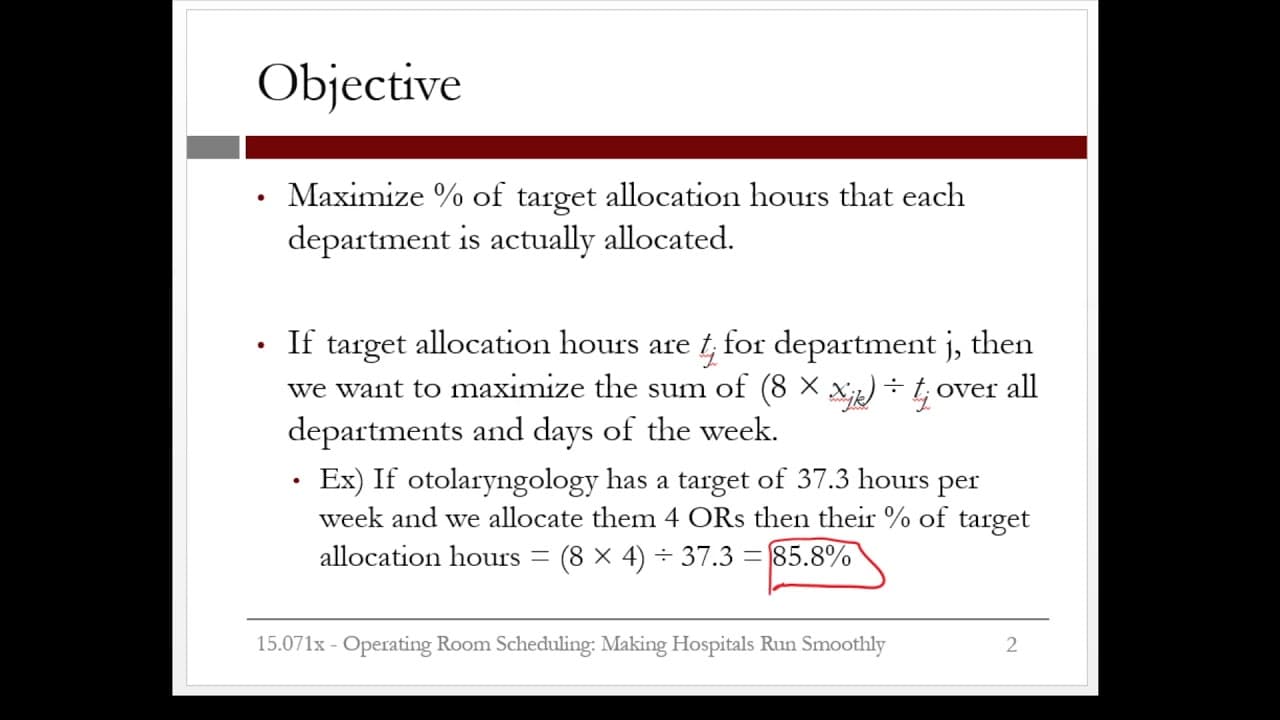
This video discusses the optimization problem of allocating operating rooms to different departments and days in order to maximize the percent of target allocation hours.
Transcript
In this video, we'll design the optimization problem that the operating room manager would need to solve. The decision to be made is how many operating rooms to assign each department on each day. This means that we need to define integer decision variables x_jk. x_jk will represent the number of operating rooms department j is allocated on day k. ... Read More
Key Insights
- 🏬 Objective: Maximize the percentage of target allocation hours for each department.
- 🥳 Decision variables: Integer variables represent the number of operating rooms assigned to a department on a given day.
- 🥳 Constraints include a maximum limit of 10 operating rooms per day and ensuring department minimums and maximums are met.
- ⌛ The percentage of target allocation hours measures how much of the requested hours are being allocated.
- 😒 The problem aims to allocate operating rooms in a way that satisfies department requirements and makes efficient use of resources.
- 🏬 Department weekly minimums and maximums also need to be considered during the optimization process.
- ❓ Mathematical constraints are used to represent the allocation limitations and requirements.
Install to Summarize YouTube Videos and Get Transcripts
Explore YouTube Video Summarizer or Get YouTube Transcript Extractor
Questions & Answers
Q: What are the decision variables in this operating room allocation problem?
The decision variables are represented by x_jk, where j represents the department (e.g., ophthalmology, gynecology) and k represents the day of the week (e.g., Monday, Tuesday). They indicate the number of operating rooms allocated to a department on a given day.
Q: How is the percentage of target allocation hours calculated for a department?
The percentage of target allocation hours for a department is calculated by taking the sum of 8*x_jk divided by t_j, where t_j represents the target allocation hours for that department. It measures how much of the requested hours are being allocated.
Q: What are the constraints related to the number of operating rooms allocated to a department on a given day?
The number of operating rooms allocated to a department on a given day cannot exceed the number of surgery teams available. The constraints ensure that the allocation is within the range of 0 to the number of available teams.
Q: How are department minimums and maximums incorporated into the optimization problem?
The optimization problem includes constraints to meet department daily minimums and maximums. For each department and day of the week, the number of operating rooms allocated must fall within the specified range.
Summary & Key Takeaways
-
The problem involves deciding how many operating rooms each department should be assigned on each day.
-
The objective is to maximize the percentage of target allocation hours that each department receives.
-
Constraints include a maximum limit of 10 operating rooms per day and ensuring department minimums and maximums are met.
Read in Other Languages (beta)
Share This Summary 📚
Summarize YouTube Videos and Get Video Transcripts with 1-Click
Try YouTube Summary with ChatGPT & Claude or YouTube Transcript Generator
Explore More Summaries from MIT OpenCourseWare 📚



Summarize YouTube Videos and Get Video Transcripts with 1-Click
Try YouTube Summary with ChatGPT & Claude or YouTube Transcript Generator