What Are MOSFET Device Models and How Do They Work?
TL;DR
MOSFET device models analyze transistor behavior using small signal and DC analysis, helping to determine performance metrics such as voltage gain and input impedance. Key aspects include the interchangeable roles of gate and drain terminals, the significance of capacitance in simulation, and the structure of the device that influences functionality. Different simulation tools further assist in accurately predicting circuit behavior.
Transcript
hi everyone in this video you are going to learn about Mass device models so when a transistor is to be used in a small signal analysis and as well as a DC analysis we should know what are the different methods are available to analyze the particular transistor like Mass transistor so there are actually a mass device capacitance that are existed an... Read More
Key Insights
- 🛩️ MOSFET transistors can be analyzed via small signal and DC models, which reveal critical performance metrics.
- 🎨 The interchangeable nature of gate and drain terminals in MOS technology simplifies circuit design and enhances flexibility.
- ❓ Device capacitance significantly impacts performance and must be accounted for in simulations and analyses to ensure accuracy.
- 🖐️ Inversion layers within the substrate play a crucial role in MOSFET functionality, influencing the overall device behavior.
- ❓ The structure of MOSFETs includes distinct layers and capacitances, each contributing to the device's electrical characteristics.
- 🌍 Simulation tools are essential for validating design choices and predicting circuit behavior in real-world applications.
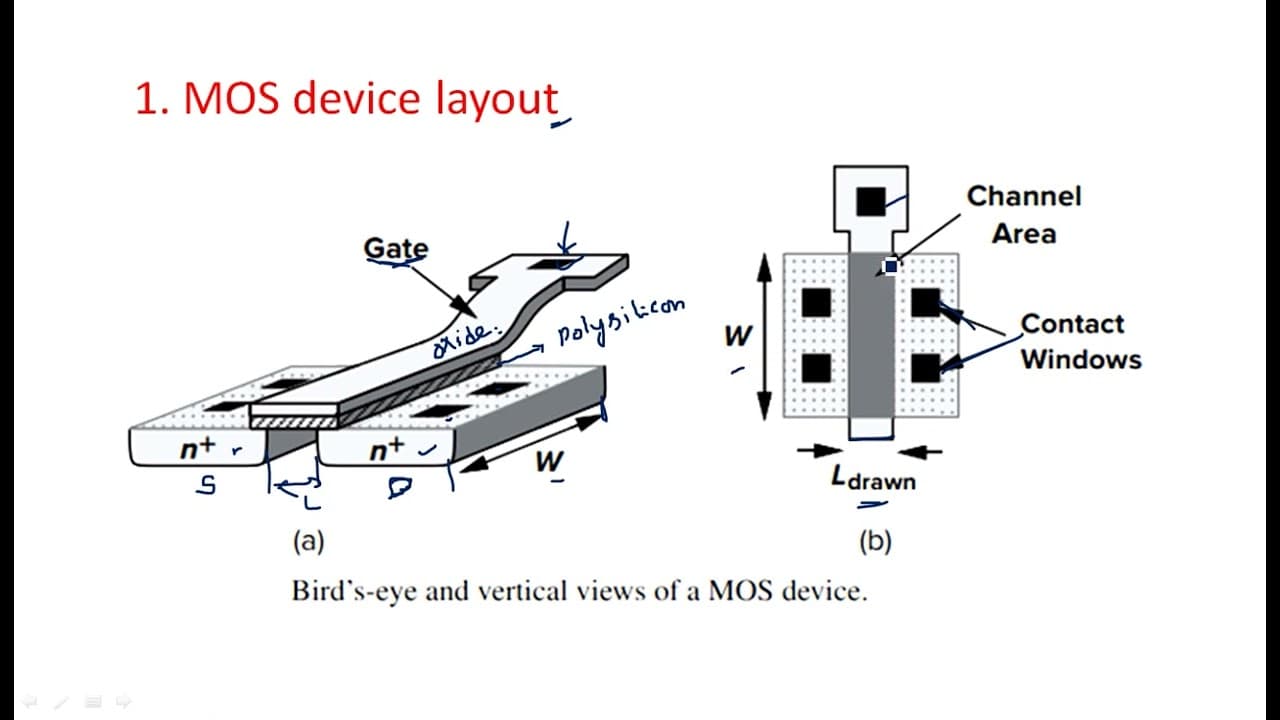
- 🎨 Understanding the internal layout of MOSFETs, including channel width and length, is critical for effective design and analysis.
Install to Summarize YouTube Videos and Get Transcripts
Explore YouTube Video Summarizer or Get YouTube Transcript Extractor
Questions & Answers
Q: What are the primary methods used for analyzing MOSFET transistors?
The primary methods for analyzing MOSFET transistors include small signal analysis and DC analysis. Each method requires an understanding of the device's internal structure and capacitances, as well as its small signal model, which is essential for calculating various operational parameters.
Q: How do NMOS and PMOS transistors differ in performance?
NMOS and PMOS transistors exhibit distinct characteristics primarily due to differences in charge carrier mobility. NMOS transistors generally offer faster switching speeds due to higher electron mobility compared to PMOS, which relies on holes. This affects their application in digital circuits, where NMOS is often preferred for speed.
Q: Why is capacitance important in MOSFET analysis?
Capacitance plays a critical role in MOSFET performance because it influences switching characteristics and speed. Different capacitances, such as gate-source and gate-drain capacitances, affect signal integrity and timing in circuits. Accurate modeling of these capacitances is essential for optimizing device performance.
Q: What simulation tools are available for modeling MOSFET transistors?
Various simulation tools for modeling MOSFET transistors include Xilinx, Cadence, Synopsys, and Microwave tools. These software platforms allow engineers to analyze and simulate the performance of MOSFET circuits, facilitating design optimization and performance prediction under different operating conditions.
Summary & Key Takeaways
-
The video focuses on MOSFET transistor analysis, covering various methods for small signal and DC analysis, including the significance of device capacitance.
-
It introduces the structure of MOSFET transistors, detailing the roles of gate, source, and drain, along with their interchangeable nature in MOS technology.
-
Different simulation tools for analyzing MOSFET characteristics are highlighted, along with the importance of small signal models in calculating parameters like voltage gain and impedance.
Read in Other Languages (beta)
Share This Summary 📚
Summarize YouTube Videos and Get Video Transcripts with 1-Click
Try YouTube Summary with ChatGPT & Claude or YouTube Transcript Generator