What Is the Napkin Ring Problem in Geometry?
TL;DR
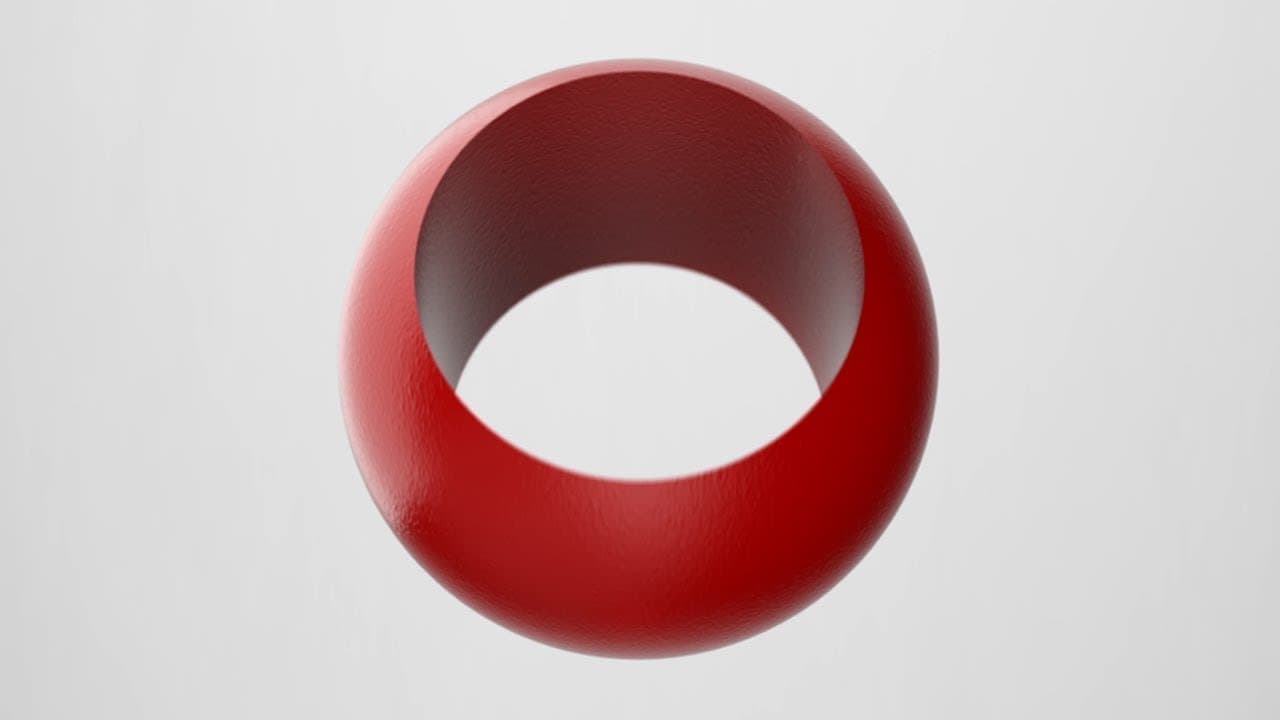
Napkin rings derived from different-sized spheres can have identical volumes as long as they share the same height. This counterintuitive phenomenon is explained by Cavalieri's principle, which states that solids with equal cross-sectional areas at any level must also have the same volume, regardless of their shapes.
Transcript
Hey, Vsauce! Michael here! If you core a sphere; that is, remove a cylinder from it, you'll be left with a shape called a Napkin ring because, well, it looks like a napkin ring! It's a bizarre shape because if two Napkin rings have the same height, well they'll have the same volume regardless of the size of the spheres they came from! (Cool) This m... Read More
Key Insights
- 😋 Removing a cylindrical hole from a sphere creates a napkin ring shape with the same volume.
- 🔇 Cavalieri's principle states that solids with equal areas of intersection have the same volume.
- 🟰 The cross-sectional areas of napkin rings, when cut from spheres, are always equal, leading to their equal volumes.
- 😋 An understanding of the napkin ring problem and Cavalieri's principle has practical applications in various fields.
- 😋 The math behind calculating the areas of napkin rings involves using the Pythagorean theorem and the given dimensions of the sphere and cylinder.
- 🔇 The concept of equal volumes in different-shaped objects challenges common intuitions about geometry.
- 😋 The napkin ring problem emphasizes the importance of considering cross-sectional areas in determining volumes.
Install to Summarize YouTube Videos and Get Transcripts
Explore YouTube Video Summarizer or Get YouTube Transcript Extractor
Questions & Answers
Q: Why do napkin rings of different sizes have the same volume?
Napkin rings have the same volume because the cross-sectional areas of the rings, when cut from spheres, are always equal due to Cavalieri's principle. The height may differ, but their volumes are identical.
Q: How is Cavalieri's principle applied to napkin rings?
Cavalieri's principle is applied by comparing the cross-sectional areas of napkin rings, which are the regions between the sphere's and cylinder's cross-sectional areas. Regardless of where the rings are cut, their cross-sectional areas are always equal, proving their equal volumes.
Q: Can you explain the math behind calculating the areas of the napkin rings?
The areas of the napkin rings can be calculated by subtracting the area of the cylinder's cross-section from the area of the sphere's cross-section. The radii of the cross-sections are determined using the Pythagorean theorem and the given height and radius of the sphere.
Q: What are the practical implications of the napkin ring problem?
The napkin ring problem demonstrates the counterintuitive nature of geometry, where objects with different shapes can have the same volume. This concept has applications in various fields, such as engineering and architecture, where equal volumes can be achieved with different geometries.
Summary & Key Takeaways
-
Cutting a cylindrical hole out of a sphere creates a napkin ring shape, which is strange because napkin rings of different sizes have the same volume.
-
This is due to Cavalieri's principle, which states that if two solids have equal areas of intersection with any plane, they have the same volume.
-
By applying Cavalieri's principle to napkin rings, it can be shown that even though their cross-sectional areas differ, their volumes are the same.
Read in Other Languages (beta)
Share This Summary 📚
Summarize YouTube Videos and Get Video Transcripts with 1-Click
Try YouTube Summary with ChatGPT & Claude or YouTube Transcript Generator
Explore More Summaries from Vsauce 📚

Summarize YouTube Videos and Get Video Transcripts with 1-Click
Try YouTube Summary with ChatGPT & Claude or YouTube Transcript Generator