L12.10 Interpreting the Correlation Coefficient
TL;DR
Correlation coefficients measure the association between two variables, but they do not imply causation.
Transcript
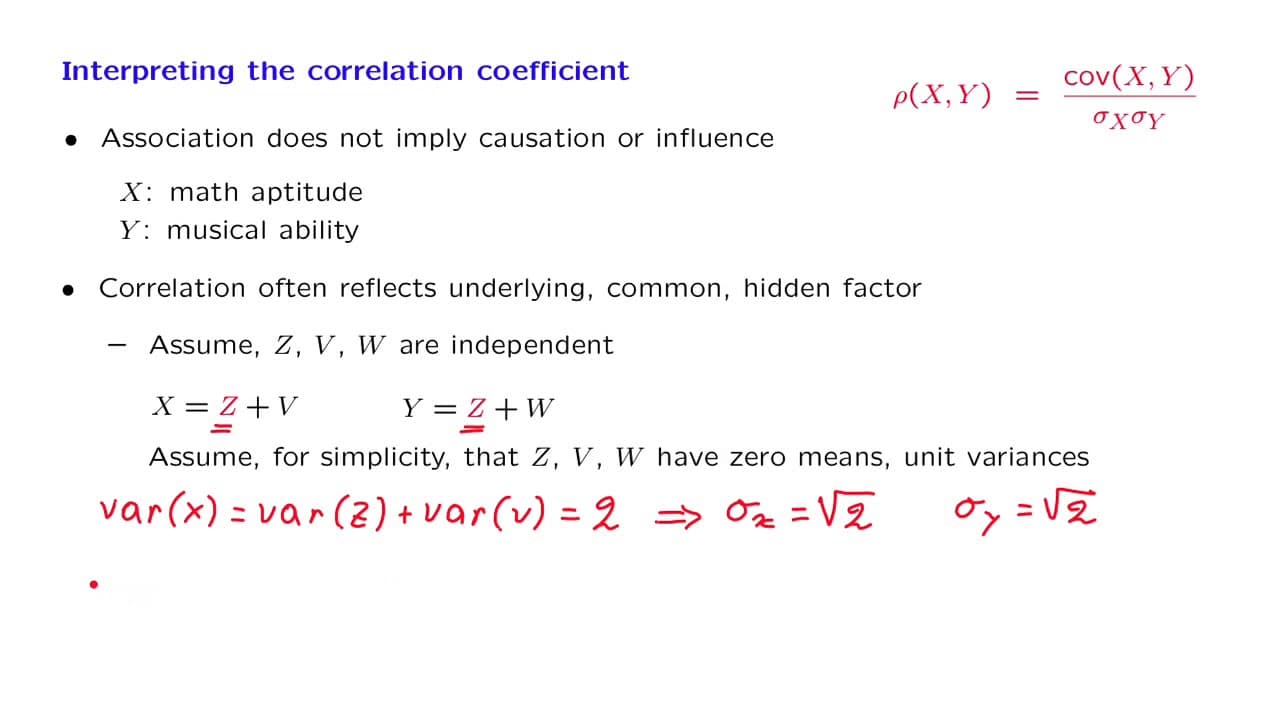
The mathematics of the correlation coefficient are important. But it is perhaps more important to be able to interpret it correctly. A correlation coefficient of let's say 0.5, tells us that something interesting is going on as far as the relation of X and Y is concerned. But what exactly? It tells us that the two random variables are associated in... Read More
Key Insights
- 📶 Correlation coefficients indicate the strength and direction of the association between two variables.
- ❓ Correlation does not imply causation, and it is important to differentiate between the two.
- 🥺 Common underlying factors can lead to significant correlation coefficients without implying causation.
- ❓ The interpretation of correlation coefficients requires careful consideration and should not be mistaken for causality.
- 📶 Variance in other variables can impact the strength of a correlation coefficient.
- 🤩 Independent random variables and their expected values play a key role in calculating correlation coefficients.
- ❓ Standard deviations and covariances are also crucial in determining correlation coefficients.
Install to Summarize YouTube Videos and Get Transcripts
Explore YouTube Video Summarizer or Get YouTube Transcript Extractor
Questions & Answers
Q: What does a correlation coefficient of 0.5 indicate?
A correlation coefficient of 0.5 suggests a strong association between two variables. However, it does not imply a causal relationship. Rather, it suggests that there is an underlying factor affecting both variables.
Q: Can a large correlation coefficient indicate causation between variables?
No, a large correlation coefficient does not indicate causation. Correlation measures the degree of association, but it does not establish causality. Other factors may be at play, and further research is needed to determine causation.
Q: How can correlation coefficients be misinterpreted?
Correlation coefficients are often mistakenly seen as implying causation. People assume that a strong correlation means one variable directly affects the other, but this is not always the case. Correlation simply measures the relationship between variables.
Q: How can a correlation arise without causation?
Correlation can arise when two variables share a common underlying factor. For example, math aptitude and musical ability may be correlated because a certain feature of the human brain impacts both skills. However, this does not mean one skill directly causes the other.
Summary & Key Takeaways
-
Correlation coefficients provide insight into the relationship between two random variables, but they do not indicate a causal relationship.
-
A correlation coefficient of 0.5 suggests a significant association between two variables, but it does not mean one variable causes the other.
-
Examples of math aptitude and musical ability demonstrate how a correlation may arise from a common underlying factor that affects both variables.
Read in Other Languages (beta)
Share This Summary 📚
Summarize YouTube Videos and Get Video Transcripts with 1-Click
Try YouTube Summary with ChatGPT & Claude or YouTube Transcript Generator
Explore More Summaries from MIT OpenCourseWare 📚



Summarize YouTube Videos and Get Video Transcripts with 1-Click
Try YouTube Summary with ChatGPT & Claude or YouTube Transcript Generator