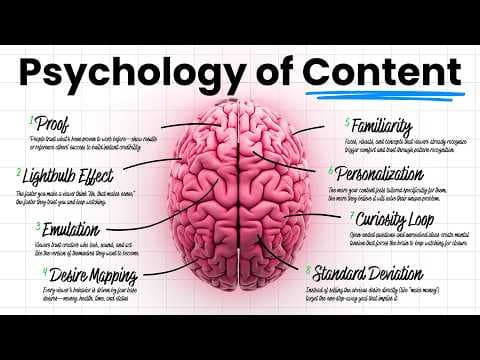
How to use psychology to hack viewers brains (& make more money)

TL;DR
Understanding fear as a motivator enhances content effectiveness.
Transcript
the best way to grow any business is better content it's a cheat code and the only thing holding you back from making better content is understanding the psychology of how viewers act online so I'm going to break down that psychology show you a bunch of different examples and then show you the Tactical changes that you should make to your content t... Read More
Key Insights
- Understanding viewer psychology is crucial for creating impactful content that drives business growth by leveraging emotional triggers.
- Fear, particularly the fear of missing out, is a powerful motivator that can drive viewers to take action, including making purchases.
- Using relatable examples helps subtly trigger fear without explicitly stating it, maintaining trust while influencing behavior.
- Content should quickly establish fear and then demonstrate how the product or service alleviates that fear to keep viewer engagement.
- The balance between fear and trust is essential; overt fear tactics can erode trust and reduce the effectiveness of content.
- Short-form content requires a more explicit approach to establishing fear due to time constraints, while long-form content allows for more nuanced storytelling.
- Curiosity loops can effectively engage viewers by embedding fear into content subtly, making them want to learn more.
- Conversion-focused content should prioritize actions like purchases over views, tailoring messaging to drive monetary results.
Install to Summarize YouTube Videos and Get Transcripts
Explore YouTube Video Summarizer or Get YouTube Transcript Extractor
Questions & Answers
Q: How does fear influence viewer behavior in content marketing?
Fear, especially the fear of missing out, is a strong motivator in content marketing. It compels viewers to take actions like making purchases by tapping into their subconscious concerns about missing opportunities or facing negative outcomes. This emotional trigger can be more effective than simply highlighting product features.
Q: Why is trust important when using fear in content?
Trust is crucial because overt fear tactics can erode the viewer's trust in the brand or content creator. Without trust, the audience may become skeptical and resist taking the desired action. Balancing fear with trust ensures that the audience feels compelled to act without feeling manipulated.
Q: What role do curiosity loops play in content marketing?
Curiosity loops engage viewers by embedding fear into content subtly. They create an initial intrigue that makes viewers want to learn more, allowing the fear to work on a subconscious level. This approach maintains viewer interest without overt fear tactics that could damage trust.
Q: How should short-form content handle the fear factor?
Short-form content requires a more explicit approach to establishing fear due to its time constraints. The content must quickly establish the fear and demonstrate the solution to keep viewers engaged. This explicitness helps in delivering the message effectively within a limited timeframe.
Q: What is the significance of conversion-focused content?
Conversion-focused content prioritizes actions like purchases over views. The goal is to drive monetary results by tailoring messaging to elicit specific actions from the audience. This approach ensures that content not only reaches a broad audience but also effectively converts viewers into customers.
Q: How can content creators balance fear and trust?
Content creators can balance fear and trust by using relatable examples to subtly trigger fear without explicitly stating it. Maintaining trust involves ensuring that the audience does not feel manipulated, which can be achieved by presenting fear in a way that resonates with the viewer's experiences and concerns.
Q: What is the framework for using fear in content marketing?
The framework involves identifying the target audience, understanding their fears, subtly messaging those fears, teasing the solution early, amplifying the fear at the right moment, and demonstrating how the product or service alleviates that fear. This structured approach ensures effective engagement and conversion.
Q: Why is it important to demonstrate value early in content?
Demonstrating value early in content is important to keep viewers engaged. If the content only focuses on fear without showing the solution, viewers might lose interest or feel overwhelmed. By presenting the solution early, viewers are more likely to stay engaged and consider taking the desired action.
Summary & Key Takeaways
-
The video explores how understanding viewer psychology, particularly the role of fear, can enhance content effectiveness and drive business growth. It emphasizes using fear as a motivator while maintaining trust.
-
Relatable examples and curiosity loops are recommended to subtly trigger fear, encouraging viewers to take actions such as making purchases. The balance between fear and trust is crucial for content success.
-
Short-form content requires a more explicit approach due to time constraints, while long-form content allows for nuanced storytelling. The focus is on conversion, prioritizing actions over views for business impact.
Read in Other Languages (beta)
Share This Summary 📚
Summarize YouTube Videos and Get Video Transcripts with 1-Click
Try YouTube Summary with ChatGPT & Claude or YouTube Transcript Generator
Explore More Summaries from Kallaway 📚





Summarize YouTube Videos and Get Video Transcripts with 1-Click
Try YouTube Summary with ChatGPT & Claude or YouTube Transcript Generator