How to Use Moving Averages in Stock Trading
TL;DR
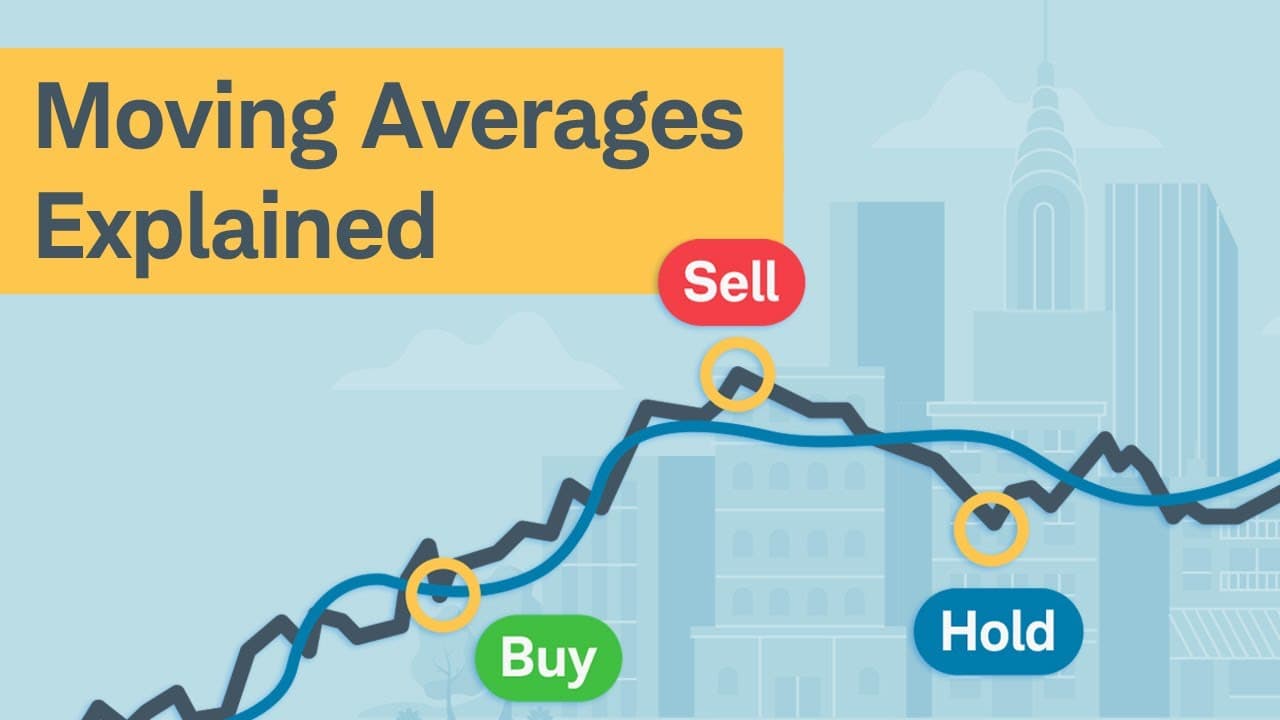
Moving averages help traders identify trends and potential buy or sell signals by smoothing out price fluctuations over a selected time frame. Short-term averages can indicate quick changes in trends, while longer-term averages provide a more stable view. Although moving averages do not predict future performance, they are useful tools in technical analysis for making informed trading decisions.
Transcript
Technical analysts often say the trend is your friend because they think a security that’s going up is more likely to keep going up and a security that’s going down is more likely to keep going down. Having a clear view of the trend can help an investor decide whether to buy, sell, or hold a position. However, sometimes determining the trend can be... Read More
Key Insights
- 📈 Simple moving averages help determine trends and buy/sell signals.
- 🍉 Different time frames (e.g., short-term, intermediate-term, long-term) offer varying levels of smoothness and frequency of signals.
- ❓ Lag is a significant drawback of simple moving averages.
- 🏋️ Weighted moving averages or exponential moving averages can help minimize lag and provide quicker responses to price changes.
- 📈 Moving averages do not predict future performance but confirm established trends.
- 📈 Simple moving averages are used in technical analysis to assess market trends and make informed investment decisions.
- 🍉 They are particularly useful for active traders who engage in short-term trades.
Install to Summarize YouTube Videos and Get Transcripts
Explore YouTube Video Summarizer or Get YouTube Transcript Extractor
Questions & Answers
Q: What is a simple moving average?
A simple moving average is a technical indicator that tracks a security's price over a specific time period and plots it on a line, helping to identify the overall trend.
Q: How can an investor create a simple moving average chart?
Choose a time frame (e.g., 20 days), calculate the average price for each day within that period, and plot the results on a chart. Continuously update the moving average by dropping the oldest price and adding the latest price.
Q: How can moving averages help investors decide when to buy or sell a stock?
Moving averages can act as support or resistance levels. When the price breaks above an upwardly sloping moving average, it may be a good time to buy. Conversely, a bounce off the moving average could signal a sell opportunity.
Q: What are the drawbacks of using simple moving averages?
The main drawback is lag, as simple moving averages are slow to reflect price changes. Additionally, they can generate false signals called whipsaws, where the stock initially gives one signal but then quickly reverses.
Summary & Key Takeaways
-
Technical analysts use the concept of simple moving averages to determine trends and make investment decisions.
-
A simple moving average smooths out price fluctuations and provides a general idea of the trend's direction.
-
By examining a security's moving average in relation to its current price, investors can identify potential buy and sell signals.
Read in Other Languages (beta)
Share This Summary 📚
Summarize YouTube Videos and Get Video Transcripts with 1-Click
Try YouTube Summary with ChatGPT & Claude or YouTube Transcript Generator
Explore More Summaries from Charles Schwab 📚






Summarize YouTube Videos and Get Video Transcripts with 1-Click
Try YouTube Summary with ChatGPT & Claude or YouTube Transcript Generator