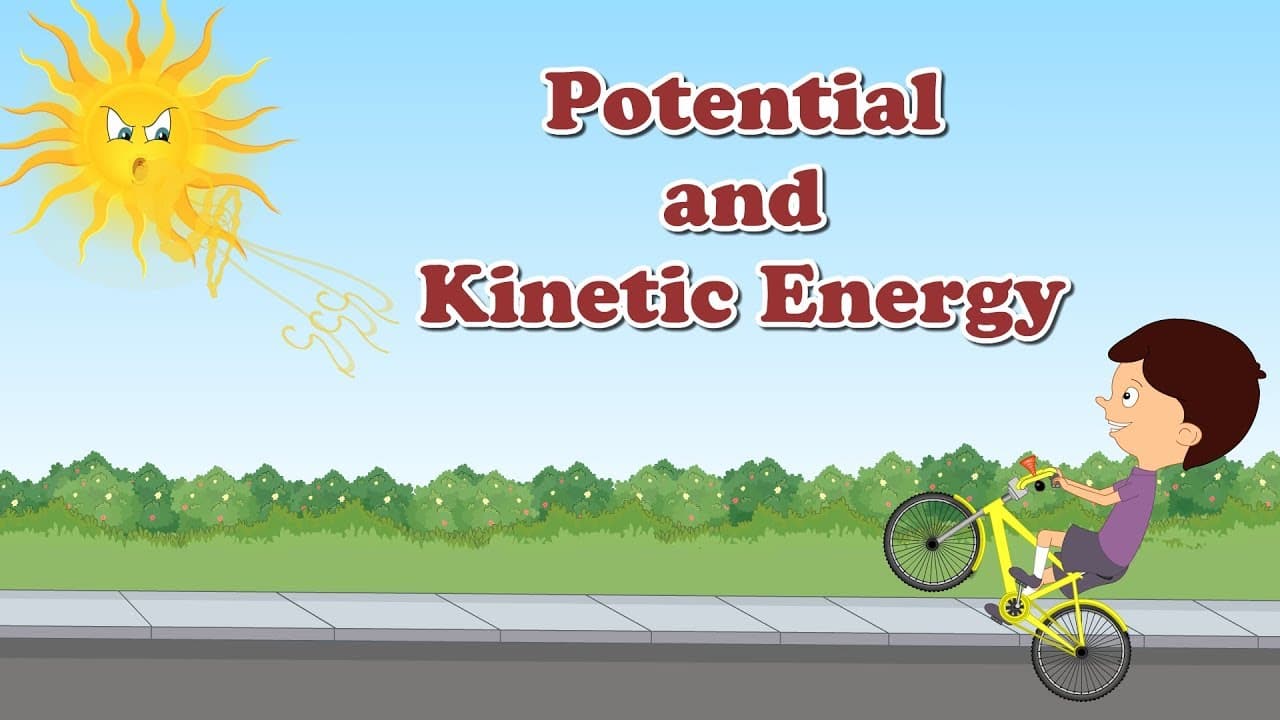
Potential and Kinetic Energy | #aumsum #kids #science #education #children
TL;DR
Energy conversion explained through potential and kinetic energy with real-life examples.
Transcript
Potential and Kinetic Energy. The law of conservation of energy. Energy cannot be created. Energy cannot be destroyed. It can only be converted from one form to another. Conversion of Energy. Solar Energy. Electrical Energy. Mechanical Energy. Potential Energy. Energy due to position. Potential Energy. Kinetic Energy. due to motion. The unit of ene... Read More
Key Insights
- 👮 Energy is conserved in conversions, from potential to kinetic and vice versa, showcasing the law of conservation of energy.
- 🧘 Potential energy is stored energy due to an object's position, while kinetic energy is the energy of motion.
- ❓ Calculating energy involves understanding formulas like PE = mgh for potential energy and KE = 0.5mv^2 for kinetic energy.
- 😪 Real-life examples, like a swinging tire or falling object, demonstrate the conversion of potential to kinetic energy.
- 🦾 Understanding energy conversion helps in designing efficient systems utilizing different forms like solar, electrical, or mechanical energy.
- 🇦🇪 Energy units like joules measure the amount of potential and kinetic energy in objects and systems.
- 💆 Knowing the relationship between mass, height, velocity, and gravity is crucial in energy calculations and conversions.
Install to Summarize YouTube Videos and Get Transcripts
Explore YouTube Video Summarizer or Get YouTube Transcript Extractor
Questions & Answers
Q: What is potential energy and how is it converted to kinetic energy?
Potential energy is energy stored in an object's position. When released, it converts to kinetic energy, energy of motion, as the object moves.
Q: How is the law of conservation of energy demonstrated in energy conversion?
The law states that energy is constant. In energy conversion, potential energy decreases as kinetic energy increases, maintaining the total energy.
Q: What is the formula for calculating potential energy?
The formula for potential energy is PE = mgh, where m is mass, g is gravity, and h is height, measured in joules.
Q: How is kinetic energy calculated and what factors affect it?
Kinetic energy is calculated as KE = 0.5mv^2, where m is mass and v is velocity squared. Factors affecting it are mass and velocity.
Summary & Key Takeaways
-
Energy cannot be created or destroyed, only converted between forms like potential and kinetic energy.
-
Potential energy is stored energy due to position, while kinetic energy is energy in motion.
-
The law of conservation of energy states that energy is constant and can be converted but not lost.
Read in Other Languages (beta)
Share This Summary 📚
Summarize YouTube Videos and Get Video Transcripts with 1-Click
Try YouTube Summary with ChatGPT & Claude or YouTube Transcript Generator
Explore More Summaries from It's AumSum Time 📚





Summarize YouTube Videos and Get Video Transcripts with 1-Click
Try YouTube Summary with ChatGPT & Claude or YouTube Transcript Generator