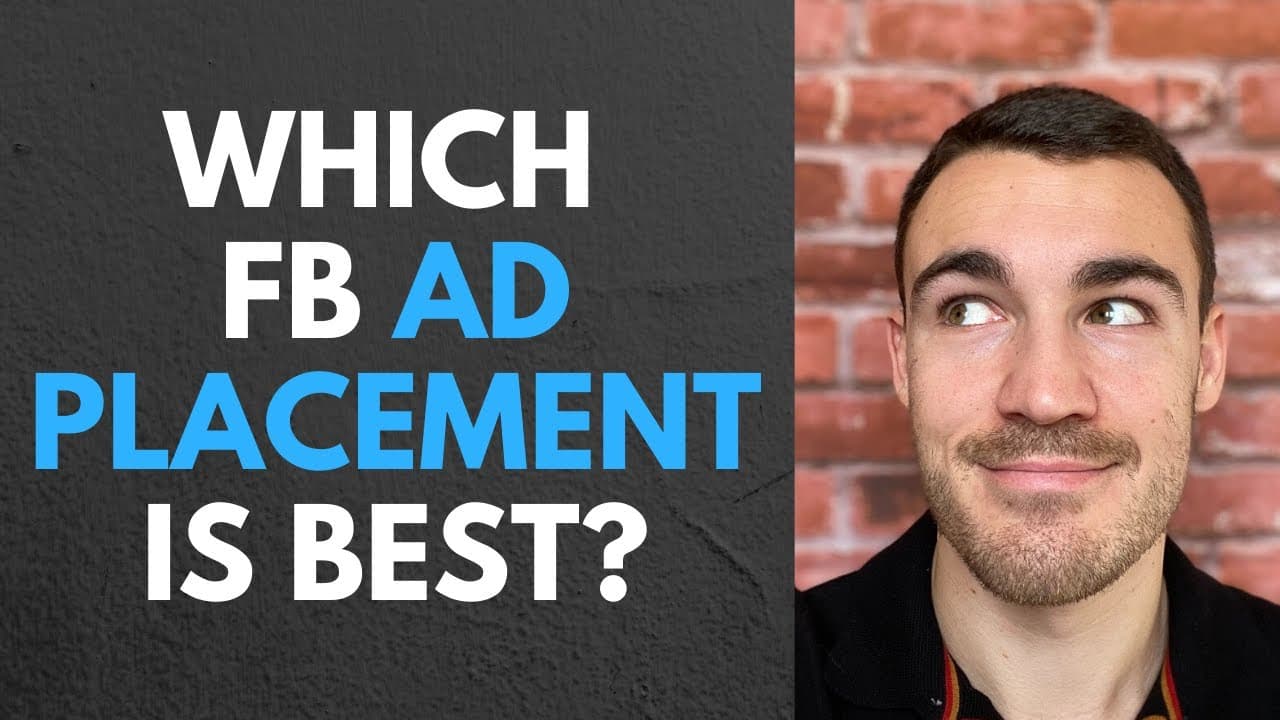
Which Facebook Ads Placement Delivers the Best Results?
TL;DR
Automatic placements are best for conversions; edit for traffic.
Transcript
hi guys it's been Heath Romney group and in this video I'm going to quickly talk about Facebook ad placements is something I got asked about quite a lot is which placement should I use which placements produce the best result so I'm gonna go through and the options here I've brought up an example campaign of ours and gone into one of the ad set so ... Read More
Key Insights
- Automatic placements are recommended for conversion or lead generation objectives because Facebook optimizes ad delivery to achieve these goals.
- For traffic objectives, editing placements is advised to avoid low-quality clicks from less effective placements like instant articles.
- The most effective placements for high-quality engagement are Facebook and Instagram feeds, as they tend to drive more meaningful interactions.
- Messenger ads may be considered based on business needs, but generally have limited delivery impact compared to feeds.
- Analyzing breakdown data is crucial to identify which placements deliver results and exclude underperforming ones.
- Businesses related to fashion often perform better on Instagram, while others may see more success on Facebook.
- Automatic placements often result in 95% of impressions from Facebook and Instagram feeds, highlighting their effectiveness.
- A free five-part Facebook ad template is available for download, providing insights into successful ad components and performance.
Install to Summarize YouTube Videos and Get Transcripts
Explore YouTube Video Summarizer or Get YouTube Transcript Extractor
Questions & Answers
Q: Why are automatic placements recommended for conversion campaigns?
Automatic placements are recommended for conversion campaigns because Facebook optimizes ad delivery to achieve the desired outcomes, such as conversions or lead generation. By allowing Facebook to choose the placements, the platform ensures that ads are shown in locations that are most likely to drive the desired actions, enhancing campaign effectiveness.
Q: What should be done for traffic objectives regarding placements?
For traffic objectives, it is advisable to edit placements rather than relying on automatic ones. This approach helps avoid low-quality clicks from less effective placements like instant articles. By selecting specific placements, advertisers can ensure that their ads reach audiences more likely to engage meaningfully, improving campaign outcomes.
Q: Which ad placements are considered most effective?
The most effective ad placements are the Facebook and Instagram feeds. These placements tend to drive more meaningful interactions and higher-quality engagement compared to others. Businesses often find that the majority of their impressions come from these feeds, highlighting their importance in achieving successful ad campaign results.
Q: How can businesses identify and exclude underperforming placements?
Businesses can identify and exclude underperforming placements by analyzing breakdown data. This data provides insights into which placements deliver results and which do not. By examining this information, advertisers can make informed decisions about which placements to exclude, ensuring that their ads are shown in more effective locations.
Q: Why might fashion businesses prefer Instagram over Facebook?
Fashion businesses might prefer Instagram over Facebook because Instagram's platform is visually oriented and aligns well with the fashion industry's aesthetic nature. Instagram's audience is often more engaged with fashion content, making it a more effective channel for fashion brands to reach their target audience and achieve better engagement and conversion rates.
Q: What is the impact of Messenger ads compared to feeds?
Messenger ads generally have a limited impact compared to feeds. While they can be considered based on specific business needs, their delivery is often not as extensive or impactful as ads placed in Facebook and Instagram feeds. Consequently, advertisers typically prioritize feeds for more significant engagement and conversion opportunities.
Q: What is included in the free five-part Facebook ad template?
The free five-part Facebook ad template includes examples of successful ads from various clients. It breaks down each ad into its component parts, explaining why specific elements were included and how they contributed to the ad's performance. This resource provides valuable insights into creating effective Facebook ads, helping advertisers improve their campaigns.
Q: How do automatic placements affect impression distribution?
Automatic placements often result in the majority of impressions coming from Facebook and Instagram feeds. This distribution occurs because these placements are generally the most effective at driving meaningful engagement and conversions. By using automatic placements, advertisers can leverage Facebook's optimization to ensure their ads are shown in the best-performing locations.
Summary & Key Takeaways
-
Automatic placements are ideal for conversion-focused campaigns as Facebook optimizes ad delivery to achieve desired outcomes. For traffic objectives, it's better to edit placements to avoid low-quality clicks. The most effective placements are Facebook and Instagram feeds, which drive more meaningful interactions.
-
Editing placements for traffic objectives helps avoid ineffective clicks from sources like instant articles. Analyzing breakdown data is essential to identify and exclude underperforming placements. Fashion businesses often perform better on Instagram, while others may find more success on Facebook.
-
Automatic placements often result in the majority of impressions from Facebook and Instagram feeds, underscoring their effectiveness. A free five-part Facebook ad template is available, offering insights into successful ad components and performance. Messenger ads have limited impact compared to feeds.
Read in Other Languages (beta)
Share This Summary 📚
Summarize YouTube Videos and Get Video Transcripts with 1-Click
Try YouTube Summary with ChatGPT & Claude or YouTube Transcript Generator
Explore More Summaries from Ben Heath 📚
Summarize YouTube Videos and Get Video Transcripts with 1-Click
Try YouTube Summary with ChatGPT & Claude or YouTube Transcript Generator