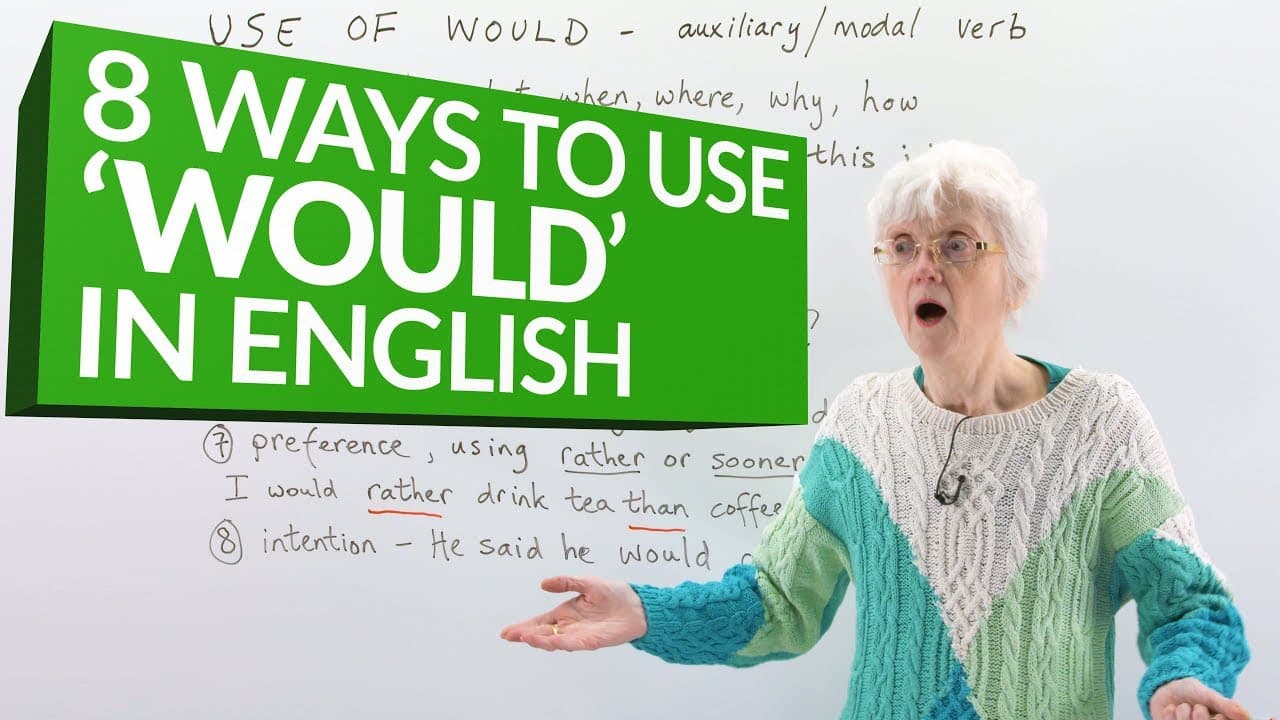
Learn English Grammar: How to use the auxiliary verb 'WOULD'
TL;DR
Learn how to use "would" in various contexts to express hypothetical situations, preferences, intentions, and more.
Transcript
Hello. I'm Gill at engVid, and today's lesson is about the verb: "would" and how to use it. So, it's an auxiliary modal verb, okay? This lesson also links with two other lessons; one on "could" and the other on "should". So, if you haven't already seen those, do look out for them. So, what we have, we have eight different examples of how the word "... Read More
Key Insights
- 🍝 "Would" is versatile, being utilized in questions, requests, hypothetical scenarios, regular past actions, preferences, and intentions.
- 🙊 Contractions like "would've" are informal spoken forms of "would have," while "would of" is grammatically incorrect and should be avoided.
Install to Summarize YouTube Videos and Get Transcripts
Explore YouTube Video Summarizer or Get YouTube Transcript Extractor
Questions & Answers
Q: How is "would" used in questions and polite requests?
"Would" is used to ask questions politely, such as "Would you like some tea?" It is a way of offering or suggesting something in a courteous manner.
Q: What does "would" indicate in hypothetical situations?
In hypothetical scenarios, "would" is used to imagine or speculate about possible future outcomes, such as "I would give some money to charity if I won the lottery."
Q: How is "would" utilized in regular past actions?
When describing regular past actions, "would" is employed to indicate something that used to happen frequently, like "My neighbor's dog would howl every afternoon."
Q: Can you explain the use of "would" in expressing preferences and intentions?
"Would" is used to show preferences, as in "I would rather drink tea than coffee." It also denotes intentions or promises, like "He said he would clean the kitchen."
Summary & Key Takeaways
-
"Would" is an auxiliary modal verb used in questions, polite requests, imaginings, and hypothetical situations.
-
It is also used in regular past actions, preferences, and expressing intentions or promises.
-
Contractions like "would've" are informal, while avoiding incorrect forms like "would of" is essential.
Read in Other Languages (beta)
Share This Summary 📚
Summarize YouTube Videos and Get Video Transcripts with 1-Click
Try YouTube Summary with ChatGPT & Claude or YouTube Transcript Generator
Explore More Summaries from Learn English with Gill · engVid 📚




Summarize YouTube Videos and Get Video Transcripts with 1-Click
Try YouTube Summary with ChatGPT & Claude or YouTube Transcript Generator