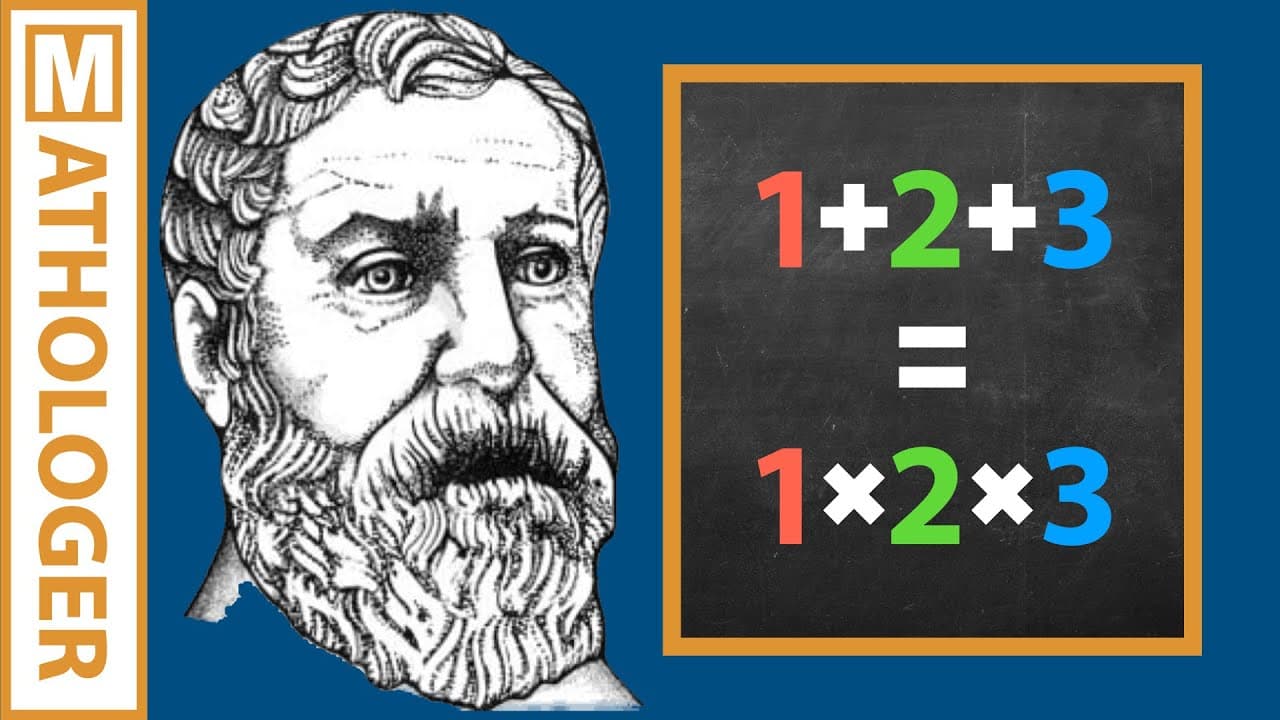
Heron’s formula: What is the hidden meaning of 1 + 2 + 3 = 1 x 2 x 3 ?
TL;DR
Mathematical gems like 3-4-5 triangles and 1+2+3 patterns have surprising connections and can be explained using Heron's formula and Brahmagupta's formula for calculating areas of triangles and quadrilaterals.
Transcript
welcome to another mythology video let me start by showing you a very surprising connection between two mathematical gems first up we have 3 squared plus 4 squared equals 5 squared and it's associated right angle triangle you've seen that one a million times right the second gem is this 1 plus 2 plus 3 equals 1 times 2 times 3 well maybe not so muc... Read More
Key Insights
- 💎 Mathematical gems and patterns can have surprising connections to deeper mathematical concepts.
- 💨 Heron's formula provides a way to calculate the area of triangles based on their side lengths.
- ❓ Brahmagupta's formula extends Heron's formula to calculate the area of any quadrilateral, particularly those within cyclic quadrilaterals.
- 🆘 Dissecting shapes and using scaling methods can help reveal the underlying relationships between various geometric properties.
- 💅 Heron's formula and Brahmagupta's formula showcase the elegance and beauty of mathematics, even in ancient mathematical discoveries.
Install to Summarize YouTube Videos and Get Transcripts
Explore YouTube Video Summarizer or Get YouTube Transcript Extractor
Questions & Answers
Q: What are some examples of mathematical gems and patterns mentioned in the video?
Examples include the 3-4-5 triangle, where the squares of the two smaller sides add up to the square of the larger side, and the pattern of 1+2+3 equaling the product of 1, 2, and 3.
Q: How is Heron's formula derived in the video?
Heron's formula is derived by dissecting a triangle into smaller triangles and using scaling methods to fit them together. It is also explained using the concept of the in-circle radius of a triangle.
Q: What is the significance of Brahmagupta's formula?
Brahmagupta's formula extends Heron's formula by including an additional correction term, and it can be used to calculate the area of any quadrilateral, especially cyclic quadrilaterals.
Q: How does Heron's formula and Brahmagupta's formula relate to the mathematical gems and patterns mentioned?
Heron's formula provides a way to calculate the area of triangles, allowing for a deeper understanding of the relationships between the sides and angles of geometric shapes. Brahmagupta's formula, in turn, extends this understanding to the area calculation of quadrilaterals within cyclic quadrilaterals.
Summary & Key Takeaways
-
The video explores the connection between mathematical gems such as Pythagorean triangles (3-4-5 triangles) and patterns like 1+2+3, demonstrating how they can be explained using Heron's formula.
-
Heron's formula, which calculates the area of a triangle, is derived using different methods, including dissecting a triangle into smaller triangles and scaling methods.
-
The video also introduces Brahmagupta's formula for calculating the area of a quadrilateral, which extends Heron's formula and has additional applications for cyclic quadrilaterals.
Read in Other Languages (beta)
Share This Summary 📚
Summarize YouTube Videos and Get Video Transcripts with 1-Click
Try YouTube Summary with ChatGPT & Claude or YouTube Transcript Generator
Explore More Summaries from Mathologer 📚


Summarize YouTube Videos and Get Video Transcripts with 1-Click
Try YouTube Summary with ChatGPT & Claude or YouTube Transcript Generator