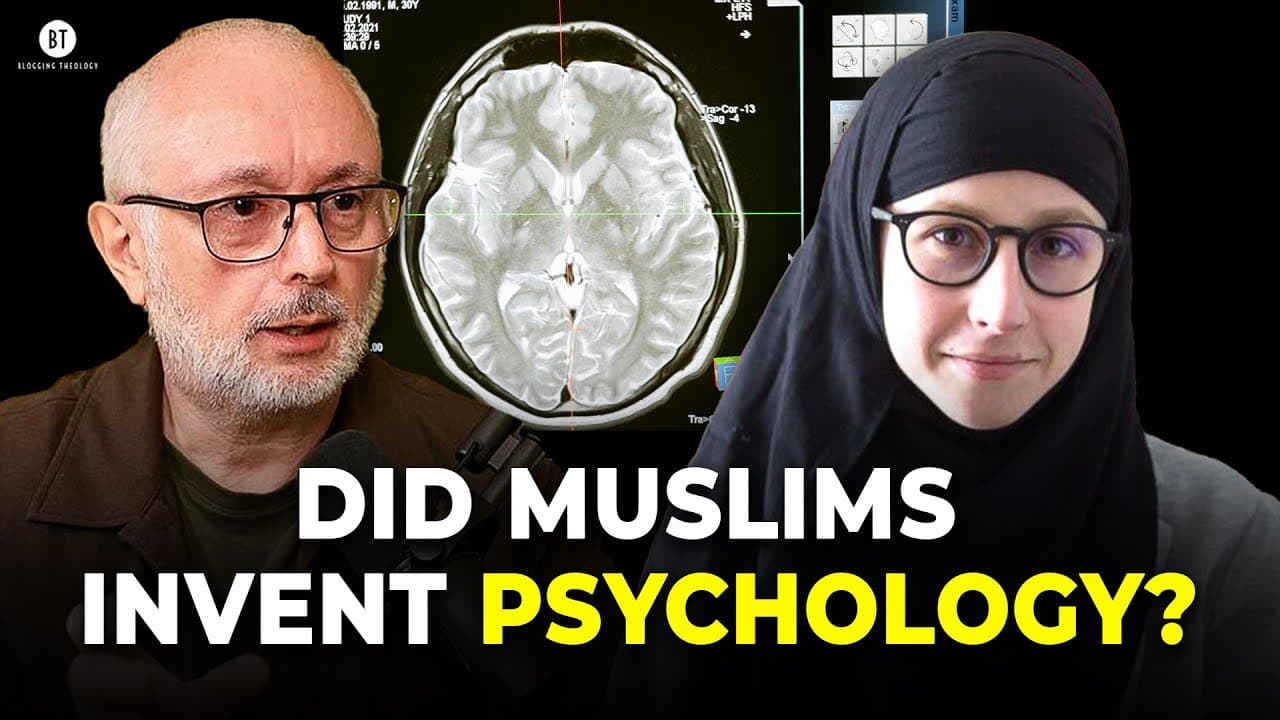
Did Muslims Invent Psychology? With Dr Francesca Bocca-Aldaqre, part 1
TL;DR
Exploration of Islamic contributions to psychology and mental health care.
Transcript
hello everyone and welcome to blogging Theology and today I'm delighted to welcome back Dr franchester bcka you're most welcome assalamu alaykum allaikum Salam thank you so much Paul for having me again it's great to have you back and for those who don't recall uh Franchesca has a master's degree in neurocogn... Read More
Key Insights
- Islamic scholars like Al-Kindi and Ibn Sina made significant contributions to psychology, including early descriptions of schizophrenia and cognitive behavioral therapy.
- Islamic psychology focuses on the equilibrium between the body, self, heart, soul, and intellect, contrasting with Western reductionist approaches.
- The scientific method was utilized by Muslim thinkers, but was not seen as epistemologically superior to other methods of understanding.
- Islamic mental health care was provided through independent charitable institutions, not the state, offering a model of community-based support.
- Islamic psychology encompasses a broader understanding of the psyche, including spiritual and metaphysical dimensions, unlike contemporary Western approaches.
- Muslim contributions to psychology are often overlooked in Western narratives, highlighting a need for recognition of non-Western historical influences.
- The integration of spiritual, physical, and mental health in Islamic psychology offers a holistic approach to well-being.
- The historical model of mental health care in Muslim lands provides insights into alternative, non-state-controlled healthcare systems.
Install to Summarize YouTube Videos and Get Transcripts
Explore YouTube Video Summarizer or Get YouTube Transcript Extractor
Questions & Answers
Q: Did Muslims invent psychology?
Muslims did not invent psychology as a whole, but they made significant early contributions to the field. Islamic scholars like Al-Kindi and Ibn Sina were among the first to describe various mental disorders and therapeutic techniques, which laid foundational work for modern psychology.
Q: What is distinctive about Islamic psychology?
Islamic psychology is distinctive in its holistic approach to the human psyche. It considers the balance between the body, self, heart, soul, and intellect, integrating spiritual and metaphysical dimensions. This contrasts with Western psychology, which often focuses on observable behavior and tends to be reductionist.
Q: How did Islamic scholars contribute to the scientific method?
Islamic scholars utilized the scientific method as one of their tools for inquiry, though they did not regard it as superior to other methods of understanding. Figures like Ibn Sina applied empirical observation and experimentation, such as using electroconvulsive therapy, to explore psychological phenomena.
Q: What was mental health care like in historical Muslim societies?
Mental health care in historical Muslim societies was community-based, provided through independent charitable institutions called waqfs. These institutions offered comprehensive care, including therapeutic and medical treatments, and emphasized the well-being of individuals through a holistic approach that integrated spiritual and physical health.
Q: Are the discoveries of Islamic scholars still relevant today?
Yes, the discoveries of Islamic scholars remain relevant, as they addressed fundamental aspects of psychology and mental health that continue to be explored today. Their holistic approach and understanding of the psyche offer valuable insights that can complement contemporary psychological practices.
Q: How does Islamic psychology differ from Western psychology?
Islamic psychology differs from Western psychology in its broader scope, incorporating spiritual and metaphysical aspects alongside physical and mental health. It seeks to understand the equilibrium between various components of the self, whereas Western psychology often focuses on behavior and empirical observation.
Q: What role did the state play in mental health care in Muslim lands?
In historical Muslim lands, the state did not directly control mental health care. Instead, it was provided by independent charitable institutions, allowing for a more autonomous and community-based approach. This system emphasized holistic care and was supported by charitable donations rather than state funding.
Q: What are some key historical figures in Islamic psychology?
Key historical figures in Islamic psychology include Al-Kindi, who described neurosis and psychosis, Ibn Sina, who identified schizophrenia, and Al-Farabi, who contributed to social psychology. Their work laid the groundwork for understanding mental health and therapeutic practices in a holistic context.
Summary & Key Takeaways
-
Islamic scholars made significant contributions to psychology, describing mental disorders and therapeutic methods long before Western psychology's emergence. Figures like Al-Kindi and Ibn Sina were pioneers in identifying conditions like schizophrenia and employing cognitive behavioral therapy techniques.
-
Islamic psychology emphasizes a holistic understanding of the human psyche, considering spiritual and metaphysical dimensions alongside physical and mental health. This contrasts with the reductionist views often found in contemporary Western psychology, which tends to focus on observable behaviors.
-
Mental health care in historical Muslim societies was provided through independent charitable institutions, offering a community-based model of support. These systems were not controlled by the state, allowing for a more autonomous and holistic approach to mental health care, which included spiritual and physical well-being.
Read in Other Languages (beta)
Share This Summary 📚
Summarize YouTube Videos and Get Video Transcripts with 1-Click
Try YouTube Summary with ChatGPT & Claude or YouTube Transcript Generator
Explore More Summaries from Blogging Theology 📚





Summarize YouTube Videos and Get Video Transcripts with 1-Click
Try YouTube Summary with ChatGPT & Claude or YouTube Transcript Generator