Why use Type and not Interface in TypeScript
TL;DR
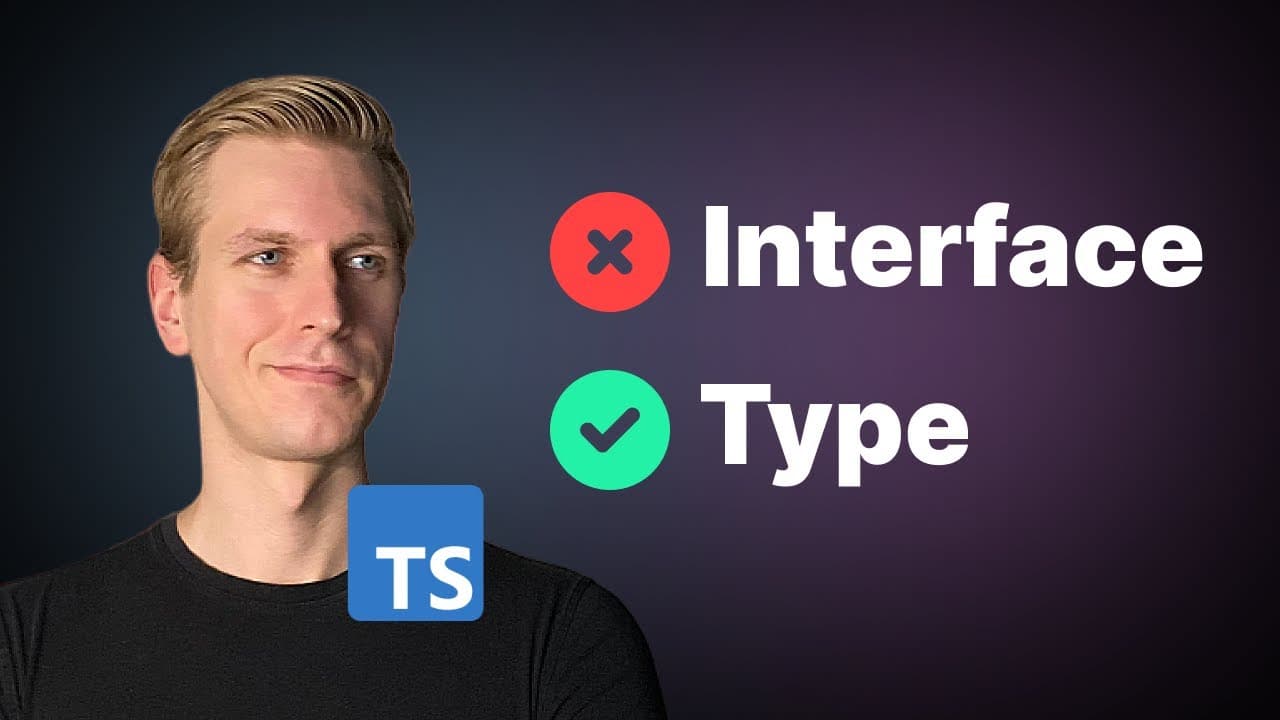
Type aliases offer more flexibility and functionality than interfaces in TypeScript.
Transcript
I've come to the conclusion that you should pretty much always favor type over interface and here's why so very quickly what are the differences between Type Alias and interface well let's say we have some kind of component user component and take some props and we want to describe it with user props right so I could use type user props equal sign ... Read More
Key Insights
- 🤔 The differences between type aliases and interfaces are that type aliases use the equal sign and interfaces use the extends keyword, type aliases can describe object and primitive types while interfaces can only describe objects, type aliases can describe union types while interfaces cannot, and type aliases have cleaner and more consistent syntax compared to interfaces.
- 🔑 Type aliases are preferred over interfaces because they can describe primitive, object, and union types, they allow for cleaner syntax when using utility types and omitting properties, they handle tuple types more easily, they provide a more predictable codebase by disallowing merging, they can be used with classes just like interfaces, and they have fewer characters to type compared to interfaces.
- 👍 One argument for using interfaces is that they provide shorter and more focused error messages in some cases. Another reason is for the merging feature of interfaces, where multiple declarations with the same identifier can be merged into one interface.
- ⚠️ Some developers may still choose to use interfaces in specific use cases, such as when shorter error messages or merging features are beneficial.
- 📚 If you're interested in learning more about TypeScript in the context of React and Next.js, consider joining an email list for an upcoming course. However, it's important to have a solid foundation in JavaScript and CSS before diving into advanced topics like TypeScript.
- 💡 It's essential for developers to master fundamentals like JavaScript and CSS before delving into frameworks like React. Consider taking courses in these areas to enhance your skills and understanding.
- 👍 If you found this video helpful, please leave a like and subscribe to the channel with the notification bell on. Your support is greatly appreciated.
Install to Summarize YouTube Videos and Get Transcripts
Explore YouTube Video Summarizer or Get YouTube Transcript Extractor
Questions & Answers
Q: What are the differences between type aliases and interfaces in TypeScript?
Type aliases and interfaces are both ways to describe object structure in TypeScript, but type aliases offer more flexibility and functionality. Type aliases can describe not only objects but also primitive values, union types, and utility types like omit and tuples. They have a cleaner syntax and are more predictable, as they do not allow for merging like interfaces do.
Q: Can interfaces be used to describe object properties other than objects?
No, interfaces can only describe object properties, whereas type aliases can describe objects as well as primitive values like strings, numbers, and Booleans. This makes type aliases more versatile and suitable for various use cases.
Q: Can interfaces be extended or combined with other interfaces or types?
Yes, interfaces can be extended and merged with other interfaces using the 'extends' keyword. This can be useful when you want to add or modify properties in an existing interface. However, this can lead to confusion and unintended consequences, as the merged interface may have multiple declarations with the same identifier. Type aliases, on the other hand, are closed and do not allow for merging.
Q: Are there any performance differences between using type aliases and interfaces in TypeScript?
In the past, there were slight performance differences between type aliases and interfaces, with interfaces being slightly faster for larger codebases. However, in recent versions of TypeScript, there doesn't seem to be any noticeable performance difference between the two.
Summary & Key Takeaways
-
Type aliases and interfaces are similar ways to describe object structure in TypeScript, but type aliases offer more flexibility.
-
Type aliases allow for the description of not only objects but also primitive values, union types, and utility types like omit and tuples.
-
Type aliases offer more predictability, as they do not allow for merging like interfaces do, and they have a cleaner syntax.
Read in Other Languages (beta)
Share This Summary 📚
Summarize YouTube Videos and Get Video Transcripts with 1-Click
Try YouTube Summary with ChatGPT & Claude or YouTube Transcript Generator
Explore More Summaries from ByteGrad 📚


Summarize YouTube Videos and Get Video Transcripts with 1-Click
Try YouTube Summary with ChatGPT & Claude or YouTube Transcript Generator