Mustang vs Viper: Which Tuned Car Wins a Drag Race?
TL;DR
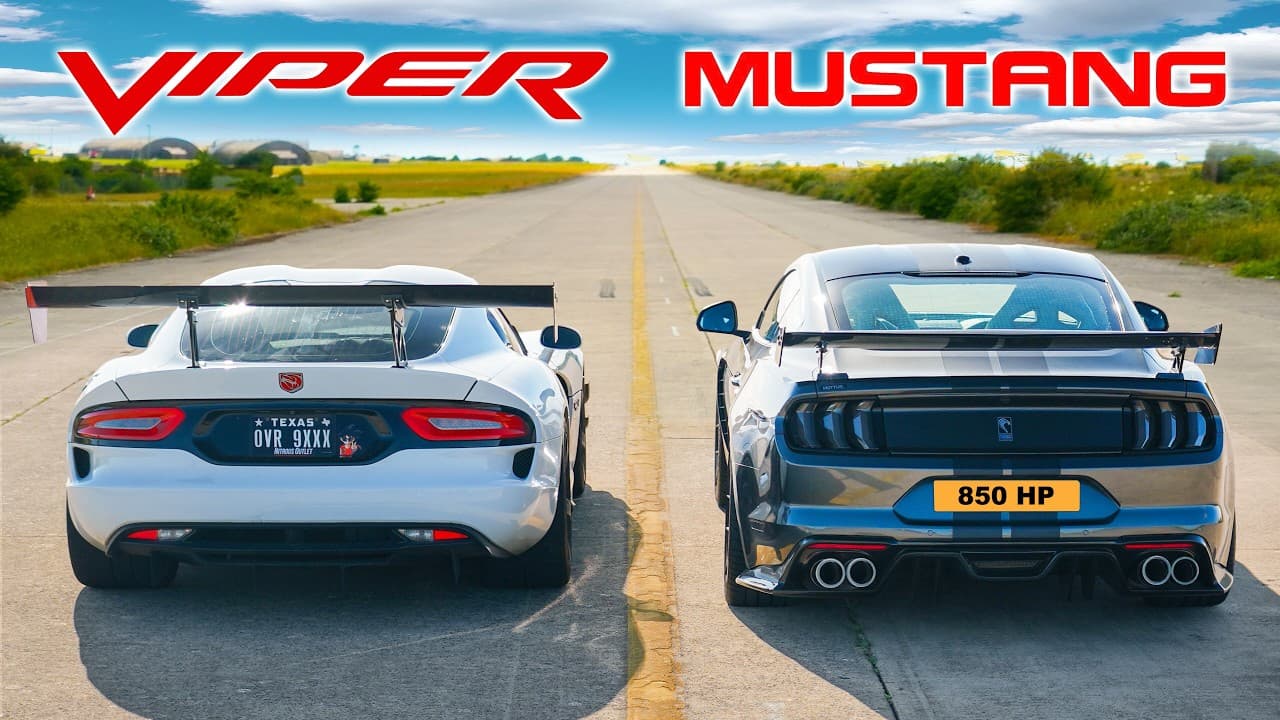
The tuned Ford Mustang CS850 and Dodge Viper GTC face off in a drag race. Despite the Mustang's higher horsepower, the lighter Viper ultimately wins the standing quarter mile in 12.3 seconds, while the Mustang finishes in 12.6 seconds. Both cars demonstrate impressive performance, but the Viper's weight advantage proves decisive.
Transcript
What will win between a previous generation Ford Mustang GT that has been fitted with a supercharger and now has 850 horsepower or a fifth generation Dodge Viper GTC? Well, we're going to find out cuz we're going to race them over the standing quarter mile. I'm Watson and you're watching Car Wow. The Ford Mustang CS850 has a 5 L supercharged V8 tha... Read More
Key Insights
- The Ford Mustang CS850 is equipped with a 5-liter supercharged V8 engine, producing 850 horsepower after tuning.
- The Dodge Viper GTC features an 8.4-liter naturally aspirated V10 engine, delivering 710 horsepower after modifications.
- Both cars utilize a six-speed manual transmission, sending power to the rear wheels.
- The Mustang weighs approximately 1,900 kg, while the Viper is lighter at 1,560 kg.
- The Mustang's upgrades include a Whipple supercharger, intercooler, and new exhaust system.
- The Viper's tuning includes a new exhaust system, enhancing its power output.
- In the drag race, the Viper completes the standing quarter mile in 12.3 seconds, outperforming the Mustang's 12.6 seconds.
- Despite the Mustang's higher horsepower, the Viper's lighter weight gives it a competitive edge in acceleration.
Install to Summarize YouTube Videos and Get Transcripts
Explore YouTube Video Summarizer or Get YouTube Transcript Extractor
Questions & Answers
Q: How does the Ford Mustang CS850 compare to the Dodge Viper GTC in a drag race?
In the drag race, the Ford Mustang CS850, with its 850 horsepower from a supercharged V8 engine, competes against the Dodge Viper GTC, which has 710 horsepower from a naturally aspirated V10 engine. Despite the Mustang's higher horsepower, the Viper's lighter weight allows it to complete the quarter mile faster, finishing in 12.3 seconds compared to the Mustang's 12.6 seconds.
Q: What modifications were made to the Ford Mustang CS850?
The Ford Mustang CS850 underwent several modifications, including the addition of a Whipple supercharger, an intercooler, and a new exhaust system. These upgrades increased its power output from the standard 454 horsepower to 850 horsepower, significantly enhancing its performance for the drag race.
Q: What are the key features of the Dodge Viper GTC used in the race?
The Dodge Viper GTC used in the race features an 8.4-liter naturally aspirated V10 engine, producing 710 horsepower after tuning. Its key modifications include a new exhaust system. The car is equipped with a six-speed manual transmission and weighs 1,560 kg, making it lighter than its competitor, the Ford Mustang CS850.
Q: Why did the Dodge Viper GTC win the drag race against the Ford Mustang CS850?
The Dodge Viper GTC won the drag race due to its lighter weight of 1,560 kg, which provided a performance advantage over the heavier Ford Mustang CS850, despite the Mustang's higher horsepower. The Viper's weight allowed it to accelerate more efficiently, completing the quarter mile in 12.3 seconds compared to the Mustang's 12.6 seconds.
Q: What role does weight play in the performance of these tuned cars?
Weight plays a crucial role in the performance of tuned cars, as it affects acceleration and handling. In the drag race, the lighter Dodge Viper GTC was able to accelerate more efficiently than the heavier Ford Mustang CS850, despite the Mustang's higher horsepower, ultimately allowing the Viper to win the race.
Q: How does the launch control system affect the performance of the Ford Mustang CS850?
The launch control system in the Ford Mustang CS850 is designed to optimize the car's acceleration from a standstill by holding the engine revs at a specific level. However, during the race, the driver noted that the system did not provide enough revs, causing the car to bog down slightly at the start. Adjustments were made to improve the launch by increasing the revs.
Q: What are the costs associated with these tuned cars?
The Ford Mustang CS850, with all its tuning upgrades, costs around £115,000. The Dodge Viper GTC, after its modifications, costs approximately £70,000. These prices reflect the extensive modifications made to enhance the performance of both vehicles, making them competitive in the drag race.
Q: What were the results of the rolling race between the Mustang and Viper?
In the rolling race, the Dodge Viper GTC initially took the lead due to its lighter weight and torque advantage. However, as the race progressed, the Ford Mustang CS850 began to catch up, showcasing its higher horsepower. Ultimately, the Viper maintained its lead, demonstrating the importance of weight and torque in rolling acceleration.
Summary & Key Takeaways
-
The Ford Mustang CS850 and Dodge Viper GTC compete in a drag race, both boasting significant tuning upgrades. The Mustang, with 850 horsepower, faces off against the lighter Viper, which produces 710 horsepower. Despite the Mustang's power advantage, the Viper's lighter weight allows it to win the quarter mile race in 12.3 seconds compared to the Mustang's 12.6 seconds.
-
Both vehicles are rear-wheel drive with six-speed manual transmissions. The Mustang's tuning includes a Whipple supercharger and intercooler, while the Viper's modifications focus on a new exhaust system. The race highlights the importance of weight in performance, as the Viper's lighter build gives it an edge over its more powerful competitor.
-
Throughout the race, drivers adjust their launch techniques and gear settings to optimize performance. Ultimately, the Viper's weight advantage proves decisive, allowing it to outperform the Mustang despite the latter's greater horsepower. The video showcases the thrilling dynamics of tuning and drag racing between two iconic American muscle cars.
Read in Other Languages (beta)
Share This Summary 📚
Summarize YouTube Videos and Get Video Transcripts with 1-Click
Try YouTube Summary with ChatGPT & Claude or YouTube Transcript Generator
Explore More Summaries from carwow 📚


Summarize YouTube Videos and Get Video Transcripts with 1-Click
Try YouTube Summary with ChatGPT & Claude or YouTube Transcript Generator