Underwater Sodium - Periodic Table of Videos
TL;DR
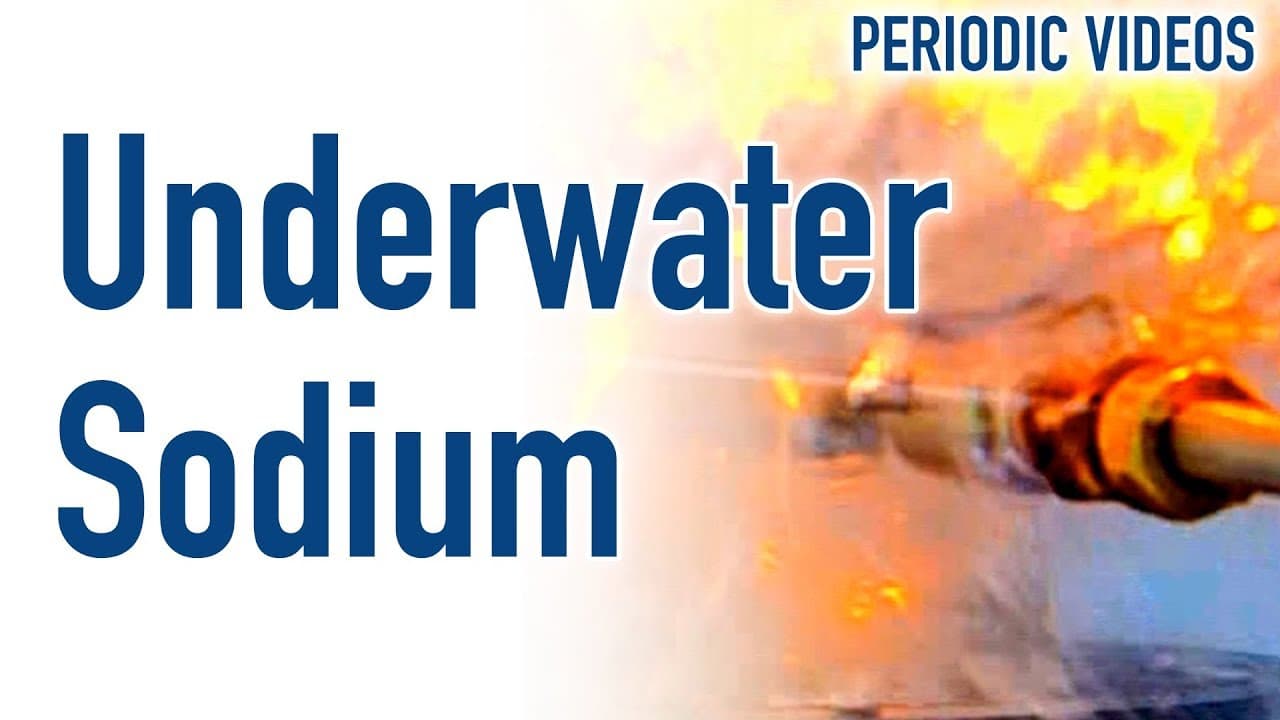
Underwater sodium reacts gradually at first, producing bubbles believed to be hydrogen, before accelerating and ending in a large surface reaction. The controlled setup breaks a glass vessel underwater so the sodium initially reacts without contact with outside air, while cameras record multiple angles and speeds. The reaction lasts about 0.1 second, fast visually but slow chemically, so read on to understand the apparatus, observations, safety precautions, and nuclear-reactor context.
Transcript
we've done lots of experiments with the alkaline metals pop it into the water and see what we can do with the reaction you can see the orange sodium flame but our technician Neil felt that we weren't really doing them scientifically enough we were just dropping alkaline metals into water and seeing what happened and we've also done the reverse expe... Read More
Key Insights
- 💦 Controlled conditions enhance understanding of alkaline metal reactions in water.
- 👁️🗨️ Hydrogen bubble formation signifies the gradual intensification of the reaction.
- 👨🔬 Historical context reveals the research's importance in nuclear reactor safety.
- 🚄 High-speed camera technology revolutionizes the visualization of chemical reactions.
- 👨🔬 Previous studies guide current research efforts, showcasing the value of existing knowledge.
- 🐢 The controlled experiments showcase the slow yet impactful nature of chemical reactions.
- 🦺 Safety measures, such as conducting experiments outdoors, ensure minimal risk in case of unexpected reactions.
Install to Summarize YouTube Videos and Get Transcripts
Explore YouTube Video Summarizer or Get YouTube Transcript Extractor
Questions & Answers
Q: What happens when sodium reacts with water underwater?
When the glass tube breaks, water rushes in and the reaction begins with bubbles that the speaker believes are hydrogen. The bubbling increases gradually, and the sodium appears to be carried to the surface before reacting with the air in a large final burst.
Q: How was the underwater sodium experiment controlled?
Sodium was sealed inside a glass vessel submerged in a plastic box of water. A remotely operated shaft forced a metal pin through the tube, allowing the reaction to begin underwater and be filmed from different angles and at different speeds.
Q: Why was the sodium broken open underwater?
The setup allowed the researchers to observe the sodium-water reaction before the metal encountered outside air. The sodium could contact air only if it floated to the water’s surface.
Q: Were the bubbles in the experiment confirmed to be hydrogen?
No, the bubbles were not collected and analyzed. The speaker identifies them as hydrogen based on the well-researched reaction of alkaline metals with water, but explicitly notes that this was not experimentally confirmed here.
Q: Why does the underwater sodium reaction end with a large burst?
The speaker thinks hydrogen bubbles carry the sodium upward because sodium has a density similar to water. At the surface, the sodium then reacts with the water and air and explodes, creating a large white image on the video.
Q: How fast was the sodium-water reaction?
The reaction took about 0.1 second, or a good fraction of a second. Although that looks rapid, the speaker calls it relatively slow chemically because very fast chemical reactions can occur in a millionth of a second.
Q: What safety precautions were used during the experiment?
The experiment was conducted outside so that any explosion would not harm the building. Outdoor filming also provided bright sunlight for recording the reaction.
Q: Why were sodium-water reactions studied for nuclear-reactor safety?
Research from the 1970s examined what could happen if liquid sodium leaked into a reactor’s water-cooling system. Some reactors under development contained hundreds of tons of liquid sodium, making the consequences of sodium-water contact an important safety question.
Summary & Key Takeaways
-
Experimental control was added to observe reactions of sodium in water in a controlled environment.
-
The reaction starts slowly, releasing hydrogen bubbles, gradually intensifying.
-
The experiment sheds light on the known reactions of alkaline metals with water.
Read in Other Languages (beta)
Share This Summary 📚
Summarize YouTube Videos and Get Video Transcripts with 1-Click
Try YouTube Summary with ChatGPT & Claude or YouTube Transcript Generator
Explore More Summaries from Periodic Videos 📚
Summarize YouTube Videos and Get Video Transcripts with 1-Click
Try YouTube Summary with ChatGPT & Claude or YouTube Transcript Generator