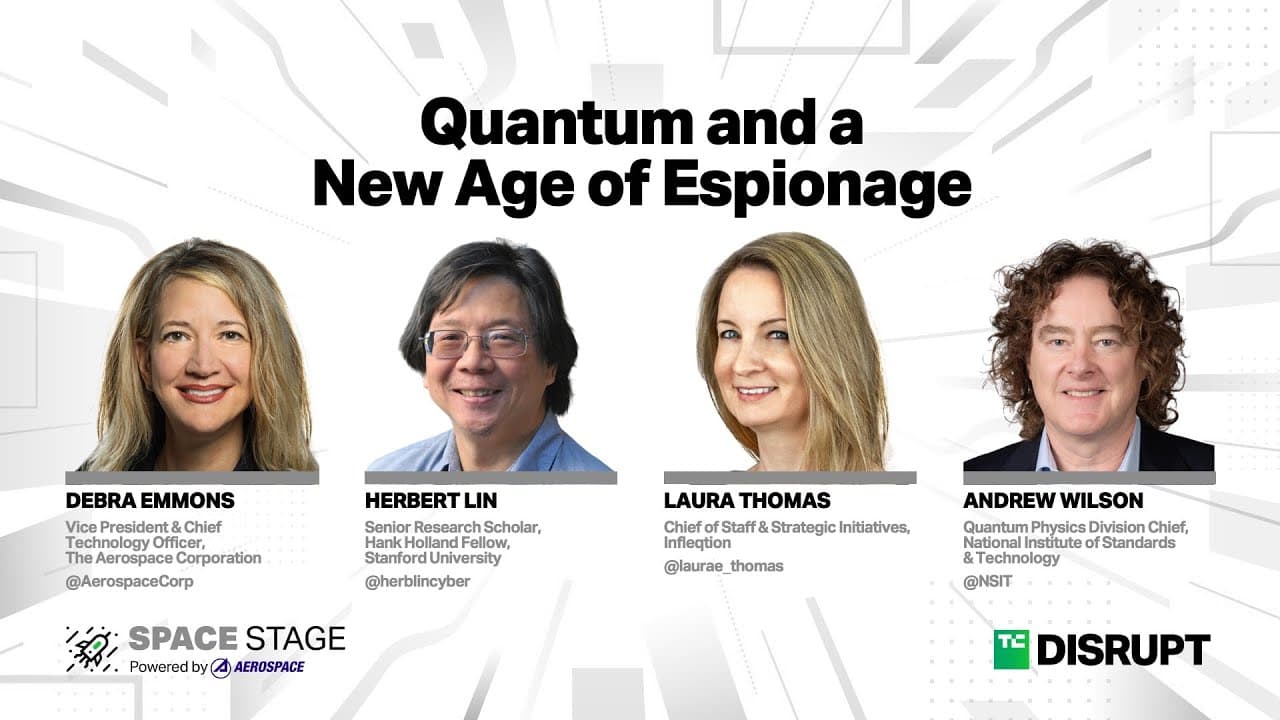
Quantum Computing and a New Age of Espionage | TechCrunch Disrupt 2023
TL;DR
Quantum technologies have the potential to transform the world of espionage and cryptography, bringing advancements in computing, sensing, and communications.
Transcript
Quantum and a new age of espionage for this next session prepare to have your mind blown from busting open sensitive encryption to creating new unbreakable codes Quantum technologies have the potential to transform the world of Espionage and cryptography a government official and physicist a former CA officer now operating in Industry a Stanford Pr... Read More
Key Insights
- 🍉 Quantum technologies offer advantages in computing, sensing, and communications, but near-term applications are more likely to emerge in sensing.
- 🖤 Quantum computing is still in its early stages and lacks real-world problem-solving applications.
- 🪡 The workforce needs to be skilled and diverse to meet the demands of scaling quantum technologies.
- 🌍 Post-quantum cryptography and international standards are vital for maintaining secure communication systems in the future.
- 🥺 The United States leads in quantum research and development but faces competition from other countries, particularly China.
Install to Summarize YouTube Videos and Get Transcripts
Explore YouTube Video Summarizer or Get YouTube Transcript Extractor
Questions & Answers
Q: What advantages do quantum technologies offer over classical technologies?
Quantum technologies introduce concepts like superposition and entanglement, which allow for more complex and precise information processing, sensing, and communications.
Q: What are the most promising areas for quantum applications?
Quantum sensing shows the most potential for near-term applications, with the ability to create highly sensitive and accurate sensors. Quantum computing and quantum communications are still in the early stages of development and lack concrete problem-solving applications.
Q: What are the challenges in adopting quantum technologies?
One major challenge is the need for a skilled workforce that understands the complexities of quantum technologies and can scale production. Another challenge is the global supply chain for components, which requires onshoring and vertical integration.
Q: How do post-quantum cryptography and standards play a role in the future of quantum technologies?
Post-quantum cryptography is essential for ensuring secure communication systems remain robust in the face of potentially powerful quantum computers. Standards are being developed internationally to implement these cryptographic protocols and mitigate security risks.
Summary & Key Takeaways
-
Quantum technologies, such as superposition and entanglement, offer advantages over classical technologies in computing, sensing, and communications.
-
Near-term applications are expected in quantum sensing, with sensors that are more sensitive and accurate than current technologies.
-
While quantum computing shows promise, there is currently a lack of real-world problems that require quantum computing exclusively.
-
Quantum communications offer enhanced security but may not be necessary for current secure communication systems.
Read in Other Languages (beta)
Share This Summary 📚
Summarize YouTube Videos and Get Video Transcripts with 1-Click
Try YouTube Summary with ChatGPT & Claude or YouTube Transcript Generator
Explore More Summaries from TechCrunch 📚






Summarize YouTube Videos and Get Video Transcripts with 1-Click
Try YouTube Summary with ChatGPT & Claude or YouTube Transcript Generator