CH03_VID01_Mapping strong and weak entities
TL;DR
Converting conceptual design into logical design using ER diagrams.
Transcript
After talking about the Conceptual Design, getting out this chart; the Entity Relationship Diagram, now we'll talk about how to convert this conceptual design into a logical design, representing the relations we have. What is the Relation Database? It is a group of tables or relations. What does the relation contain? It's consisted... Read More
Key Insights
- The transition from conceptual to logical design involves converting an Entity Relationship Diagram into a relational database structure consisting of tables and relations.
- A relational database is made up of tables or relations, each containing tuples or records and columns representing specific information.
- Primary keys are crucial in tables, ensuring each record is unique and not null, and are chosen based on uniqueness and storage efficiency.
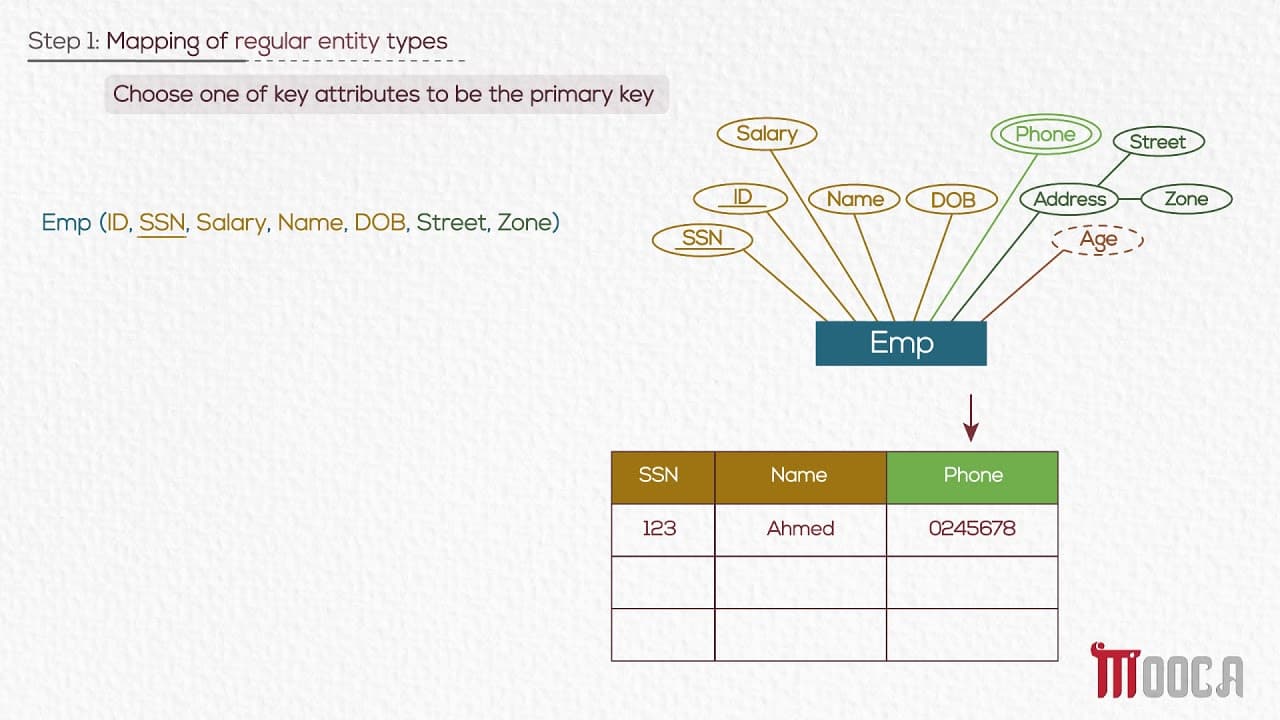
- Composite attributes are divided into subparts, each represented in separate columns to maintain clarity and organization within the database.
- Multi-valued attributes, such as phone numbers, require separate tables to avoid violating primary key rules and ensure data integrity.
- Foreign keys link tables by referencing primary keys from other tables, ensuring relational integrity across the database.
- Derived attributes, like age, are not stored by default to prevent performance issues, unless frequently used or needed for specific calculations.
- Weak entities require the primary key of the owner entity as a foreign key, with a combination of attributes forming a unique identification.
Install to Summarize YouTube Videos and Get Transcripts
Explore YouTube Video Summarizer or Get YouTube Transcript Extractor
Questions & Answers
Q: What is the process of converting a conceptual design into a logical design?
The process involves using an Entity Relationship Diagram to map entities into relational database tables. Each entity is converted into a table, with attributes becoming columns. Special attention is given to primary keys for uniqueness and foreign keys for maintaining relationships between tables.
Q: How are composite attributes handled in a relational database?
Composite attributes are divided into their subparts, with each subpart represented in a separate column within the table. This approach ensures that each piece of information is stored clearly and distinctly, allowing for better organization and retrieval of data.
Q: Why are multi-valued attributes problematic, and how are they resolved?
Multi-valued attributes, such as phone numbers, can violate primary key rules if stored directly in a table. To resolve this, they are placed in separate tables, with the primary key of the original table used as a foreign key, ensuring data integrity and avoiding duplication.
Q: What is the role of primary keys in a relational database?
Primary keys ensure that each record in a table is unique and not null, providing a way to distinctly identify each entry. They are chosen based on their uniqueness and storage efficiency, often preferring numerical data types over text for space considerations.
Q: How are derived attributes treated in a database, and why?
Derived attributes, such as age, are not stored by default to prevent performance issues, as they require recalculating each time the table is accessed. They are only stored if frequently used or necessary for specific calculations to optimize database performance.
Q: What are foreign keys, and how do they function in a database?
Foreign keys are used to link tables by referencing primary keys from other tables, ensuring relational integrity. They help maintain relationships between different entities, allowing for accurate data retrieval and enforcing consistency across the database.
Q: How are weak entities mapped differently from strong entities?
Weak entities use the primary key of their owner entity as a foreign key. A combination of attributes forms their unique identification, ensuring that each instance of the weak entity can be distinctly identified within the database.
Q: What considerations are made when selecting a primary key for a table?
When selecting a primary key, considerations include the uniqueness of the attribute and its storage efficiency. Typically, the shortest unique combination is chosen, often preferring numerical data types to minimize storage space and improve retrieval speed.
Summary & Key Takeaways
-
The video explains how to convert a conceptual design into a logical design, focusing on mapping entities into tables within a relational database. Key concepts include primary keys, composite attributes, and handling multi-valued attributes.
-
Primary keys are essential for ensuring data uniqueness and integrity, and foreign keys are used to maintain relationships between tables. Derived attributes are typically not stored to avoid performance issues unless frequently accessed.
-
Mapping weak entities involves using the primary key of the owner entity as a foreign key. The video provides detailed examples of mapping various entities, including Employee, Department, Project, and Dependent, into tables.
Read in Other Languages (beta)
Share This Summary 📚
Summarize YouTube Videos and Get Video Transcripts with 1-Click
Try YouTube Summary with ChatGPT & Claude or YouTube Transcript Generator
Explore More Summaries from MaharaTech - ITI MOOCA 📚

Summarize YouTube Videos and Get Video Transcripts with 1-Click
Try YouTube Summary with ChatGPT & Claude or YouTube Transcript Generator