PS.10.1 Worked Example - Blocks with Friction and Massive Pulley
TL;DR
This video analyzes a pulley system with translational and rotational motion, explaining the torque and force principles involved.
Transcript
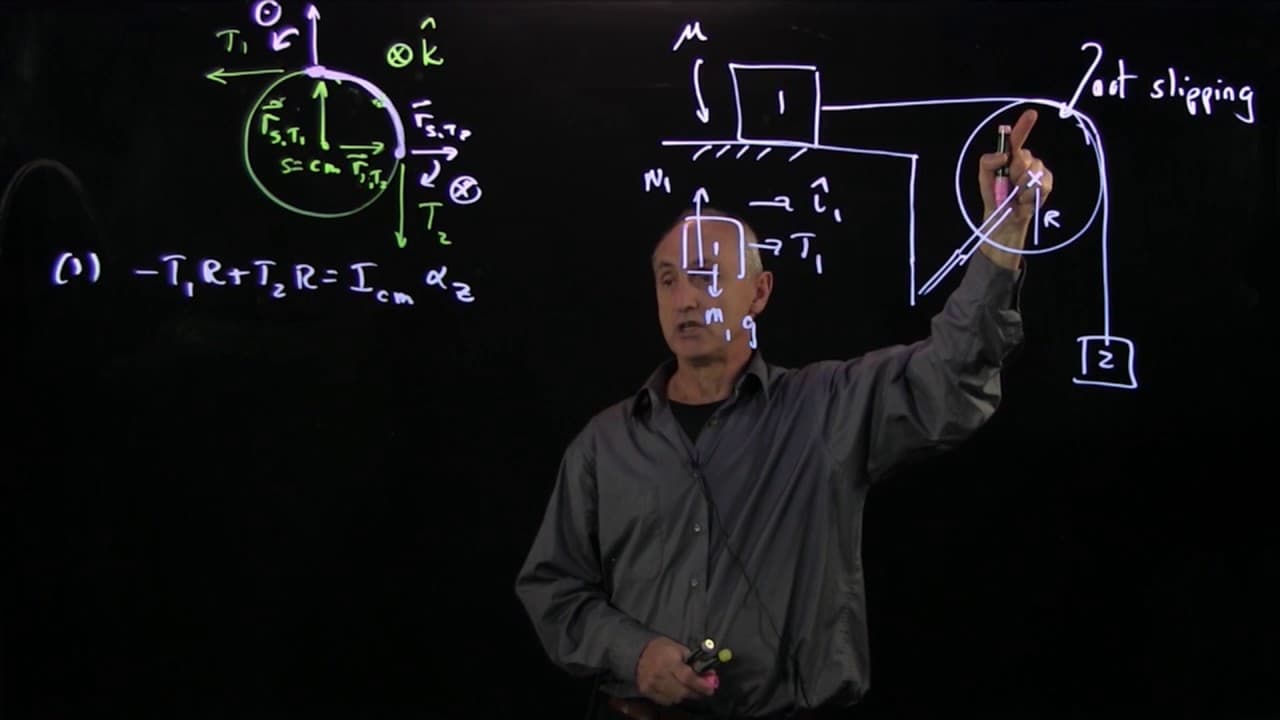
DR. PETER DOURMASHKIN: I would like to now analyze the motion of a system of particles that has both translational and rotational motion. So I'm going to consider a pulley, and the pulley has radius R. And there is a string wrapped around THE pulley and a block of object 1 that's on a plane, and another block of object 2. And as object 2 falls down... Read More
Key Insights
- 🈸 The motion of a pulley system involves both translational and rotational motion, requiring the application of torque and force principles.
- 📐 The angular acceleration of the pulley is related to the linear accelerations of the blocks by the radius of the pulley.
- 🙃 The tensions on both sides of the string are not equal, as the pulley's rotational inertia requires a greater torque on one side.
- 🚫 The condition for block 2 to start moving downwards is that its weight is greater than the force of friction between block 1 and the surface.
- 🚫 The analysis of the system involves solving a system of equations while considering the constraints between the accelerations of the blocks and the pulley.
- 🙃 Special cases, such as massless pulleys or frictionless strings, can simplify the analysis and make the tensions on both sides of the string equal.
Install to Summarize YouTube Videos and Get Transcripts
Explore YouTube Video Summarizer or Get YouTube Transcript Extractor
Questions & Answers
Q: How are the angular acceleration of the pulley and the linear accelerations of the blocks related?
The angular acceleration of the pulley is equal to the linear acceleration of the blocks divided by the radius of the pulley. This relationship is derived based on the fact that the string is not slipping around the pulley.
Q: What is the difference between the tensions on both sides of the string?
The tension T2 on the side where the block is falling is greater than the tension T1 on the side where the block is moving to the right. This is because the pulley's rotational inertia requires a greater torque to cause the pulley to accelerate.
Q: Under what conditions will block 2 start to go downwards?
Block 2 will start to go downwards when the weight of block 2 (M2g) is greater than the force of friction between block 1 and the surface (MuM1g). This condition ensures that the tension in the string is sufficient to overcome the force of friction and cause block 2 to accelerate downwards.
Q: What happens to the system if the weight of block 2 is less than the weight of block 1?
If the weight of block 2 is less than the weight of block 1, the friction between block 1 and the surface will be static rather than kinetic. The system's behavior will depend on the specific values of the weights, and the blocks may not accelerate as in the case of kinetic friction.
Summary & Key Takeaways
-
The video introduces a pulley system with a string wrapped around it, two blocks, and a coefficient of friction between one block and the surface.
-
The analysis of the system involves applying torque and force principles to determine the motion of the blocks and the angular acceleration of the pulley.
-
Constraints between the acceleration of the blocks and the angular acceleration of the pulley are introduced to help solve the system of equations.
Read in Other Languages (beta)
Share This Summary 📚
Summarize YouTube Videos and Get Video Transcripts with 1-Click
Try YouTube Summary with ChatGPT & Claude or YouTube Transcript Generator
Explore More Summaries from MIT OpenCourseWare 📚


Summarize YouTube Videos and Get Video Transcripts with 1-Click
Try YouTube Summary with ChatGPT & Claude or YouTube Transcript Generator