How Hackers Deliver Malware to Hack you using Social Media
TL;DR
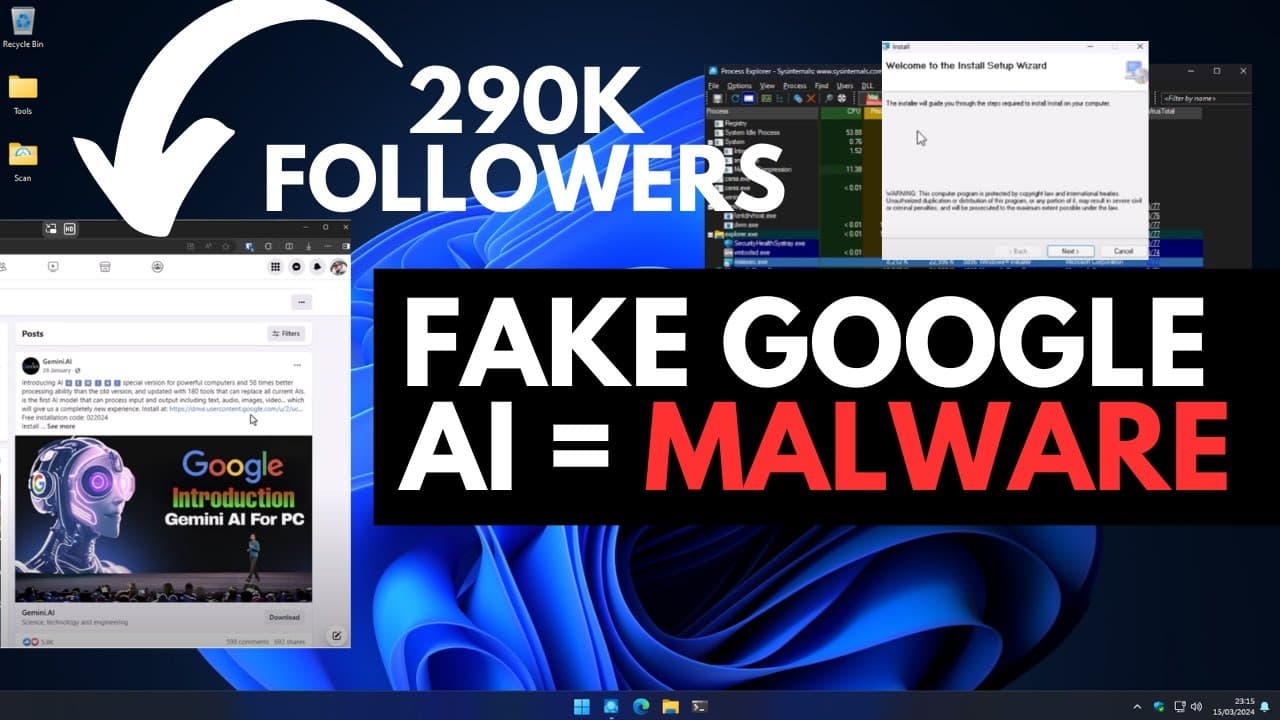
Gemini AI, a Facebook page posing as Google's AI platform, is spreading malware through seemingly legitimate posts, highlighting the vulnerabilities of major corporations' infrastructure.
Transcript
so one of our Discord members just pointed out this Facebook page Gemini AI which is basically the name for Google's AI platform it's chat GPT competitor and as you can see it has 290,000 followers it says they're based in Los Angeles California but if we take a look at their latest post which seems to have a screenshot of Google's actual event it ... Read More
Key Insights
- 👤 Facebook pages like Gemini AI can deceive users by imitating legitimate platforms.
- 🏃 Seemingly normal posts can contain malware downloads, making it crucial to exercise caution online.
- ❓ Malware developers exploit major corporations' infrastructure, such as Google and Amazon, to evade detection.
- 📁 Password-protected installers and MSI files are commonly used to distribute malware.
- 👤 Credential-stealing malware targets stored cookies on specific folders on users' computers.
- ❓ Online platforms like Google Drive and Facebook are not entirely secure, as evidenced by the malware's origin.
- 📁 The internet may seem magical, but it is ultimately composed of files and folders on physical systems.
Install to Summarize YouTube Videos and Get Transcripts
Explore YouTube Video Summarizer or Get YouTube Transcript Extractor
Questions & Answers
Q: What is Gemini AI and what is it pretending to be?
Gemini AI is a Facebook page posing as Google's AI platform, spreading malware through its supposedly legitimate posts.
Q: How are seemingly legitimate posts used to distribute malware?
Even posts with comments and shares can contain malicious links, leading to malware downloads disguised as password-protected installers.
Q: How does the malware steal user credentials?
The rar file contains an MSI installer that prompts users for a password. Once installed, a hidden command line script steals stored cookies, including credentials, and sends them to attackers.
Q: Can antivirus software detect this malware?
While 33 antivirus engines detected the malware on VirusTotal, Windows Defender and Voral did not flag it, emphasizing the need to remain cautious.
Summary & Key Takeaways
-
A Facebook page called Gemini AI, which claims to be Google's AI platform, is actually spreading malware through its posts.
-
Even seemingly legitimate posts with comments and shares can contain malicious content.
-
The malware is delivered through a rar file, disguised as a password-protected installer, which steals user credentials.
Read in Other Languages (beta)
Share This Summary 📚
Summarize YouTube Videos and Get Video Transcripts with 1-Click
Try YouTube Summary with ChatGPT & Claude or YouTube Transcript Generator
Explore More Summaries from The PC Security Channel 📚




Summarize YouTube Videos and Get Video Transcripts with 1-Click
Try YouTube Summary with ChatGPT & Claude or YouTube Transcript Generator