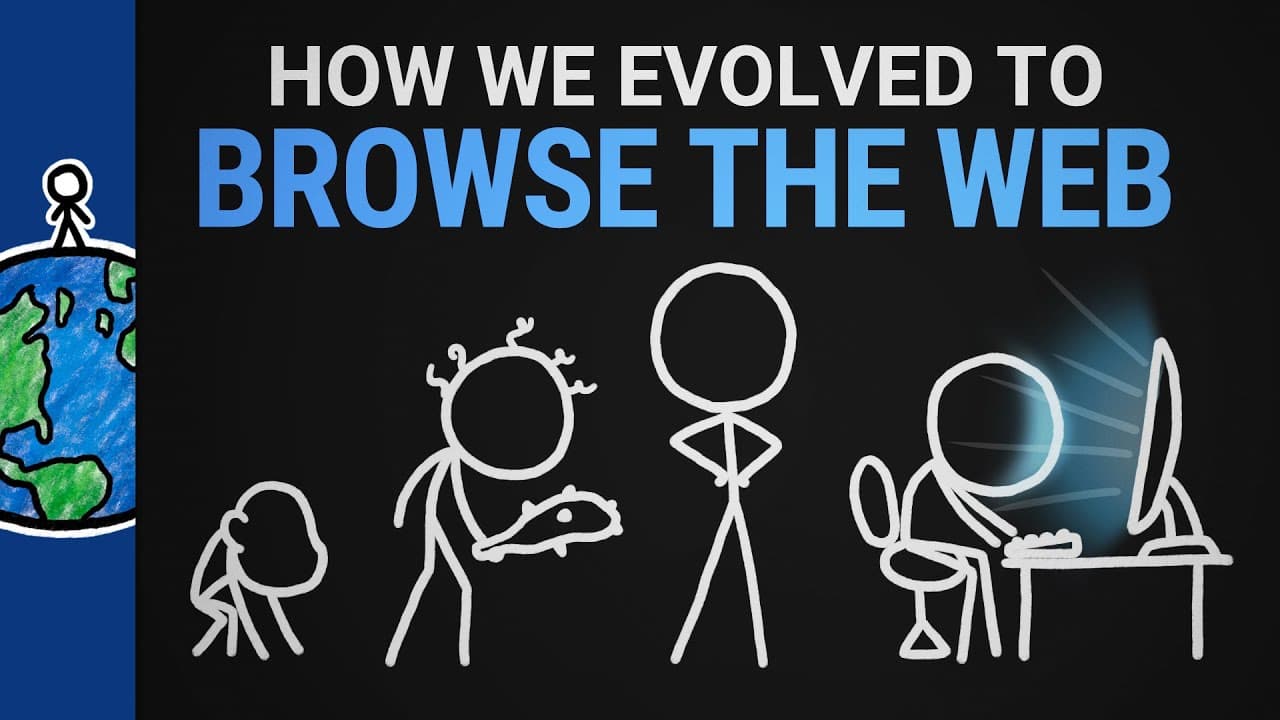
How We Evolved To Browse The Web
TL;DR
Animals and humans, including online users, exhibit similar foraging behavior where they choose and stay on websites until the rewards they receive decrease, prompting them to move on to another site.
Transcript
Hi, this is Kate from MinuteEarth. Let’s find some cat memes! This site looks good - yeah, there’s some funny kittehs and some great cattos on here! But, hmm, not that much...yeah, the pickings are definitely getting slimmer. Maybe we should try another site? But that means we have to FIND another site! And we’re already here… so, should we stay or... Read More
Key Insights
- ❓ Foraging behavior is not exclusive to animals but extends to humans in their online browsing activities as they seek rewards.
- 🥺 Investing more time and resources in a task or endeavor often leads to a higher payoff, as observed in animals gathering larger hauls and humans finding lasting relationships.
- 💄 Animals and humans share decision-making circuitry, possibly due to the importance of making good food-finding tradeoffs in the distant past.
- 🦮 The constraints and underlying mechanisms that guide us in everyday scenarios, such as choosing which websites to visit, are likely similar to those of animals.
Install to Summarize YouTube Videos and Get Transcripts
Explore YouTube Video Summarizer or Get YouTube Transcript Extractor
Questions & Answers
Q: What is foraging behavior and how does it relate to online browsing?
Foraging behavior refers to the process of searching, selecting, and consuming resources. Online browsing is similar to foraging as users choose websites based on the reward they expect to receive.
Q: How do animals and humans determine when to switch from one website to another?
Both animals and humans switch from one website to another when the rate of reward they are receiving from the current site drops below what they expect to receive elsewhere. This decision is generally subconscious.
Q: How does investment of time and resources affect the rewards obtained in foraging?
Animals that invest more time and effort in foraging activities tend to bring back bigger hauls. Similarly, the longer humans spend searching for a romantic partner, the more likely the relationship is to last.
Q: What evidence suggests that animals and humans share decision-making circuitry?
Monkeys have specialized neurons that track the rate of reward in a patch, and when it drops too low, they switch to a new patch. Humans also possess similar neurons, indicating shared decision-making mechanisms.
Summary & Key Takeaways
-
Online users and animals both engage in foraging behavior, choosing where to spend their time and energy for maximum rewards.
-
Animals that invest more time and effort in foraging tend to bring back bigger hauls, similar to humans who spend longer searching for romantic partners.
-
Animals and humans share decision-making circuitry that tracks the rate of reward, leading to optimized choices in resource allocation.
Read in Other Languages (beta)
Share This Summary 📚
Summarize YouTube Videos and Get Video Transcripts with 1-Click
Try YouTube Summary with ChatGPT & Claude or YouTube Transcript Generator
Explore More Summaries from MinuteEarth 📚


Summarize YouTube Videos and Get Video Transcripts with 1-Click
Try YouTube Summary with ChatGPT & Claude or YouTube Transcript Generator