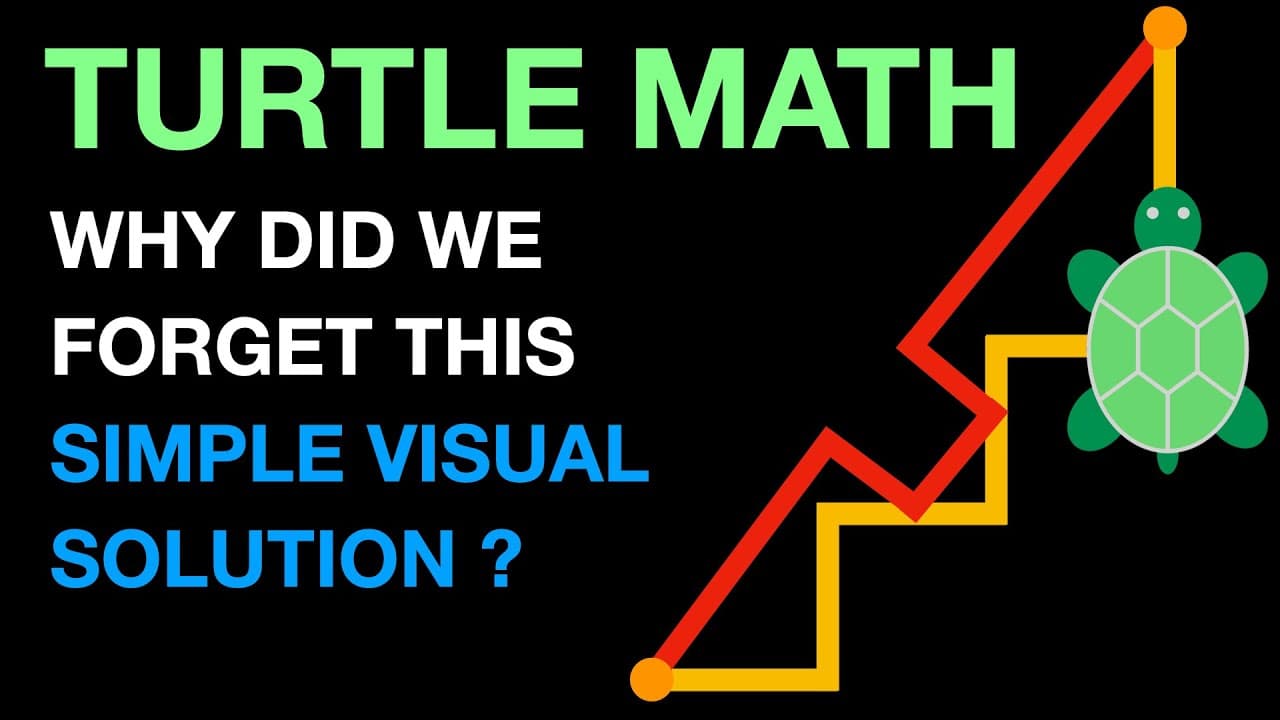
Why did we forget this simple visual solution? (Lill's method)
TL;DR
Use a turtle and laser tag to solve polynomial equations in a fun and visual way.
Transcript
Welcome to another Mathologer video. Let me show you something really amazing, how to solve an equation by playing laser tag with a turtle. That sounds very strange but just wait and see. Okay here's an equation, here's our pet turtle and here's my laser tag gun. Here's the turtle at his starting point, facing to the right. The leading coefficient ... Read More
Key Insights
- 🐢 Using a turtle and laser tag, polynomial equations can be solved visually and interactively.
- 🐢 The turtle's movements represent the coefficients of the polynomial, and the laser aims to hit the turtle to find the solutions.
- ⭕ The method can be extended to solve quadratic equations using circles and cubic equations using origami.
- 🎭 The Horner form of the polynomial allows for efficient evaluation and performs synthetic division, enabling the solution of the equation.
- 👻 Iterating the laser and turtle method allows for finding additional solutions and taking into account the multiplicities of the zeros.
- 💨 This method provides a unique and engaging way to explore and understand polynomial equations.
- 🐢 Turtle laser tag can also be applied to complex equations and has connections to Pascal's triangle.
Install to Summarize YouTube Videos and Get Transcripts
Explore YouTube Video Summarizer or Get YouTube Transcript Extractor
Questions & Answers
Q: How does the turtle's movements represent the coefficients of the polynomial?
The turtle's movements correspond to the coefficients of the polynomial. For example, if the coefficient is 5, the turtle moves forward 5 units. Negative coefficients make the turtle move backward, and zero coefficients make the turtle turn without moving.
Q: How does the laser tag game help in solving the equation?
The aim of the laser tag game is to hit the turtle with the laser. By adjusting the angle of the laser, it is possible to find the solutions of the equation. The laser always bounces off at a right angle, which adds an extra challenge to hitting the turtle.
Q: Can this method be used to solve any polynomial equation?
Yes, this method can be used to solve polynomial equations of any degree. Higher degree polynomials will require more segments in the turtle's path, but the basic principles remain the same.
Q: How does the Horner form of the polynomial come into play?
The Horner form of the polynomial allows for efficient evaluation of the polynomial and also performs synthetic division. This division by a linear factor corresponds to finding the solutions of the equation. It is a clever and efficient way to solve the equation using the turtle method.
Summary & Key Takeaways
-
By using a turtle and a laser, it is possible to solve polynomial equations.
-
The turtle's movements represent the coefficients of the polynomial, and the laser aims to hit the turtle, corresponding to finding the solutions of the equation.
-
The method can be extended to higher degree polynomials, and it is also possible to solve quadratic equations using circles and cubic equations using origami.
Read in Other Languages (beta)
Share This Summary 📚
Summarize YouTube Videos and Get Video Transcripts with 1-Click
Try YouTube Summary with ChatGPT & Claude or YouTube Transcript Generator
Explore More Summaries from Mathologer 📚



Summarize YouTube Videos and Get Video Transcripts with 1-Click
Try YouTube Summary with ChatGPT & Claude or YouTube Transcript Generator